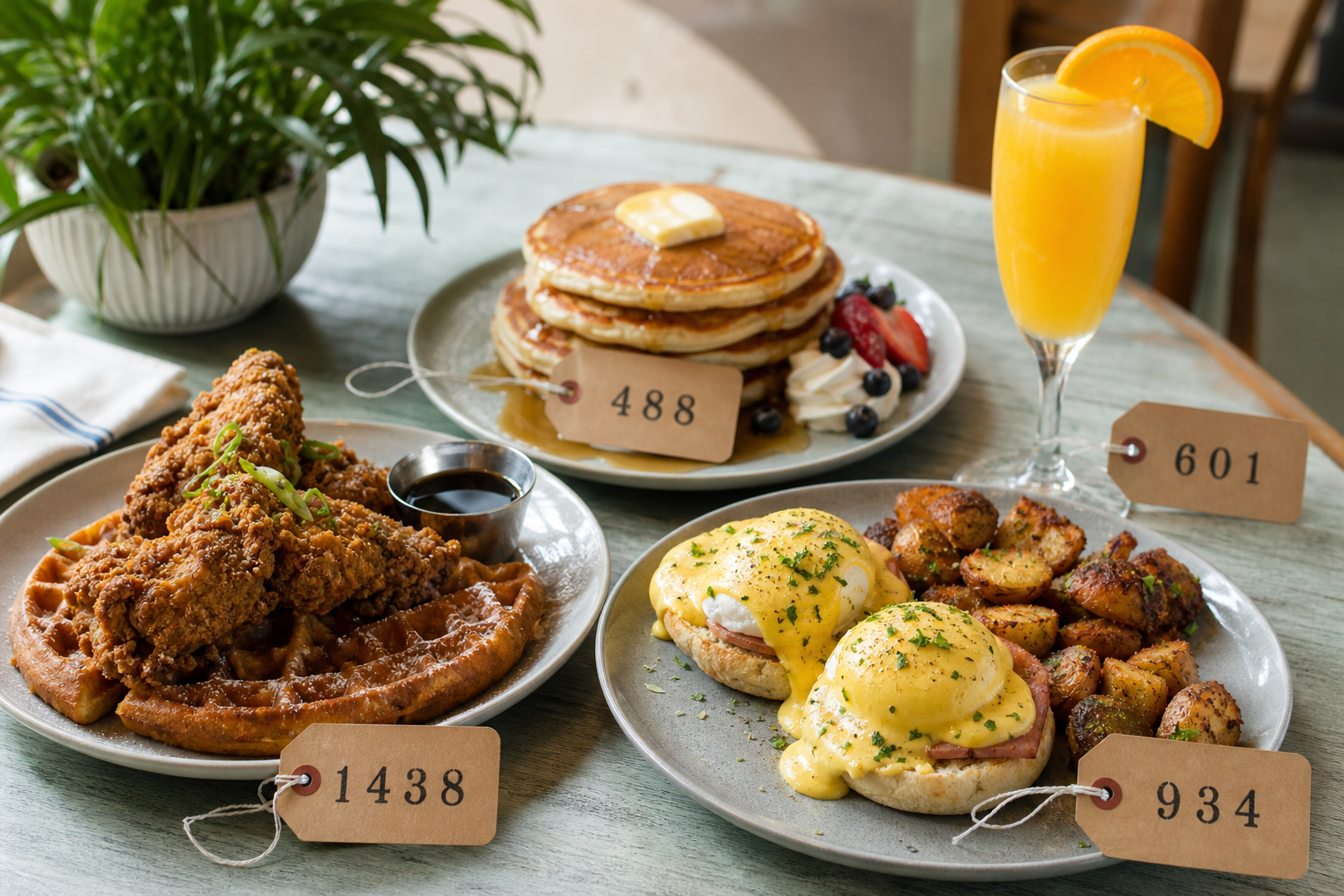
Chicken and waffles is about 1,438 kcal. Two eggs Benedict with home fries are about 1,319. A ham and cheese omelet with hash browns and buttered toast is about 1,213. Three restaurant pancakes with butter and syrup are 1,092.
For scale, McDonald’s lists three Hotcakes with butter and syrup at 580 kcal, the figure on its US site in January 2025. The restaurant stack is 88% heavier. A 14 oz ribeye at a steakhouse, by the same USDA method, is about 1,010 kcal before the sides. Five of the seven plates below pass it.
Brunch replaces two meals, so a heavy plate is not a surprise. The size of the gap is. Against the 2,000 kcal reference day FDA uses on labels, these plates run from 24% to 72%.
Most independent brunch spots do not print calories. Nothing here was ordered or weighed. Every figure is built from USDA’s per-100 g data at FNDDS portion weights, or at a stated assumption. Calories are estimates.
Seven brunch plates, ranked
Brunch plates, USDA figures at FNDDS portion weights, ranked by kcal
| Plate | Build | Grams | kcal | Protein, g | Sodium, mg |
|---|---|---|---|---|---|
| Chicken and waffles | 125 g waffle, 3 pieces fried chicken, 1 tbsp butter, 60 g syrup | 454 | 1,438 | 66 | 2,596 |
| Eggs Benedict | 2 halves, 1 cup home fries | 510 | 1,319 | 47 | 2,243 |
| Ham and cheese omelet | 3 eggs, 1 cup hash browns, 2 slices toast, 2 pats butter | 479 | 1,213 | 43 | 2,275 |
| Pancake stack | 3 large pancakes, 1 tbsp butter, 60 g syrup | 344 | 1,092 | 20 | 1,579 |
| French toast | 3 slices, 1 tbsp butter, 60 g syrup | 329 | 1,053 | 25 | 1,020 |
| Breakfast burrito, large | Egg and sausage, 380 g | 380 | 977 | 43 | 1,839 |
| Breakfast burrito, standard | Egg and sausage, 190 g | 190 | 488 | 21 | 920 |
What each plate costs you
Every plate has a weak line. These are the cons.
- Chicken and waffles. The most kcal and the most sodium: 2,596 mg, 113% of the Daily Value. USDA’s restaurant waffle is 428 kcal per 100 g, so the waffle alone is 535. The chicken is 640.
- Eggs Benedict. The hollandaise. USDA lists it at 546 kcal per 100 g, about 87 a tablespoon. The two halves are 893 before the potatoes.
- Omelet. The sides outweigh the eggs. The omelet is 528. The hash browns are 435 and the buttered toast 250.
- Pancakes. The least protein of the full plates, 20 g. Three large pancakes are 829 by themselves.
- French toast. Same problem, 25 g of protein. The syrup cup carries 25 g of sugar, half the 50 g added-sugar Daily Value.
- Breakfast burrito. The size. FNDDS sizes an egg and sausage burrito at 190 g. The large row assumes a burrito twice that, the size that fills a plate. It is an assumption, not a USDA portion. Lift yours; if it feels close to a pound, use the large row.
The fixed lines
Three lines repeat across the sweet plates. They are worth knowing by number.
Repeat lines on a brunch plate, USDA figures
| Line | Portion | kcal |
|---|---|---|
| Home fries, restaurant | 1 cup, 200 g | 426 |
| Hash browns, restaurant | 1 cup, 160 g | 435 |
| Pancake syrup | 60 g cup | 159 |
| Butter | 1 tbsp, 14 g | 104 |
| Bacon | 2 slices, 16 g | 75 |
| Fruit cup | 1 cup, 150 g | 84 |
The potato side is the second-largest line on any savory plate. A cup of home fries is 426 kcal. Swap it for a cup of fruit and the Benedict plate drops 342, to about 977.
Butter and syrup together are 263 kcal on every sweet plate. Use half the syrup and the stack is 80 kcal lighter.
The pancake is a size problem
USDA weighs pancakes by size. A medium pancake is 50 g. A large is 90 g. At USDA’s restaurant figure of 307 kcal per 100 g, that is 154 kcal against 276 a pancake.
Three medium pancakes with the same butter and syrup come to about 724 kcal. Three large come to 1,092. The menu says “stack” for both. The 368 kcal difference is in the diameter, and the diameter is not printed.
If you can, ask how big the pancakes are. If the answer is “big,” use the large row.
The drinks
Brunch drinks are counted per glass. A mimosa of 3 fl oz sparkling wine and 3 fl oz orange juice is about 111 kcal by USDA figures. Three glasses are about 334.
Brunch drinks, USDA figures
| Drink | Portion | kcal |
|---|---|---|
| Mimosa | 6 fl oz, half wine, half juice | 111 |
| Orange juice | 8 fl oz | 117 |
| Three mimosas | 18 fl oz | 334 |
Chicken and waffles with three mimosas is about 1,772 kcal. That is 89% of the reference day, one table, before noon.
How to cut the plate
Each line is an estimate of what the change removes.
- Order one Benedict half instead of two: about 446.
- Swap home fries or hash browns for fruit: about 342 to 351.
- Two pancakes instead of three: about 276.
- Half the syrup: about 80.
- Dry toast instead of buttered: about 104.
None of these change what you ordered. They change how much of it you eat. The brunch calories you do not eat stay in the box.
What the table does not show
- Your kitchen’s portions. FNDDS weights are averages. A tall stack or a jumbo waffle is not in the table.
- Whipped cream, powdered sugar and fruit compote on the sweet plates. Not counted.
- Coffee with cream. Not counted.
- Biscuits and gravy, shrimp and grits, avocado toast. Not covered here.
- Prices. Independent menus vary; this file prints none.
For the drive-through version of the same breakfast, see 18 McDonald’s items under 600 kcal. For the sandwich most people eat on the way to work, see the 600 kcal breakfast sandwich. For dinner by the same method, see steakhouse cuts by the menu ounce. All eating-out files are on the Eating Out desk.
How these numbers were built
Every kcal, protein and sodium figure is a USDA per-100 g value from FoodData Central, Survey (FNDDS) 2021-2023, multiplied by the grams in the row. Portions are FNDDS weights: a large pancake, 90 g; a restaurant French toast slice, 85 g; a large restaurant waffle, 125 g; an eggs Benedict half, 155 g; a piece of fried chicken, 85 g; a syrup cup, 60 g. The large burrito and the mimosa pour are assumptions, stated in the rows. The McDonald’s figure is as listed on its US site in January 2025. Totals are sums of rounded components. Calorie figures are estimates.