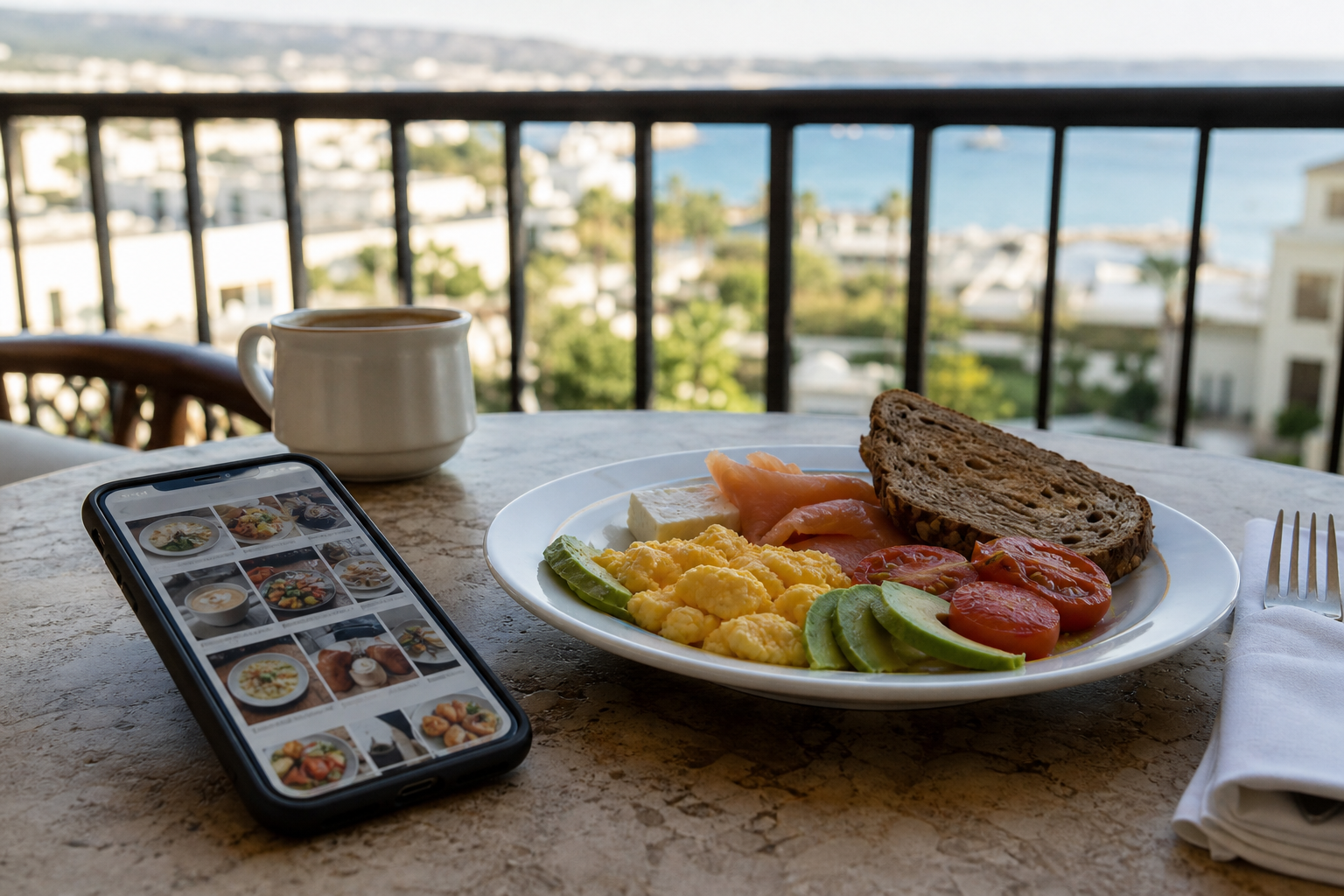
Partly. The apps keep logging on vacation; what changes is the size of the miss. The desk’s typed-error figures, 4.4% to 16.5%, were measured with every meal weighed. A vacation takes the scale away, and the record has no figure for typed entries with guessed portions.
A photo entry never needed a scale on your side. Its error, 10.6% to 29.5% in the record, is the figure that carries over. On a 2,500 kcal vacation day that is about 265 to 738 kcal, before any single meal that misses by more than the average.
Sylistic is run by the company that builds PlateLens; every table prints its cons.
What the record measured, and what a vacation takes away
The test ran on one tester, 30 days and 8 apps. It covered 90 weighed meals, 800 barcode scans at 100 per app, and 420 photos at 60 per app across the seven apps with a photo result. Typed error is the app’s calorie estimate for typed entries against the weighed reference. Photo error is the same comparison for photo entries.
A vacation does not hit the three modes equally.
Typed entries lose their measured figure. The tester typed portions that had been weighed. You will type portions you guessed. Your miss becomes the app’s miss plus your own, and the record measures only the first. Treat 4.4% to 16.5% as a floor, not a forecast.
Photo entries lose less. Judging the portion was already the camera’s job. The plates change: food you did not cook, with fat and sauce you did not see go in. The record’s figure is the best guide available, not a promise.
Barcode scans stay closest to test conditions, as long as the food is sealed and the app’s database holds it. A scan counted as right when it returned the right product and figures, checked against the printed Nutrition Facts panel.
What each logging mode keeps on vacation, with the catch in each
| Mode | Record figure | Measured with | On vacation | Catch |
|---|---|---|---|---|
| Typed | 4.4–16.5% error | Weighed portions | Portions guessed; error grows by an unmeasured amount | The best typed figures need a scale |
| Photo | 10.6–29.5% error | No scale on the user’s side | Same conditions, different plates | Oil, sauce and hidden layers |
| Barcode | 81–97 of 100 right, by app | Printed Nutrition Facts panel | Same, for sealed food | 88 of 800 scans were wrong |
| Posted chain figure | Not tested | — | US chains with 20+ locations only | It is the chain’s own estimate |
How big the miss gets on a 2,500 kcal day
2,500 kcal is a round number for the arithmetic, not a target. Every row below is the record’s percentage applied to it.
Arithmetic on the record’s error rates for a 2,500 kcal day, rounded to the nearest kcal. The photo columns match vacation conditions; the typed columns assume weighed portions, which a vacation rarely has.
| App | Photo error | Photo, kcal off | Typed error, weighed | Typed, kcal off, weighed | Con |
|---|---|---|---|---|---|
| PlateLens | 10.6% | 265 | 4.4% | 110 | Free photo logging capped at 3 a day |
| YAZIO | 19.4% | 485 | 15.5% | 388 | Camera on Premium |
| MyFitnessPal | 21.8% | 545 | 11.5% | 288 | $79.99/yr; scanner on Premium |
| Lose It! | 23.1% | 578 | 9.7% | 243 | Scanner on Premium |
| MyNetDiary | 24.6% | 615 | 7.6% | 190 | Meal Scan on Premium |
| FatSecret | 27.2% | 680 | 16.5% | 413 | Ads throughout; 88 s a meal |
| Cronometer | 29.5% | 738 | 7.1% | 178 | Worst photo result; camera on Gold |
| MacroFactor | — | — | 5.0% | 125 | No free tier; no photo result recorded |
Four things follow from the table.
The app matters by about 473 kcal a day. That is the distance between the best photo result, 265, and the worst, 738.
Even the smallest photo miss is larger than most weighed typed misses. PlateLens’s 265 kcal by photo is larger than five of the eight typed results with weighed portions: its own 110, MacroFactor’s 125, Cronometer’s 178, MyNetDiary’s 190 and Lose It!‘s 243.
Photo is the weaker mode everywhere. In all seven apps, photo entries missed by more than typed ones. The gap runs from 1.25 times in YAZIO to 4.2 times in Cronometer.
These are sizes, not directions. The record’s error figures, as used here, give the size of each app’s average miss, not whether it ran high or low.
Over a week
A seven-day trip is seven of those days. Multiply the daily photo figure by 7: about 1,855 kcal at 265 a day, about 5,166 kcal at 738 a day.
That is the ceiling, the case where every miss runs the same way. If misses run both ways, part of them cancel. The record does not say which happens, so do not assume the friendly case. Read a week-long vacation log as a range, not a number.
The same arithmetic on typed entries is not available. The weighed figures do not apply, and the record has no unweighed ones.
What moves the error more: the app or the mode
Two levers change the vacation figure. Switching app moves the photo miss on a 2,500 kcal day from about 738 kcal, Cronometer’s, to about 265, PlateLens’s: a 473 kcal difference. Switching mode inside one app can move it further.
The mode lever, arithmetic on a 2,500 kcal day, sorted by what a scale saves. Typed figures assume weighed portions; MacroFactor has no photo result, so it has no row.
| App | Photo, kcal off | Typed with a scale, kcal off | What the scale saves | Con |
|---|---|---|---|---|
| Cronometer | 738 | 178 | 560 | Camera on Gold |
| MyNetDiary | 615 | 190 | 425 | Meal Scan on Premium |
| Lose It! | 578 | 243 | 335 | Scanner on Premium |
| FatSecret | 680 | 413 | 267 | Ads throughout |
| MyFitnessPal | 545 | 288 | 257 | $79.99/yr |
| PlateLens | 265 | 110 | 155 | Free photo capped at 3 a day |
| YAZIO | 485 | 388 | 97 | Typed entries 15.5% off |
For Cronometer and MyNetDiary users, a scale is worth more than switching to any other app’s camera: about 560 and 425 kcal a day. For PlateLens users it is worth about 155. For YAZIO users, about 97, because YAZIO’s typed entries are weak to begin with. The catch is the one this piece started with. Those typed figures exist only with a scale in the bag. Without one, the typed column has no number.
Where the extra error comes from
None of these are measured in the record. They are the reasons a vacation log drifts further than a home log, in general terms.
- Portions you did not serve. A restaurant decides the size, and you cannot weigh it at the table.
- Fat and sauce added out of sight. Cooking oil, butter, dressings, glazes. They change the calories more than they change the look of the plate.
- Shared plates. Your share of a dish for the table is a guess on top of a guess.
- Buffets. Second plates, and the items picked up between photos.
- Entries never made. The record measures entries that were made. A meal left out of the log is off by the whole meal, and on a trip it is the easiest miss to make.
The last one can be the largest, and no app ranking fixes it.
What to do about it: match the mode to the food
The record supports a simple rule. Use the mode with the smallest error the food allows.
Vacation food, the logging mode to use, and the error that comes with it
| Food | Mode | Error the record or rule supports | Catch |
|---|---|---|---|
| US chain item with posted calories | Type the posted figure | Not tested; the chain’s estimate | Daily specials and custom orders are not covered |
| Plated meal, no posted figure | Photo | 10.6–29.5% | Add the oil and sauce yourself |
| Packaged food with a panel | Type the panel figure for the amount eaten | Label rounding; 20% allowance | Your portion against the printed serving |
| Snack with a barcode | Scan, then check the match | 3 to 19 wrong per 100, by app | Check name and kcal against the panel |
Chain meals: type the posted figure
The FDA’s menu labeling rule covers restaurants and similar retail food establishments in chains with 20 or more locations. They post calories for standard menu items on menus and menu boards, and offer more nutrition information in writing on request. The posted figure is the chain’s estimate for a standard portion. The record did not test it, so there is no error figure to print. Outside the US, and at independent restaurants, assume no posted figure unless you see one. Where to use which mode at a gate, a hotel buffet or an independent restaurant is covered in the situation-by-situation travel guide.
Plates: photograph them, then add what the camera missed
This is where the 2,500 kcal table applies. Photograph each plate before you eat. If you saw oil, butter or a sauce go on, add it as a typed entry. If the app is PlateLens on its free tier, photo logging stops after 3 a day; spend them on the plates you cannot look up or scan. YAZIO’s camera, MyNetDiary’s Meal Scan and Cronometer’s camera are on paid plans in the record. The photo ranking sets out each app’s camera paywall and its photo-to-typed gap.
Packaged food: read the panel, type the amount
A sealed package carries its own reference. Read calories per serving, then count servings eaten. Two catches come from the label rules in 21 CFR 101.9. First, panel calories are rounded: to the nearest 5 kcal up to 50 kcal, and to the nearest 10 above that. Second, the food can contain up to 20% more calories than the panel declares before it counts as misbranded. A label-perfect entry is still the label’s estimate.
For loose foods with no panel, such as fruit from a market, USDA FoodData Central lists per-100 g values you can use if you can estimate the weight.
Snacks: scan, then check the match
A UPC or EAN barcode, per GS1, identifies the product. It carries no nutrition data. The figures come from the app’s database, so a scan is only as right as the entry it finds. In the record, 712 of 800 scans returned the right product and figures, 89.0%. By app: PlateLens 97, Cronometer 94, MacroFactor 92, MyNetDiary 90, MyFitnessPal 88, YAZIO 86, Lose It! 84, FatSecret 81. Before you save a scan, check the product name and the calories per serving against the panel. All 800 results are in the 800-scan barcode test.
The record does not break scans down by country, so it says nothing about packaging bought abroad.
The apps on vacation, with their cons
Vacation-relevant figures for all 8 apps, with the main con for each
| App | Photo error | Log time | Barcode right | Photo on the free tier | Yearly | Main con |
|---|---|---|---|---|---|---|
| PlateLens | 10.6% | 38 s | 97% | 3 a day | $34.99 | Free photo cap of 3 a day |
| YAZIO | 19.4% | 64 s | 86% | Camera on Premium | Varies | Typed fallback 15.5% off |
| MyFitnessPal | 21.8% | 82 s | 88% | Not listed separately | $79.99 | Scanner on Premium; no export on free |
| Lose It! | 23.1% | 78 s | 84% | Not listed separately | Varies | 16 wrong scans of 100 |
| MyNetDiary | 24.6% | 71 s | 90% | Meal Scan on Premium | Varies | Export on Premium only |
| FatSecret | 27.2% | 88 s | 81% | All logging free | Free | Ads throughout |
| Cronometer | 29.5% | 74 s | 94% | Camera on Gold | $59.99 | Worst photo result; ads on free |
| MacroFactor | — | 69 s | 92% | No free tier | $71.99 | Trial only; no photo result recorded |
Varies: the price varies by offer and region; the record holds no single list price.
- PlateLens. Free photo logging stops at 3 a day, and a vacation day with snacks and second plates can need more. Its photo entries miss by 2.4 times its typed ones, about 265 kcal on a 2,500 kcal day. The company that runs this site builds it. Its full numbers are in the PlateLens test.
- YAZIO. The camera is on Premium. When a photo is the wrong tool, typed entries, its fallback, missed by 15.5%. Ads on free; export on Premium.
- MyFitnessPal. $79.99 a year, the highest listed price. Scanner on Premium; ads and no export on free; 82 s a meal.
- Lose It! Scanner on Premium; 16 wrong scans of 100; export on Premium only.
- MyNetDiary. Meal Scan is on Premium and missed by 24.6%, 3.2 times its typed error. Export on Premium only.
- FatSecret. Ads throughout; 88 s a meal, the slowest; 81 of 100 scans right, the lowest; typed error 16.5%, the worst.
- Cronometer. Camera and voice on Gold, $59.99 a year, for the worst photo result in the record, about 738 kcal on a 2,500 kcal day. Ads on free.
- MacroFactor. No free tier, trial only; all logging needs a subscription at $71.99 a year. No photo result recorded, so the vacation figure is missing.
What the test does not measure
The record is one tester over one 30-day window, built around weighed meals, not a vacation. Apps update often, and plans can change. Every error here is an average; a single meal can miss by more. The record has no typed error without a scale, no test of logging without a connection, no scans of packaging bought abroad, no check of chain menu figures, and no count of meals left out of a log.
All eight app tests, with the same figures, are on the Apps desk.
Is the log worth keeping on a trip?
The record can price a vacation log. It cannot decide for you. The price is time and a wide error band. At the record’s log times, 21 meals over a week cost 13 min 18 s at 38 s a meal and 30 min 48 s at 88 s. What you get back is a range: on a 2,500 kcal day, about 265 kcal either way at the best photo result and about 738 at the worst.
If you want an exact daily total, a vacation log will not give you one, in any app tested. If you want to know roughly what you ate, and keep the habit going for when you are home, it does that. Neither use needs a perfect entry. Both need an entry.
A vacation log that holds up
- Decide what the log is for. A rough record of what you ate holds up by photo. A daily total trusted to within 100 kcal does not, in any of the seven apps with a photo result: the smallest photo miss on a 2,500 kcal day is about 265.
- Log the easy meals well. Sealed food by barcode, checked against the panel. Chain items from the menu board.
- Photograph every plate. Then add the fat and sauce you saw as typed entries.
- Log at the table, not at night. An entry made at the table is a photo. An entry made at night is a guess about a guess.
- Pack a small kitchen scale if the numbers matter. It puts typed entries back under the conditions the record measured.
- Read the day as a range. At YAZIO’s 19.4%, a logged 2,500 kcal day reads as about 2,015 to 2,985 kcal. At PlateLens’s 10.6%, about 2,235 to 2,765.
- Budget the time. At 38 to 88 s a meal, three meals cost 1 min 54 s to 4 min 24 s a day. That is the price of a log that exists.