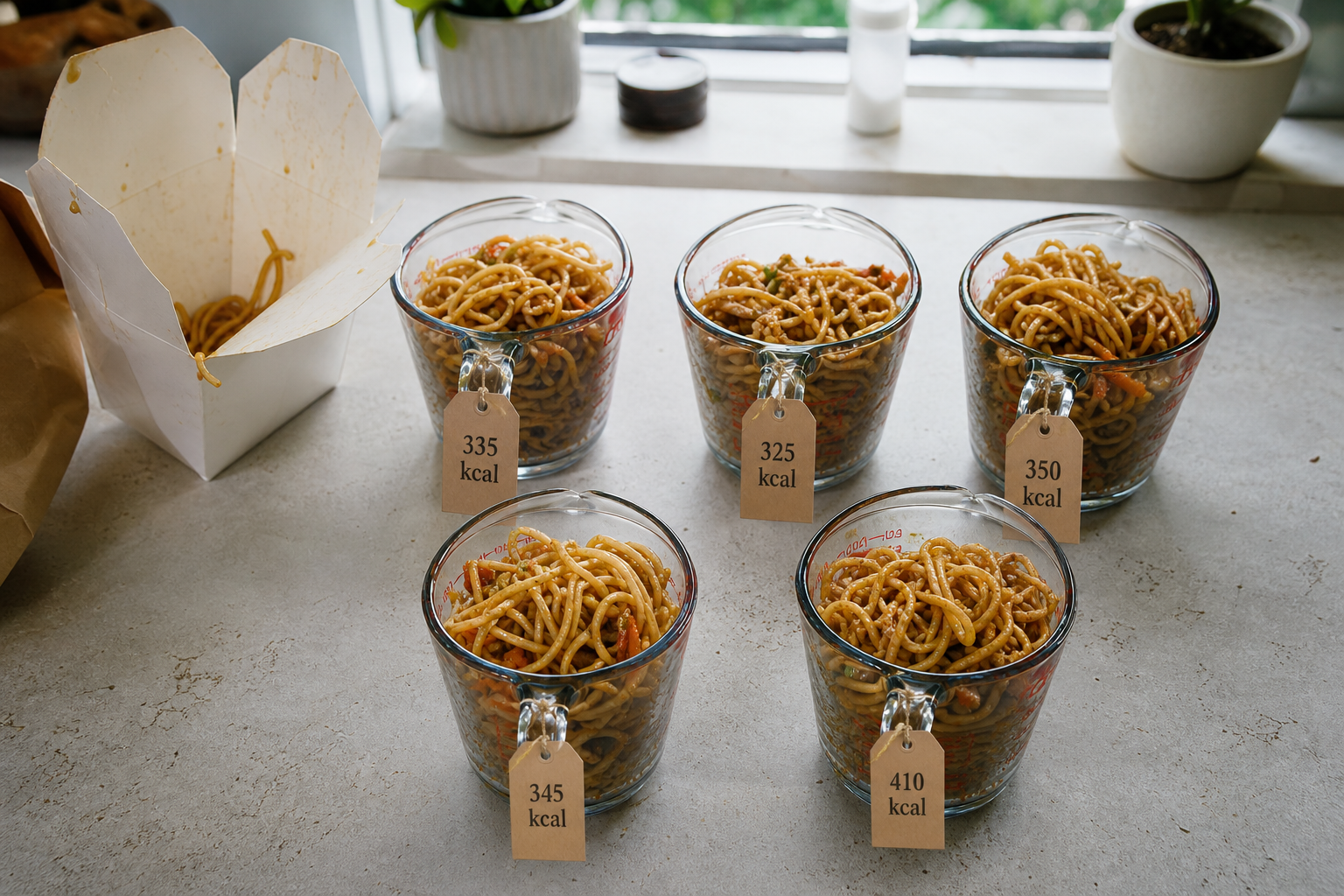
One order of General Tso’s chicken weighs 535 g in USDA’s restaurant data. That is 1,578 kcal before the rice. One cup of it is 431.
You eat takeout out of the container. The container does not say how many plates it holds. This file does the math with USDA’s own order weights, then puts a cup next to each one. The cup is FDA’s reference amount for mixed dishes like these. Nothing here was bought or weighed for this file. Calories are estimates.
One order, in cups
One takeout order against one cup, USDA restaurant figures
| Dish | Order, g | Order, kcal | 1 cup, g | 1 cup, kcal | Cups per order |
|---|---|---|---|---|---|
| Sweet and sour chicken | 706 | 1,765 | 252 | 630 | 2.8 |
| Orange chicken | 648 | 1,698 | 252 | 660 | 2.6 |
| Sesame chicken | 547 | 1,603 | 252 | 738 | 2.2 |
| General Tso’s chicken | 535 | 1,578 | 146 | 431 | 3.7 |
| Vegetable lo mein | 741 | 897 | 136 | 165 | 5.4 |
| Kung pao chicken | 604 | 779 | 162 | 209 | 3.7 |
| Spaghetti with meat sauce | 554 | 670 | 250 | 302 | 2.2 |
| Chicken and vegetables | 693 | 658 | 153 | 145 | 4.5 |
| Spaghetti pomodoro | 510 | 530 | 250 | 260 | 2.0 |
Every order is at least 2 cups. Lo mein is 5.4. The four fried, sauced chicken dishes are 1,578 to 1,765 kcal an order, 79% to 88% of the 2,000 kcal reference day FDA uses for menu labels. None of them includes rice.
The light end is the stir-fry. Chicken and vegetables is 693 g and 658 kcal. Same container, about 1,100 kcal less than sweet and sour chicken.
The reference amount is one cup
FDA sets reference amounts for labels in 21 CFR 101.12. For a mixed dish you can measure with a cup, the amount is 1 cup. For a burrito or a sandwich, it is 140 g. For plain rice or pasta, 140 g cooked. For salad dressing, 30 g.
These are not recommendations. They are the amount people typically eat at one sitting, by FDA’s count, and the basis of a label serving. Takeout has no label. Your neighborhood restaurant is not covered by the federal menu-labeling rule, which applies to chains with 20 or more locations. The container is the only serving size you get.
The quart of fried rice
USDA puts a cup of restaurant fried rice at 137 g and 174 kcal per 100 g. Its survey database puts a cup at 198 g. The difference is how hard the rice is packed.
Fried rice by container, USDA figures
| Container | Cups | g, loose | g, packed | kcal range |
|---|---|---|---|---|
| 1 cup | 1 | 137 | 198 | 238 to 345 |
| Pint | 2 | 274 | 396 | 477 to 689 |
| Quart | 4 | 548 | 792 | 954 to 1,378 |
A full quart of fried rice is 954 to 1,378 kcal on its own. An order of General Tso’s with a pint of fried rice is 2,055 to 2,267 kcal.
The burrito and the salad
USDA’s survey database lists a chicken burrito with beans, rice and cheese at 209 kcal per 100 g. Its regular size is 220 g, 460 kcal. Its large is 330 g, 690 kcal. FDA’s reference amount is 140 g, 293 kcal. The large is 2.4 reference amounts in one tortilla.
The salad goes the other way. The greens are not the number. USDA lists a chicken Caesar salad without dressing at 286 g and 180 kcal. Caesar dressing is 542 kcal per 100 g.
- A 57 g dipping-size cup of Caesar dressing: 309 kcal. Salad total: 489.
- Two tablespoons, 29 g, about FDA’s 30 g reference amount: 159 kcal. Salad total: 339.
The container of dressing outweighs the salad it comes with. See salad dressing per tablespoon for the bottle side of the same math.
The recipe gap
Portion is the first difference. The recipe is the second. USDA’s survey database carries a restaurant version and a home-recipe version of the same pasta dishes. Same 250 g cup, different kcal.
Same pasta, restaurant vs. home recipe, per 250 g cup
| Dish | Restaurant, kcal | Home recipe, kcal | Difference |
|---|---|---|---|
| Tomato sauce | 400 | 265 | +135, 51% |
| Tomato sauce with meat | 445 | 313 | +133, 42% |
| Tomato sauce with poultry | 428 | 295 | +133, 45% |
| Cream sauce | 510 | 385 | +125, 32% |
| Cream sauce with poultry | 515 | 393 | +123, 31% |
The tomato-sauce gap is mostly fat: 17 g more per cup, about 1.2 tablespoons of oil. The cream-sauce gap is smaller in percentage because the home recipe already carries cream.
Both at once
Put the two together on one dish. A restaurant order of spaghetti with meat sauce weighs 554 g. At USDA’s sampled restaurant figure, 121 kcal per 100 g, it is 670 kcal. At the survey database’s restaurant recipe, 178 kcal per 100 g, it is 986. A home cup of the home recipe is 313.
One order is 2.1 to 3.2 times the home plate. The range is the honest answer. USDA’s two restaurant figures do not agree, and your restaurant is neither of them.
How to get a real number
- Weigh the container once. Tare the scale with an empty container of the same size, then weigh the full one.
- Divide by the cup weights in Table 1. That gives you cups.
- Or pour it out. A measuring cup and two plates settle the question faster than a guess.
- Split before you eat. The order stays the same size. The plate does not have to.
What the tables do not show
- Rice. No Chinese entree in Table 1 includes it.
- Your restaurant. USDA’s order weights come from its restaurant samples. Containers and scoops differ by kitchen.
- Sauce left in the container. The figures assume you eat all of it.
- Pad thai and curry. USDA lists no order weight for them. At USDA’s 200 g cup of pad thai, a 3-cup container would be 924 kcal. For the curry side, see Thai curry and the coconut milk and the Indian takeout baseline.
- Sodium. Not ranked here.
The question of takeout portion sizes has one answer that travels: read the container as several cups, not one plate. For a chain that prints every scoop, see the Chipotle bowl file. All restaurant files are on the Eating Out desk.
How these numbers were built
Order weights, cup weights and kcal per 100 g are from USDA FoodData Central: the SR Legacy restaurant entries for Chinese and Italian dishes, and the FNDDS 2021-2023 survey database for fried rice, burritos, Caesar salad, Caesar dressing and the restaurant and home-recipe pasta pairs. Reference amounts are from 21 CFR 101.12. Sources were consulted Apr 24, 2025. Kcal are arithmetic from those figures, rounded to the nearest whole number. Nothing was ordered, weighed or priced for this file. Calorie figures are estimates.