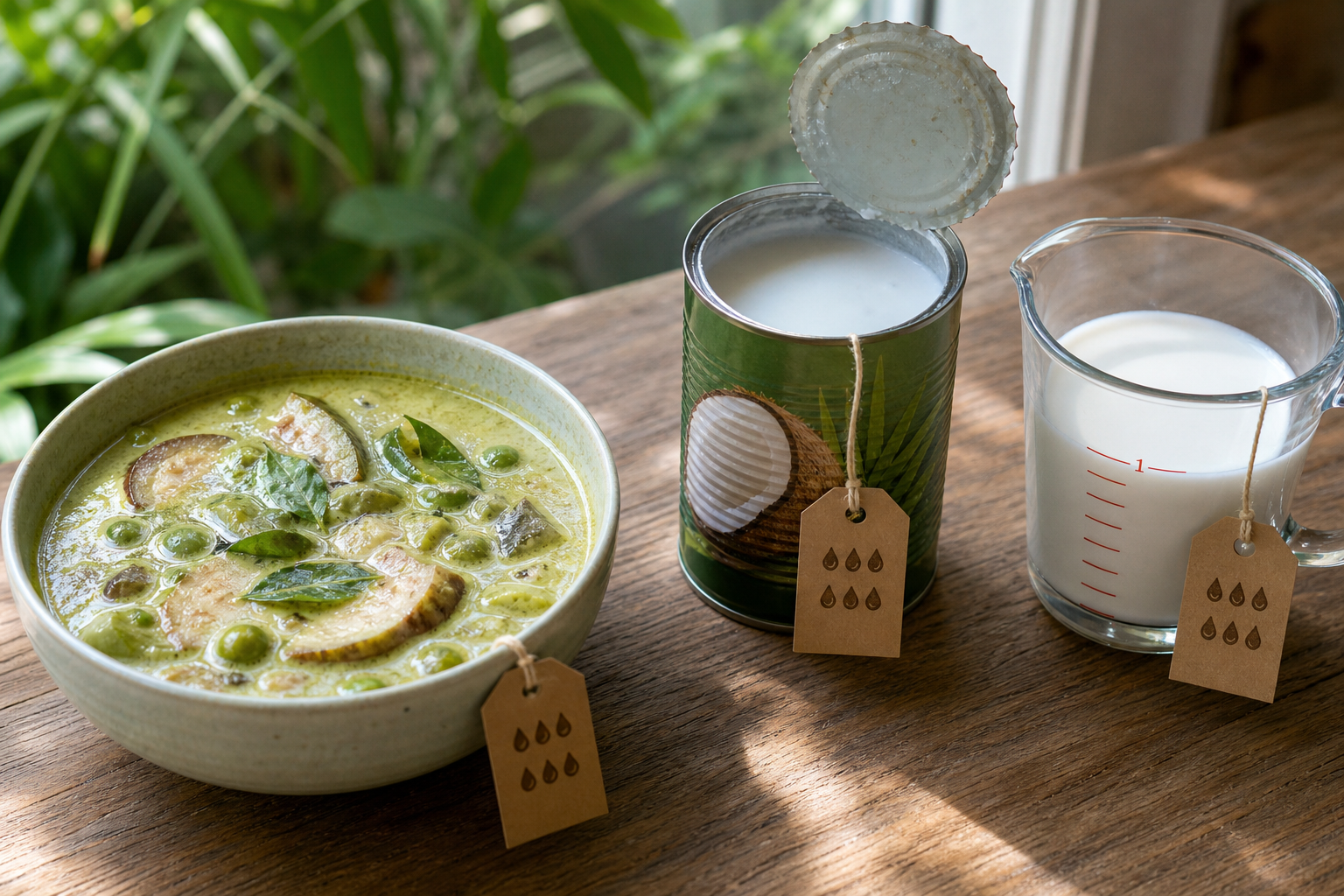
A cup of canned coconut milk is 445 kcal. That is before the chicken, the oil, the sugar and the rice.
A Thai curry is coconut milk with a paste in it. The paste sets the color. The coconut milk sets the number. Restaurants do not print how much they use, so this file builds the curry three ways from USDA FoodData Central figures and prints every line. Nothing was ordered or weighed for this file. Calories are estimates.
The can
USDA lists canned coconut milk at 197 kcal per 100 g, with 21.3 g of fat. A cup weighs 226 g.
- 1 tablespoon: about 30 kcal.
- 1/2 cup: 223 kcal.
- 1 cup: 445 kcal, 48 g of fat, 43 g of it saturated.
- One 13.5 oz can: about 1.7 cups, 751 kcal.
The saturated fat in 1 cup is 214% of the 20 g Daily Value FDA uses on labels. That is a label fact, not a verdict.
One curry, three builds
The builds below differ in two places: how much coconut milk goes in, and whether the paste is fried in oil first. Everything else is held close.
One chicken curry, three builds, kcal from USDA figures
| Line | Light | Typical | Heavy |
|---|---|---|---|
| Coconut milk, canned | 3/4 cup, 334 | 1 cup, 445 | 1 1/2 cups, 668 |
| Chicken breast, raw weight | 120 g, 144 | 150 g, 180 | 150 g, 180 |
| Bamboo shoots and red pepper | 100 g, 22 | 100 g, 22 | 100 g, 22 |
| Oil to fry the paste | none, 0 | 1 tbsp, 124 | 1 tbsp, 124 |
| Palm or brown sugar | 1 tsp, 17 | 1 tbsp, 52 | 1 tbsp, 52 |
| Fish sauce | 1 tbsp, 6 | 1 tbsp, 6 | 1 tbsp, 6 |
| Total | 523 | 829 | 1,052 |
The coconut milk is 64% of the light build, 54% of the typical one and 63% of the heavy one. The chicken never passes 28%. Going from 3/4 cup to 1 1/2 cups of coconut milk adds 334 kcal. Swapping the chicken for tofu or shrimp moves the total far less.
Where the fat is
Fat carries most of the energy in all three builds.
- Light: about 40 g of fat, 36 g of it from the coconut milk.
- Typical: about 66 g, 48 g from the coconut milk and 14 g from the oil.
- Heavy: about 91 g, 72 g from the coconut milk.
At 9 kcal per gram, fat supplies 68% of the light build’s energy, 72% of the typical one’s and 77% of the heavy one’s. The chicken breast brings about 4 g. Frying the paste in oil adds 14 g. The coconut milk is the line that doubles from light to heavy.
The paste changes the color
Menus describe massaman with potatoes and peanuts, and panang with peanuts in the paste. Built on the typical curry above:
Curry styles on the typical build, kcal
| Curry | Added to the typical build | kcal |
|---|---|---|
| Massaman | 150 g boiled potato, 2 tbsp peanuts | 1,064 |
| Panang | 1 tbsp ground peanuts | 882 |
| Green or red | nothing | 829 |
| Jungle curry | no coconut milk | 384 |
Green and red are the same build with a different paste. Massaman is 235 kcal heavier from potato and peanuts. Jungle curry, made with stock or water instead of coconut milk, is less than half of a green curry. Same chicken, same oil.
The rice
USDA has no jasmine rice entry. Its long-grain white rice, cooked, is the closest: 130 kcal per 100 g, 158 g per cup.
The rice under the curry, USDA figures
| Rice | g | kcal |
|---|---|---|
| Coconut rice, 1 cup | 200 | 534 |
| White rice, 2 cups | 316 | 411 |
| White rice, 1 1/2 cups | 237 | 308 |
| White rice, 1 cup | 158 | 205 |
Coconut rice is the curry’s coconut milk again, cooked into the rice. USDA’s version is 267 kcal per 100 g. One cup of it is 2.6 times a cup of white rice.
The order
- Light curry, 1 cup of rice: 728 kcal.
- Typical curry, 1 1/2 cups of rice: 1,137.
- Massaman, 1 1/2 cups of rice: 1,372.
- Typical curry, 1 cup of coconut rice: 1,363.
- Heavy curry, 2 cups of rice: 1,463.
The spread is 735 kcal for what the menu calls one dish. The heavy order is 73% of the 2,000 kcal reference day FDA uses on menus.
Pad Thai, for comparison
USDA’s survey database lists pad Thai with chicken at 154 kcal per 100 g, at 200 g a cup. Its recipe puts about 7 g of oil and 7 g of peanuts in each cup.
- 2 cups: 616 kcal.
- 3 cups: 924 kcal.
Two cups of pad Thai come in 521 kcal under a typical curry with rice. Three cups still come in under it.
Sodium
The fish sauce is the sodium line. USDA lists it at 7,851 mg per 100 g. One tablespoon is 1,413 mg, 61% of the 2,300 mg Daily Value, before the paste and any salt.
How to tighten the estimate
- Ask how much coconut milk goes into one order. The kitchen knows. A kitchen that splits one 13.5 oz can between two orders puts about 376 kcal of it in each.
- Leave sauce in the bowl. The sauce is where the coconut milk is. The chicken and vegetables are the light part.
- Pick the rice size. White over coconut rice saves 329 kcal a cup.
- Order jungle curry if it is on the menu and you want the paste without the coconut milk.
What the tables do not show
- Your restaurant’s recipe. These are this file’s builds, not any kitchen’s.
- Light coconut milk. USDA lists no light version. If a kitchen uses it, its label is the figure.
- Curry paste. Small in kcal and not counted.
- Coconut cream finishes. A swirl on top is extra and not counted.
- Jasmine rice. Counted as long-grain white.
The short answer on Thai curry calories: count the cups of coconut milk first, then the rice. For a dish where the rice carries the number instead, see sushi is mostly rice. For the cream-and-ghee version of the same problem, see the Indian takeout baseline. For rice weighed dry or cooked, see rice dry vs. cooked. For how big a takeout container really is, see takeout vs. home plates. All restaurant files are on the Eating Out desk.
How these numbers were built
Ingredient figures are from USDA FoodData Central, SR Legacy, at USDA’s cup, tablespoon and teaspoon weights. Pad Thai and coconut rice are from the FNDDS 2021-2023 survey database. The three curry builds and the style additions are this file’s stated assumptions, not a restaurant’s recipe. Chicken is counted at raw weight. Sources were consulted May 26, 2025. Calorie figures are estimates.