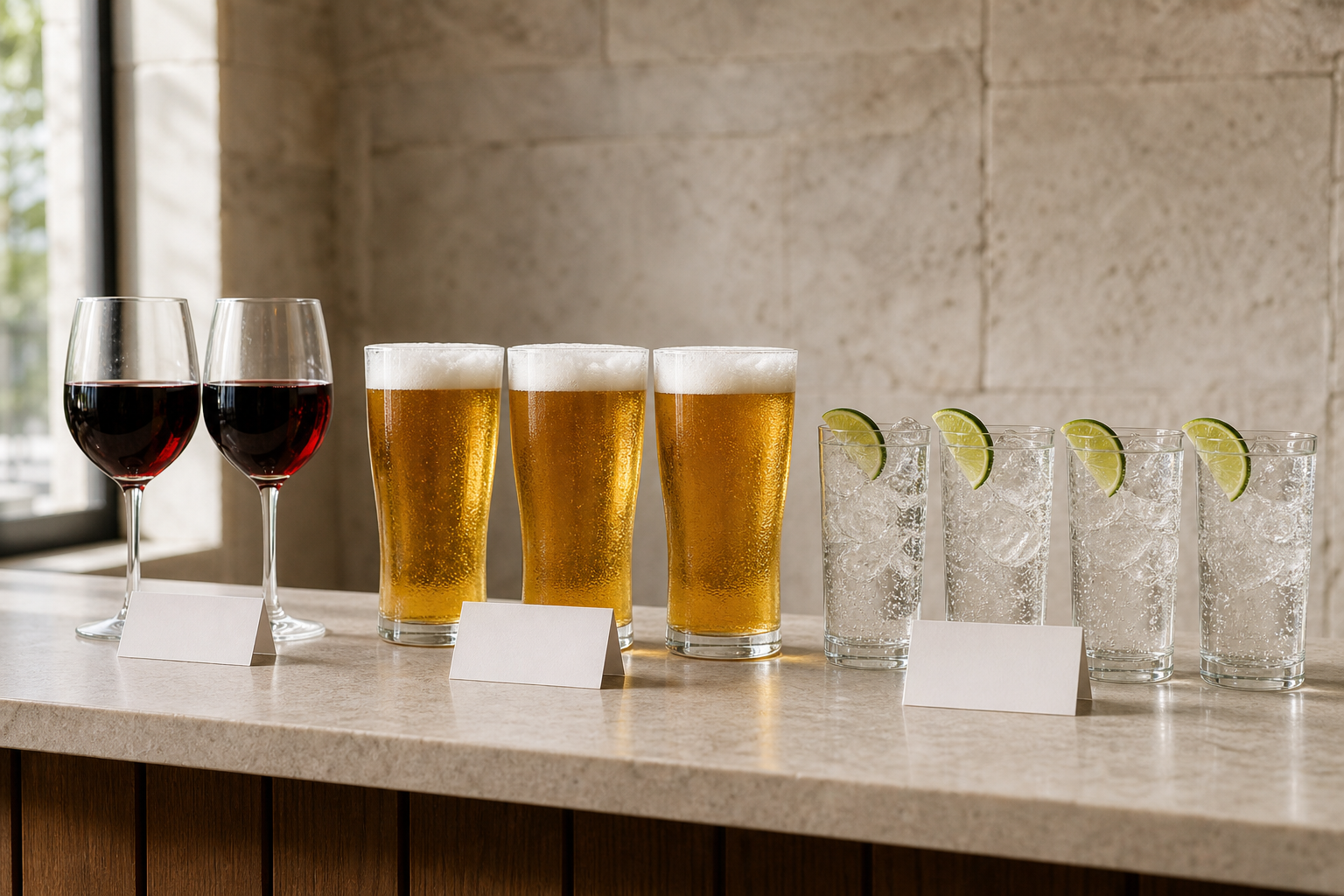
Two 5 oz glasses of red wine are about 250 kcal. That is 12.5% of a 2,000 kcal day. It is also more than the 240 kcal that USDA’s 2,000 kcal eating pattern leaves for “other uses”: the room for added sugars, saturated fat and alcohol once the food groups are met.
This file counts drinks against that day. Per-pour figures match the 23-pour reference table, all built from USDA FoodData Central. Every figure is an estimate. Brands, pours and ABV vary.
Where the kcal come from
USDA’s figures work out to about 6.9 kcal per gram of alcohol. Fat is 9, carbs 4. The table splits each drink into alcohol and everything else.
Energy per drink, alcohol vs. the rest, USDA values
| Drink | Pour | kcal | Alcohol, g | kcal from alcohol | Share from alcohol | Con |
|---|---|---|---|---|---|---|
| 80-proof spirits | 1.5 fl oz | 97 | 14.0 | 97 | 100% | Before any mixer |
| White table wine | 5 fl oz | 121 | 15.1 | 104 | 87% | 1.1 standard drinks, not 1 |
| Red table wine | 5 fl oz | 125 | 15.6 | 108 | 86% | Pour size is not printed on the glass |
| Light beer | 12 fl oz | 103 | 11.0 | 76 | 74% | Saving is mostly carbs |
| Whiskey sour | 3.5 fl oz | 158 | 14.9 | 103 | 65% | Sour mix varies by bar |
| Regular beer | 12 fl oz | 153 | 13.9 | 96 | 63% | Many craft beers run 6 to 9% |
| Hard lemonade | 11.2 fl oz | 228 | 13.4 | 92 | 41% | 33.7 g of carbs |
| Piña colada | 4.5 fl oz | 245 | 14.0 | 96 | 39% | USDA recipe pour; bar pours vary |
Every row carries 11 to 16 g of alcohol, so the alcohol side sits between 76 and 108 kcal. The spread in the kcal column comes from the rest. Dry wine and spirits are almost all alcohol. Beer adds carbs. Sweet drinks add sugar until it is the larger part.
One evening
Ordinary evenings, priced against a 2,000 kcal day. Standard drinks are alcohol grams ÷ 14, the US drink equivalent in the Dietary Guidelines.
One evening of drinks as a share of 2,000 kcal
| Evening | kcal | Share of 2,000 | Standard drinks | Con |
|---|---|---|---|---|
| 3 pints of regular beer, 16 oz | 612 | 30.6% | 4.0 | Binge level for women within two hours |
| 4 rum and colas, 1.5 oz + 4 oz cola | 594 | 29.7% | 4.0 | 49 g of sugar from the cola |
| 2 piña coladas, USDA recipe | 491 | 24.6% | 2.0 | 63 g of sugar |
| 3 regular beers, 12 oz | 459 | 23.0% | 3.0 | Over the 2-drink line for men |
| 2 restaurant pours of red, 9 oz | 450 | 22.5% | 4.0 | Two glasses, four drinks |
| 4 vodka sodas | 388 | 19.4% | 4.0 | Lowest kcal, same alcohol |
| 2 glasses of red, 5 oz | 250 | 12.5% | 2.2 | Above the 240 kcal other-uses limit |
Two things stand out. Four vodka sodas and four rum and colas carry the same alcohol; the cola adds 206 kcal. And the 9 oz pour doubles both columns without changing the count of glasses.
One week
A week at 2,000 kcal a day is 14,000 kcal. Spread the drinks across it and the daily share looks small. The weekly total does not.
Weekly drinking patterns, kcal per week and per day
| Pattern | Glasses a week | kcal a week | Average kcal a day | Share of the week |
|---|---|---|---|---|
| 2 regular beers every day | 14 | 2,143 | 306 | 15.3% |
| 3 pints Friday, 3 pints Saturday, 2 glasses of red Sunday | 8 | 1,474 | 211 | 10.5% |
| 3 regular beers Friday and Saturday | 6 | 919 | 131 | 6.6% |
| 2 rum and colas Thursday to Saturday | 6 | 892 | 127 | 6.4% |
| 1 glass of red, 5 oz, every day | 7 | 875 | 125 | 6.2% |
For scale: the Dietary Guidelines put alcohol at about 9% of calories among adults who drink. USDA’s 2021-2023 survey puts mean intake for all adults, drinkers or not, at 8.1 g of alcohol a day, about 56 kcal: 11.8 g for men, 4.7 g for women.
The limits, in kcal
The Dietary Guidelines 2020-2025 set the numbers. One drink equivalent is 14 g of pure alcohol: 12 oz of 5% beer, 5 oz of 12% wine or 1.5 oz of 80-proof spirits. For adults who drink, the guideline is 2 drinks or less in a day for men and 1 or less for women, on days alcohol is consumed. It is not an average across the week. Binge drinking is 5 or more drinks for men and 4 or more for women in about two hours.
In kcal, by USDA figures:
- 1 drink: 97 kcal as a shot of 80-proof, 121 to 125 as wine, 153 as regular beer.
- 2 drinks: 194 to 306 kcal.
- 4 drinks: 388 to 612 kcal in the evenings above.
The guidelines also note that some people should not drink at all, and that risk for some cancers rises even below one drink a day. That is a question this file does not price.
Mixers
The shot is 97 kcal. The glass decides the rest. Per 4 fl oz of mixer, USDA values:
Mixers per 4 fl oz, USDA values
| Mixer | kcal | Sugar, g | Highball with 1.5 oz 80-proof, kcal | Con |
|---|---|---|---|---|
| Cranberry juice cocktail | 68 | 15.0 | 165 | Most sugar of the six |
| Orange juice | 61 | 10.3 | 158 | Sugar is from the fruit, kcal still count |
| Cola | 52 | 12.2 | 149 | Bars pour 5 to 6 oz |
| Ginger ale | 41 | 10.9 | 138 | Same kcal as tonic |
| Tonic water | 41 | 10.7 | 138 | Not a diet drink |
| Club soda | 0 | 0 | 97 | Carries sodium, not sugar |
Diet cola is about 2 kcal per 4 oz. The Dietary Guidelines’ own example, 7 fl oz of rum and cola, is about 190 kcal: a bigger pour than this table.
Why the bottle prints no number
Most beer, wine and spirits are labeled under Treasury rules, not FDA’s Nutrition Facts panel. TTB Ruling 2013-2 lets producers print a Serving Facts panel with calories, carbs, protein and fat. It is voluntary. A calorie or carb claim, such as “low carb”, is what triggers a statement of average analysis per serving: calories, carbs, protein and fat. A bottle with no panel is not missing anything the rules require.
So the number on the shelf, when there is one, is the producer’s. When there is none, the estimate has to come from ABV and pour: mL × ABV × 0.789 = grams of alcohol, × 6.9 for kcal, plus carbs × 4.
What the store price says
BLS priced malt beverages at $1.821 per 16 oz in March 2025, US city average, and table wine at $14.00 per liter. A 12 oz beer works out to $1.37, or 112 kcal per dollar. A 5 oz glass of wine is $2.07, or 60 kcal per dollar. Store prices, not bar prices.
What this file does not cover
- Bar pours. A 9 oz glass of wine or a double are in the tables; a free pour is not.
- High-ABV beer. Scale up with the alcohol. The pint math is in three beers at happy hour.
- Food eaten with drinks. Not counted here.
- Your own day. 2,000 kcal is FDA’s label reference, not a target. Your number is worked out in estimating energy needs without a calculator.
- Soda without alcohol. See soda vs. sparkling water.
Every page in this section is filed on the Body desk.
How these numbers were built
Per-drink kcal, alcohol grams and mixer values are USDA FoodData Central, SR Legacy, scaled with USDA’s pour weights. The 6.9 kcal per gram is USDA’s 80-proof row: 231 kcal over 33.4 g of alcohol per 100 g. Limits, the drink equivalent and the 240 kcal figure are from the Dietary Guidelines for Americans, 2020-2025. Mean alcohol intake is What We Eat in America, NHANES August 2021-August 2023. Labeling is TTB Ruling 2013-2. Prices are BLS US city averages for March 2025, not a receipt. Consulted May 11, 2025. Calorie figures are estimates.