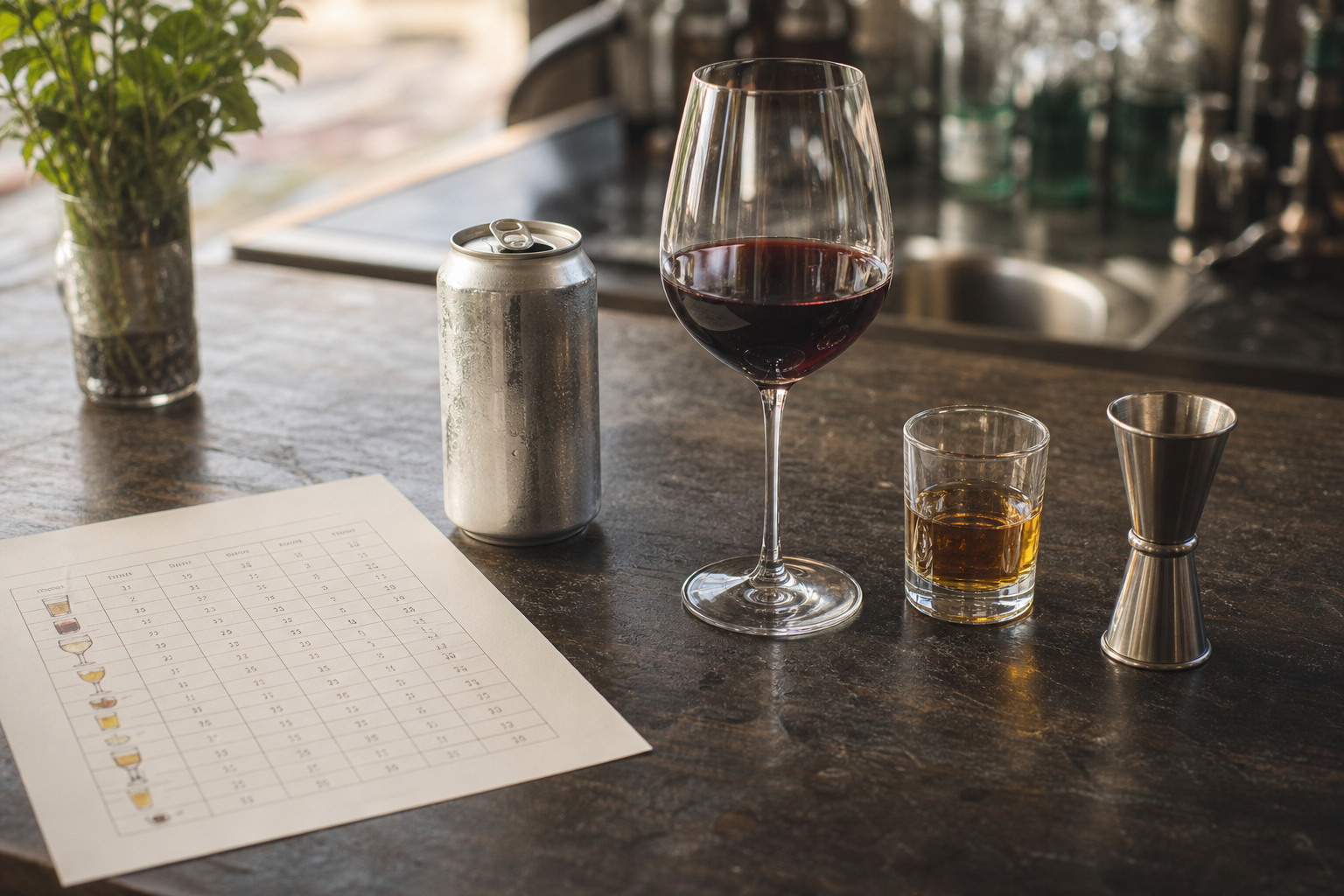
Alcohol carries about 7 kcal per gram, close to fat’s 9. A drink’s calories are mostly its alcohol grams, plus whatever sugar or mixer comes with them. This file prices 23 common pours in kcal, alcohol grams and US standard drinks.
Every row is a USDA SR Legacy value, scaled to the pour shown with USDA’s own gram weights for that drink. Bottles and brands vary: a 7% IPA or a heavy-handed pour will not match. Read every figure as an estimate.
The standard drink
In the US, one standard drink is 14 g of pure alcohol. NIAAA and CDC give three reference pours that hold about that much:
- 12 fl oz of regular beer, about 5% alcohol.
- 5 fl oz of table wine, about 12%.
- 1.5 fl oz of 80-proof distilled spirits, 40%.
The tables show how close real pours land. The “Standard drinks” column is alcohol grams divided by 14.
The tables
Beer: per drink, USDA values
| Drink | Pour | kcal | Alcohol | Standard drinks | Carbs |
|---|---|---|---|---|---|
| Light beer, low-carb | 12 fl oz | 96 kcal | 11.7 g | 0.8 | 2.6 g |
| Light beer | 12 fl oz | 103 kcal | 11.0 g | 0.8 | 5.8 g |
| Regular beer | 12 fl oz | 153 kcal | 13.9 g | 1.0 | 12.6 g |
| Regular beer, 16 oz pint | 16 fl oz | 204 kcal | 18.5 g | 1.3 | 16.9 g |
| Higher-alcohol beer | 12 fl oz | 206 kcal | 27.3 g | 2.0 | 1.0 g |
| Hard lemonade | 11.2 fl oz | 228 kcal | 13.4 g | 1.0 | 33.7 g |
Wine and sake: per drink, USDA values
| Drink | Pour | kcal | Alcohol | Standard drinks | Carbs |
|---|---|---|---|---|---|
| Light wine | 5 fl oz | 72 kcal | 9.4 g | 0.7 | 1.7 g |
| White table wine | 5 fl oz | 121 kcal | 15.1 g | 1.1 | 3.8 g |
| Red table wine | 5 fl oz | 125 kcal | 15.6 g | 1.1 | 3.8 g |
| Red table wine, large pour | 9 fl oz | 225 kcal | 28.0 g | 2.0 | 6.9 g |
| Dessert wine, sweet | 3.5 fl oz | 165 kcal | 15.8 g | 1.1 | 14.1 g |
| Sake | 5 fl oz | 195 kcal | 23.4 g | 1.7 | 7.3 g |
Spirits and liqueurs: per drink, USDA values
| Drink | Pour | kcal | Alcohol | Standard drinks | Carbs |
|---|---|---|---|---|---|
| Gin, rum, vodka, whiskey, 80 proof | 1.5 fl oz | 97 kcal | 14.0 g | 1.0 | 0.0 g |
| Spirits, 86 proof | 1.5 fl oz | 105 kcal | 15.1 g | 1.1 | 0.0 g |
| Spirits, 100 proof | 1.5 fl oz | 124 kcal | 17.9 g | 1.3 | 0.0 g |
| Spirits, 80 proof, double pour | 3 fl oz | 194 kcal | 28.1 g | 2.0 | 0.0 g |
| Coffee liqueur, 53 proof | 1.5 fl oz | 175 kcal | 11.3 g | 0.8 | 24.4 g |
| Coffee liqueur with cream, 34 proof | 1.5 fl oz | 154 kcal | 6.5 g | 0.5 | 9.8 g |
| Creme de menthe, 72 proof | 1.5 fl oz | 186 kcal | 14.9 g | 1.1 | 20.8 g |
Cocktails, USDA recipes: per drink, USDA values
| Drink | Pour | kcal | Alcohol | Standard drinks | Carbs |
|---|---|---|---|---|---|
| Daiquiri | 2 fl oz | 112 kcal | 13.9 g | 1.0 | 4.2 g |
| Whiskey sour | 3.5 fl oz | 158 kcal | 14.9 g | 1.1 | 14.0 g |
| Pina colada | 4.5 fl oz | 245 kcal | 14.0 g | 1.0 | 32.0 g |
| Tequila sunrise, canned | 6.8 fl oz | 232 kcal | 19.8 g | 1.4 | 23.8 g |
Cocktail rows are USDA’s recipe versions. Bar recipes differ in pour size, mixer and sugar.
What the tables say
- The three reference pours land within 30 kcal of each other. Beer 153, wine 121 to 125, an 80-proof shot 97. Each is about one standard drink.
- Size moves the number more than type. A 9 oz glass of red is 225 kcal and two standard drinks. A 16 oz pint of regular beer is 204 kcal and 1.3. A double pour of 80-proof is 194.
- Proof scales spirits in a straight line. 80, 86 and 100 proof are 97, 105 and 124 kcal per 1.5 oz. There are no carbs in any of them.
- Light beer saves about 50 kcal a can. 103 against 153. Most of the saving is carbs: 5.8 g against 12.6 g. The alcohol drops less, 11.0 g against 13.9 g.
- Sugar takes over in sweet drinks. A piña colada is 245 kcal with 32 g of carbs. Hard lemonade is 228 kcal with 33.7 g. Coffee liqueur is 175 kcal per 1.5 oz, with more carbs than alcohol by weight.
- Sake is stronger than wine. USDA’s sake carries about 16 g of alcohol per 100 g against 10 to 11 g for table wine, so 5 fl oz is 1.7 standard drinks and about 195 kcal.
The cons of these numbers
- ABV varies more than the label suggests. Regular beer here is USDA’s average, close to 5%. Many craft beers run 6 to 9%. Scale up with the alcohol.
- Restaurant pours are not 5 oz. The wine rows assume a measured pour. Weigh or measure once at home to see what your glass holds.
- Mixers are the wild card. Juice, soda and syrups add sugar in amounts that depend on the bar’s recipe. The sugar side of the mixers is in sugar per 100 g, drinks.
- Many bottles list no calories. Most beer, wine and spirits are labeled under Treasury rules, not FDA’s Nutrition Facts panel, so the number is often missing.
Check a drink in under a minute
- Find the ABV on the bottle.
- Pour volume in fl oz × 29.6 = mL. mL × ABV × 0.789 = grams of alcohol.
- Grams × 7 = kcal from alcohol. Add the carbs × 4 if the drink is sweet.
A 16 oz pint of 7% IPA: 473 mL × 0.07 × 0.789 = 26 g of alcohol, about 183 kcal before carbs.
If you compare drinks to soda or sparkling water, the soda file has the non-alcoholic side. Terms like ABV, proof and standard drink are defined in the calorie tracking glossary. Food per 100 g is in the 120-food table.
Every lookup table is filed on the Reference desk.