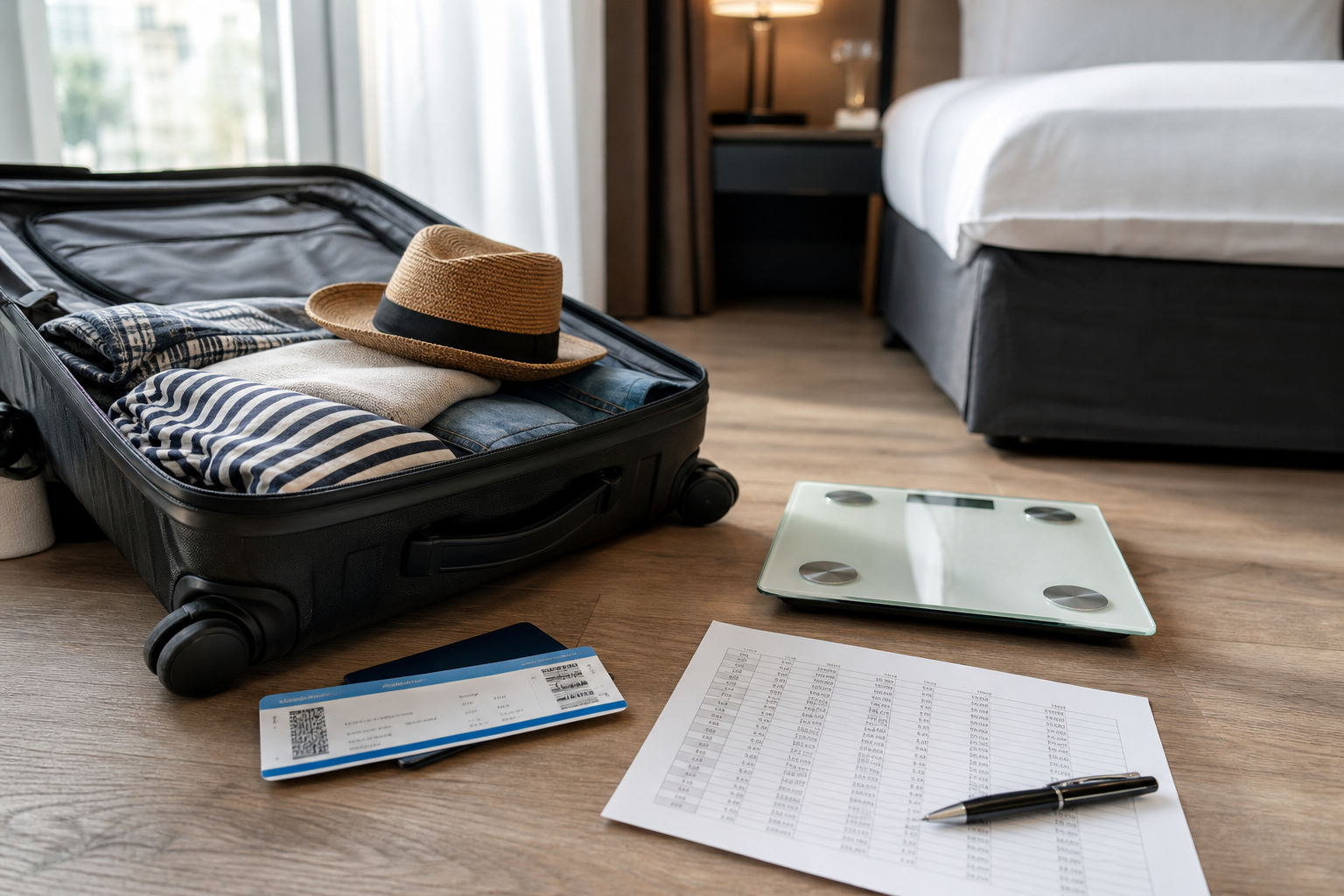
In a 2016 study, 122 adults were weighed a week before and a week after a 1- to 3-week vacation. Average weight rose 0.32 kg, about 0.7 lb. Six weeks later, the total gain was 0.41 kg, about 0.9 lb. It had not gone away.
That is the measured number. The number on the first morning home is usually bigger, and most of it is not tissue. This file separates the two, with the studies, the energy math and the water math.
Two studies, weighed, not recalled
Both studies weighed people at visits instead of asking them. Both found average gains under 1 lb.
Measured weight change over trips and the holiday season
| Study | People | Period | Mean change | Con |
|---|---|---|---|---|
| Cooper and Tokar, 2016 | 122 adults | 1 week before to 1 week after a 1- to 3-week trip | +0.32 kg, 0.7 lb | Post-trip visit came a week after return |
| Cooper and Tokar, 2016 | 122 adults | Through 6 weeks after the trip | +0.41 kg, 0.9 lb | Not reversed in the follow-up |
| Yanovski et al., 2000 | 195 adults | Late Sept or early Oct to mid-Nov | +0.18 kg, 0.4 lb | Not statistically significant |
| Yanovski et al., 2000 | 195 adults | Mid-Nov to early or mid-Jan | +0.37 kg, 0.8 lb | Wide spread, SD 1.52 kg |
| Yanovski et al., 2000 | 195 adults | Late Sept or early Oct to Feb or Mar | +0.48 kg, 1.1 lb | Convenience sample |
Yanovski’s team set out to test the claim that Americans gain 5 lb or more between Thanksgiving and New Year’s Day. The measured mean was under 1 lb. The 165 people who came back the next fall had not reversed it.
Cooper and Tokar found no clear difference by BMI group: 0.28 kg for normal weight, 0.39 kg for overweight and 0.48 kg for obese. Perceived stress went down. Self-reported physical activity tended to rise on the trip and fell after it. The authors attributed the gain to energy intake above requirements.
What a week of surplus makes in tissue
The usual estimate for fat tissue is 3,500 kcal per pound. It equals 32.2 MJ per kg and assumes tissue that is 87% fat. Hall’s 2008 analysis shows it is an approximation: the energy per pound shifts with how much body fat you start with.
Surplus over a trip, and the tissue it makes at 3,500 kcal per pound
| Extra kcal per day | 7 days, kcal | Tissue, lb | 14 days, kcal | Tissue, lb | Con |
|---|---|---|---|---|---|
| 250 | 1,750 | 0.5 | 3,500 | 1.0 | Rule of thumb, not a measurement |
| 500 | 3,500 | 1.0 | 7,000 | 2.0 | Rule of thumb, not a measurement |
| 750 | 5,250 | 1.5 | 10,500 | 3.0 | Rule of thumb, not a measurement |
| 1,000 | 7,000 | 2.0 | 14,000 | 4.0 | Rule of thumb, not a measurement |
For scale: three regular beers are about 459 kcal at USDA values. Four trips to a buffet line came to about 3,036 kcal in the buffet plates file. Chicken and waffles is about 1,438 in the brunch file. A 1,000 kcal surplus is one heavy meal above a usual one.
Run the study backward. If the whole 0.32 kg were fat tissue, it would hold about 2,460 kcal. Spread over a 7- to 21-day trip, that is about 120 to 350 kcal a day above needs. A small daily surplus explains the average.
The first morning home
The airport-morning reading is not the 0.32 kg. It sits on top of four kinds of mass that are not tissue.
What the first morning after a trip can hold
| Component | Scale change | kcal inside | Con |
|---|---|---|---|
| Glycogen refilled, 500 g, with 3 g of water per gram | About 2.0 kg, 4.4 lb | About 2,100 | Only if stores were low before the trip |
| Water held with extra sodium | Varies with the meals | 0 | Leaves as the kidneys clear the sodium |
| Food still in the gut | Varies; one ordinary day of food and drink can weigh 7 lb | Not tissue yet | Leaves over a day or more |
| Fat tissue | Surplus divided by 3,500 | 3,500 per lb | The only row that stays |
Glycogen. Acheson’s 1988 overfeeding study put human glycogen capacity at about 15 g per kg of body weight, with room for a gain of about 500 g before the body made net fat from carbohydrate. A 2015 biopsy study found each gram of glycogen stored with at least 3 g of water. Glycogen holds about 4.2 kcal per gram. So a 500 g refill is at least 2 kg on the scale, 4.4 lb, holding about 2,100 kcal. Whether you refill that much depends on how full your stores were before you left. Acheson’s figures come from three men overfed on carbohydrate; read them as a ceiling.
Sodium. Restaurant food carries more of it, and the body holds water with it until the kidneys clear it. The arithmetic ceiling, per 1,000 mg, is in the overnight two-pound file.
Food in transit. Grams weigh what they weighed on the plate, whatever their kcal.
Tissue. At 3,500 kcal per pound, 4 lb of fat tissue would need about 14,000 kcal above your needs. Over a one-week trip that is 2,000 kcal a day on top of maintenance.
Reading the scale after a trip
Cooper and Tokar weighed people a week after they got home, not the morning after. That timing is a method you can copy.
- Take a 7-day average of morning readings in the week before you leave, same scale, same conditions.
- Skip the first mornings home as a measure of tissue. Glycogen, sodium water and food in transit are all still moving.
- Take a second 7-day average starting about a week after return.
- The difference between the two averages is closer to what the study measured. A single first-morning reading is not.
Two readings of the same trip, illustrative
| Reading | What it includes | Con |
|---|---|---|
| First morning home | Tissue, glycogen and its water, sodium water, food in transit | Largest number, least informative |
| 7-day average, a week after return | Tissue, less of the mass in transit, plus the normal weekly swing | Closer to the study design |
Why the small number matters more
The 0.32 kg is small, and it did not reverse in six weeks. Yanovski’s net 0.48 kg did not reverse by the next fall. The authors of both studies point to the same thing: gains that small, if they stay, add up over adult years. The water and glycogen on the first morning are larger, and they come and go. The tissue is smaller, and it is the part the follow-up visits still found.
Neither study tells you what will happen to you. Both report averages with wide spreads. Yanovski’s standard deviation, 1.52 kg, is four times the mean.
What this file does not cover
- Drinks on the trip. Pour by pour, see alcohol calories, drink by drink.
- Sleep, time zones and jet lag. Neither study measured them.
- Cruises and all-inclusive resorts. No prospective study of them specifically was included here.
- Children. Both studies enrolled adults.
Every page in this section is on the Body desk.
How these numbers were built
Trip figures are from Cooper and Tokar, Physiology & Behavior, 2016. Holiday-season figures are from Yanovski and colleagues, New England Journal of Medicine, 2000. Kilograms are converted at 2.2046 lb per kg. The 3,500 kcal per pound rule and the energy density of glycogen are from Hall, International Journal of Obesity, 2008. Glycogen capacity is from Acheson and colleagues, 1988; water per gram of glycogen from Fernández-Elías and colleagues, 2015. Beer kcal are USDA values, as in the drink files. The surplus table is arithmetic, not a forecast. Consulted May 13, 2025. Calorie figures are estimates.