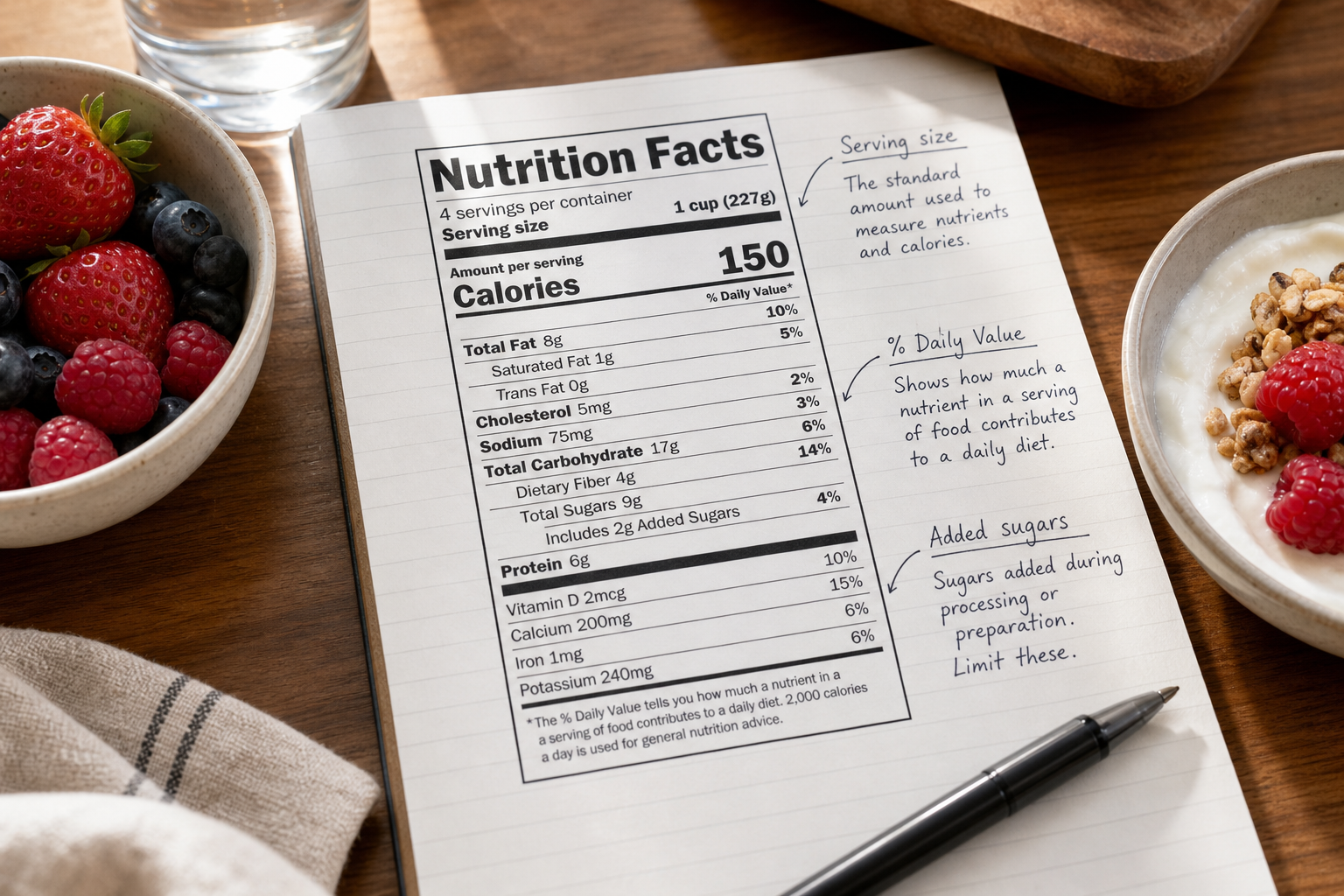
Calorie tracking borrows words from three places: food labeling law, nutrition science and the kitchen. The same word can mean different things in each. This glossary defines 37 terms the way the rest of this desk uses them, and gives the number that pins each one down.
Definitions follow FDA labeling rules where FDA has one. Where it does not, the entry says so. Every calorie figure on this site is an estimate, and so is every figure in the examples below.
How to use it
Each entry has three parts: the term, what it means here, and the number that pins it down. Where the number is a legal threshold, such as a claim or a rounding rule, it comes from FDA’s labeling regulations. Where it is a measure, such as a cup or a standard drink, it comes from the agency that defines it. Where there is no official number, the entry says so instead of inventing one.
Energy and units
Energy terms
| Term | What it means | The number |
|---|---|---|
| Calorie, on a label | A kilocalorie. US labels write “Calories” and mean kcal | 1 Calorie = 1 kcal |
| kcal | Kilocalorie, the unit this site prints | 1 kcal = 1,000 small calories |
| kJ | Kilojoule, the metric energy unit used on many non-US labels | 1 kcal = 4.184 kJ |
| Atwater factors | Average energy per gram of each macronutrient | Protein 4, carbs 4, fat 9, alcohol 7 kcal per g |
| Macronutrients | Protein, carbohydrate and fat; alcohol also carries energy | See Atwater factors |
| Energy density | kcal per gram of food | 0.15 for cucumber to 8.84 for oil |
| Estimate | Any calorie figure for a real food. Labels, menus and tables all carry error | Every number on this site |
On the label
Labeling terms
| Term | What it means | The number |
|---|---|---|
| Nutrition Facts panel | The FDA-required nutrition table on packaged food | One serving column; two on some packages |
| Reference amount | FDA’s amount customarily eaten per occasion, by food category | 12 fl oz soda, 30 g chips, 2/3 cup ice cream |
| Serving size | The household measure closest to the reference amount | Printed in units and grams |
| Servings per container | Package weight ÷ serving size | 1 for most packages under 2 reference amounts |
| Dual-column label | Per-serving and per-package columns | Required on some packages of 2 to 3 reference amounts |
| Daily Value | FDA’s reference intake for each nutrient on a label | Sodium 2,300 mg, fiber 28 g, added sugars 50 g, protein 50 g |
| %DV | One serving’s share of the Daily Value | 5% or less is low, 20% or more is high |
| 2,000 kcal | The reference diet behind every %DV. Not a target | Printed in the panel’s footnote |
| Total sugars | All sugars in the food, including milk and fruit sugar | Grams, no %DV |
| Added sugars | Sugars added in processing, plus syrups and honey | DV 50 g |
| Calorie rounding | How labels round the calorie line | Under 5 to 0; to the nearest 5 up to 50; to the nearest 10 above |
| Label tolerance | How far actual calories may run above the label | More than 120% of declared is misbranded |
| Calorie free | A claim FDA defines | Under 5 kcal per reference amount |
| Low calorie | A claim FDA defines | 40 kcal or less per reference amount |
| Reduced calorie | A claim FDA defines | At least 25% fewer kcal than the regular food |
| As packaged, as prepared | Whether the panel describes the dry mix or the finished food | Check the column header |
| Net carbs | A marketing term. FDA does not define it | No official number |
| Menu labeling | Calorie posting on chain restaurant menus | Chains with 20 or more locations |
Weights and measures
Measuring terms
| Term | What it means | The number |
|---|---|---|
| Per 100 g | Nutrients on a fixed weight, so foods compare directly | 100 g of the food as described |
| Raw weight, cooked weight | The same food before and after the pan or pot | Chicken breast keeps about 73%; rice gains about 2.8 times |
| Yield | Cooked weight ÷ raw weight | Under 1 for meat, over 1 for grains |
| Refuse | The part you buy but do not eat: peel, core, bone | Bananas 36%, whole chicken 32% |
| Household measure | Cups and spoons | Label cup 240 mL; US cup 236.6 mL |
| Ounce-equivalent | MyPlate’s unit for grains and protein | 1 slice of bread; 1 oz of cooked meat; 1 egg |
| Standard drink | A pour holding 14 g of pure alcohol | 12 oz beer, 5 oz wine, 1.5 oz spirits |
| ABV and proof | Alcohol by volume; US proof is twice the ABV | 80 proof = 40% ABV |
Body and energy use
Energy-use terms
| Term | What it means | The number |
|---|---|---|
| BMR | Basal metabolic rate: energy used at complete rest | Estimated, not read off a label |
| TEF | Thermic effect of food: energy used to digest and process food | Part of daily use |
| NEAT | Energy used in daily movement that is not exercise | Varies widely between people |
| TDEE | Total daily energy expenditure: BMR, TEF, NEAT and exercise together | Estimated from equations or records |
Three pairs people mix up
- Serving and portion. A serving is the label’s unit, set from an FDA reference amount. A portion is what is on your plate. A 20 oz soda is one serving on the label and 1.7 reference amounts in the bottle.
- Total sugars and added sugars. A carton of milk carries about 5 g of lactose per 100 g and 0 g of added sugars. A can of soda carries about the same grams of each. Only added sugars have a Daily Value.
- Raw weight and cooked weight. 100 g of raw chicken breast is about 120 kcal. 100 g of roasted breast is about 165. Same bird; the cooked one lost water. Use the entry that matches the scale.
Rounding and tolerance, worked through
A label that reads 250 kcal was rounded to the nearest 10, so the tested value could be 245 to 254. FDA’s compliance rule then lets the true value run up to 20% over the declared figure before the food counts as misbranded: up to 300 kcal for a 250 kcal label. Below the declared figure there is no such ceiling. That is the reason every calorie number on this desk is printed as an estimate.
How the terms fit together
A label tells you the kcal in one serving. The serving is a reference amount, rounded into cups or pieces. Your portion is grams on a scale, raw or cooked. Getting from the label to your plate is three steps: grams per serving, your grams, and the ratio between them. Each step has its own term above, and each one adds a little error to the estimate.
The cons of a glossary
- Rules change. FDA moved several reference amounts in 2016. The entries follow the rules in force on the date of this file.
- Some terms have no rule. Net carbs, “clean” and “guilt-free” have no FDA definition. This desk does not use them.
- Body terms are estimates. BMR and TDEE come from equations or records, not from a label. They are defined here, not calculated.
The label serving, unit by unit, is in the serving size reality check. Yield and refuse, worked through for 21 foods, are in raw to cooked weights. Standard drinks, pour by pour, are in alcohol kcal per drink. Household measures in grams are in cups to grams, and per 100 g values for 120 foods in the 120-food table.
Every lookup table is filed on the Reference desk.