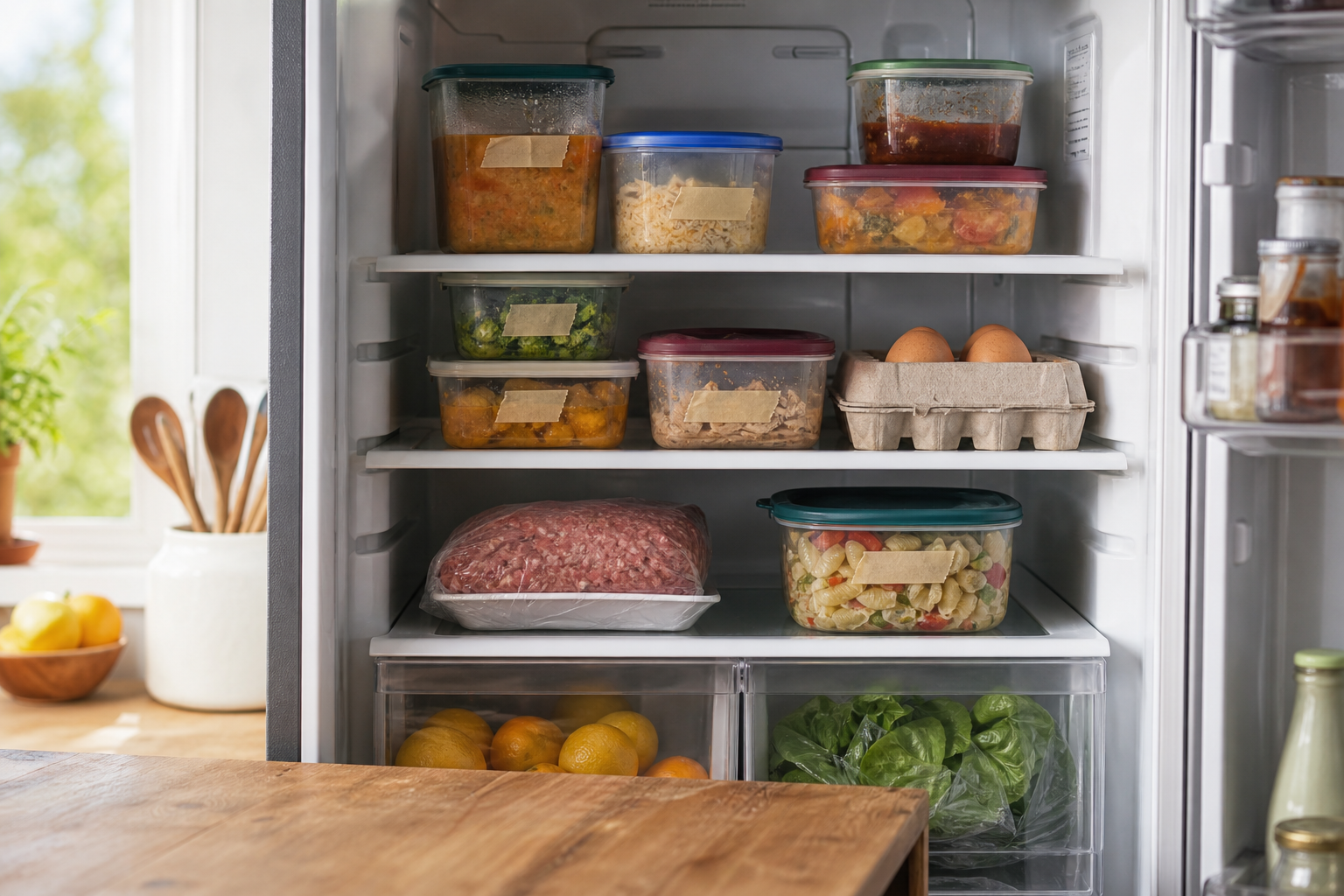
The cold storage chart is short on purpose. Its refrigerator times are about safety: they keep food from spoiling or becoming dangerous to eat. Its freezer times are about quality only. Food held at 0°F (−18°C) or below stays safe indefinitely; it just tastes worse over time.
The tables below are the FoodSafety.gov chart, last reviewed by the agencies in September 2023, grouped the way you shop. Times assume a refrigerator at 40°F (4°C) or below and a freezer at 0°F or below. Check both with an appliance thermometer.
Meat and poultry
Raw and cured meat, per the federal cold storage chart
| Food | Fridge | Freezer |
|---|---|---|
| Ground beef, turkey, chicken, pork, veal, lamb, raw | 1 to 2 days | 3 to 4 months |
| Sausage, raw, any meat | 1 to 2 days | 1 to 2 months |
| Chicken or turkey, pieces, raw | 1 to 2 days | 9 months |
| Chicken or turkey, whole, raw | 1 to 2 days | 1 year |
| Steaks, chops and roasts: beef, veal, lamb, pork, raw | 3 to 5 days | 4 to 12 months |
| Ham, fresh, uncured, raw | 3 to 5 days | 6 months |
| Ham, cured, cook-before-eating | 5 to 7 days or use-by date | 3 to 4 months |
| Bacon | 1 week | 1 month |
| Sausage, fully cooked | 1 week | 1 to 2 months |
| Hot dogs, opened | 1 week | 1 to 2 months |
| Hot dogs, unopened | 2 weeks | 1 to 2 months |
| Lunch meat, opened or deli sliced | 3 to 5 days | 1 to 2 months |
| Lunch meat, unopened | 2 weeks | 1 to 2 months |
| Ham, cooked, slices, half or spiral cut | 3 to 5 days | 1 to 2 months |
| Ham, cooked, whole, store-wrapped | 1 week | 1 to 2 months |
| Ham, fully cooked, vacuum-sealed, unopened | 2 weeks or use-by date | 1 to 2 months |
Fish and shellfish
Fish and shellfish, per the federal cold storage chart
| Food | Fridge | Freezer |
|---|---|---|
| Live crab or lobster | 1 day | Not recommended |
| Fatty fish: salmon, tuna, catfish, mackerel | 1 to 3 days | 2 to 3 months |
| Lean fish: cod, flounder, haddock, halibut, sole | 1 to 3 days | 6 to 8 months |
| Lean fish: pollock, ocean perch, rockfish, sea trout | 1 to 3 days | 4 to 8 months |
| Squid | 1 to 3 days | 6 to 18 months |
| Fresh crab meat or lobster | 2 to 4 days | 2 to 4 months |
| Shrimp and crayfish | 3 to 5 days | 6 to 18 months |
| Shucked clams, mussels, oysters, scallops | 3 to 10 days | 3 to 4 months |
| Live clams, mussels, oysters, scallops | 5 to 10 days | Not recommended |
Eggs
Eggs and egg dishes, per the federal cold storage chart
| Food | Fridge | Freezer |
|---|---|---|
| Raw eggs in the shell | 3 to 5 weeks | Do not freeze in the shell |
| Raw whites and yolks | 2 to 4 days | 12 months; yolks do not freeze well |
| Hard-cooked eggs | 1 week | Do not freeze |
| Liquid egg substitute, opened | 3 days | Do not freeze |
| Liquid egg substitute, unopened | 1 week | Do not freeze |
| Casseroles with eggs, baked | 3 to 4 days | 2 to 3 months |
| Quiche, baked | 3 to 5 days | 2 to 3 months |
| Pumpkin or pecan pie, baked | 3 to 4 days | 1 to 2 months |
| Custard or chiffon pie, baked | 3 to 4 days | Do not freeze |
| Eggnog, commercial | 3 to 5 days | 6 months |
Leftovers and prepared food
Leftovers and deli food, per the federal cold storage chart
| Food | Fridge | Freezer |
|---|---|---|
| Egg, chicken, ham, tuna and macaroni salads | 3 to 4 days | Does not freeze well |
| Cooked meat or poultry | 3 to 4 days | 2 to 6 months |
| Chicken nuggets or patties | 3 to 4 days | 1 to 3 months |
| Pizza | 3 to 4 days | 1 to 2 months |
| Soups and stews, with vegetables or meat | 3 to 4 days | 2 to 3 months |
How to use the chart
- Start the count when the food is cooked or opened. For raw meat, start it when you get home from the store.
- Label and date containers. Four days is easy to lose track of by Friday.
- Freeze inside the fridge window. Move food to the freezer before its fridge time runs out, not after.
- Thaw one of three ways. FSIS lists the refrigerator, cold water and the microwave. Food thawed in cold water or the microwave should be cooked right away.
- Refreezing is allowed in one case. Food thawed in the refrigerator can go back in the freezer without cooking, with some loss of quality.
Why the freezer column is about quality
Freezing at 0°F stops bacteria from growing; it does not kill them. Held frozen, food stays safe. What changes is moisture and texture. Fatty fish keeps 2 to 3 months before the flavor turns, lean fish 6 to 8. Whole birds keep a year. Freezer burn, the dry gray patches on badly wrapped food, is a quality problem, not a safety one.
What the chart says
- Ground and raw poultry are the shortest. 1 to 2 days in the fridge for ground meat, raw sausage and raw chicken or turkey, whole or in pieces.
- Whole cuts last longer than ground. Steaks, chops and roasts get 3 to 5 days. Grinding is what shortens it.
- Cooked food has one window. Leftover meat, soup, pizza and deli salads all get 3 to 4 days.
- Unopened is not forever. Sealed hot dogs and lunch meat get 2 weeks. Once opened or sliced at the counter, lunch meat drops to 3 to 5 days.
- Eggs are the long one. 3 to 5 weeks in the shell. Hard-cooked, 1 week.
- Freezer times run from 1 month to 18 months, and none of them are a safety limit.
The cons of a storage chart
- The clock starts when the food is cold. FSIS says to refrigerate perishable food within 2 hours, or 1 hour when it is above 90°F outside. Time on the counter counts against you.
- Fridge temperature is an assumption. A fridge at 45°F shortens every line. The chart does not adjust for that.
- Dates on packages are not the chart. Use-by, sell-by and best-by dates are set by the maker. The chart gives the federal guidance after you open or buy.
- Smell is not a test. Bacteria that cause illness do not always change how food looks or smells.
Reheat leftovers to 165°F; the full temperature list is in the cooking temperature table. A five-container week, planned around the 3 to 4 day window, is in meal prep for five days. Store-cooked chicken is in the rotisserie chicken file, and sliced meats by sodium in deli meat by sodium.
Every lookup table is filed on the Reference desk.