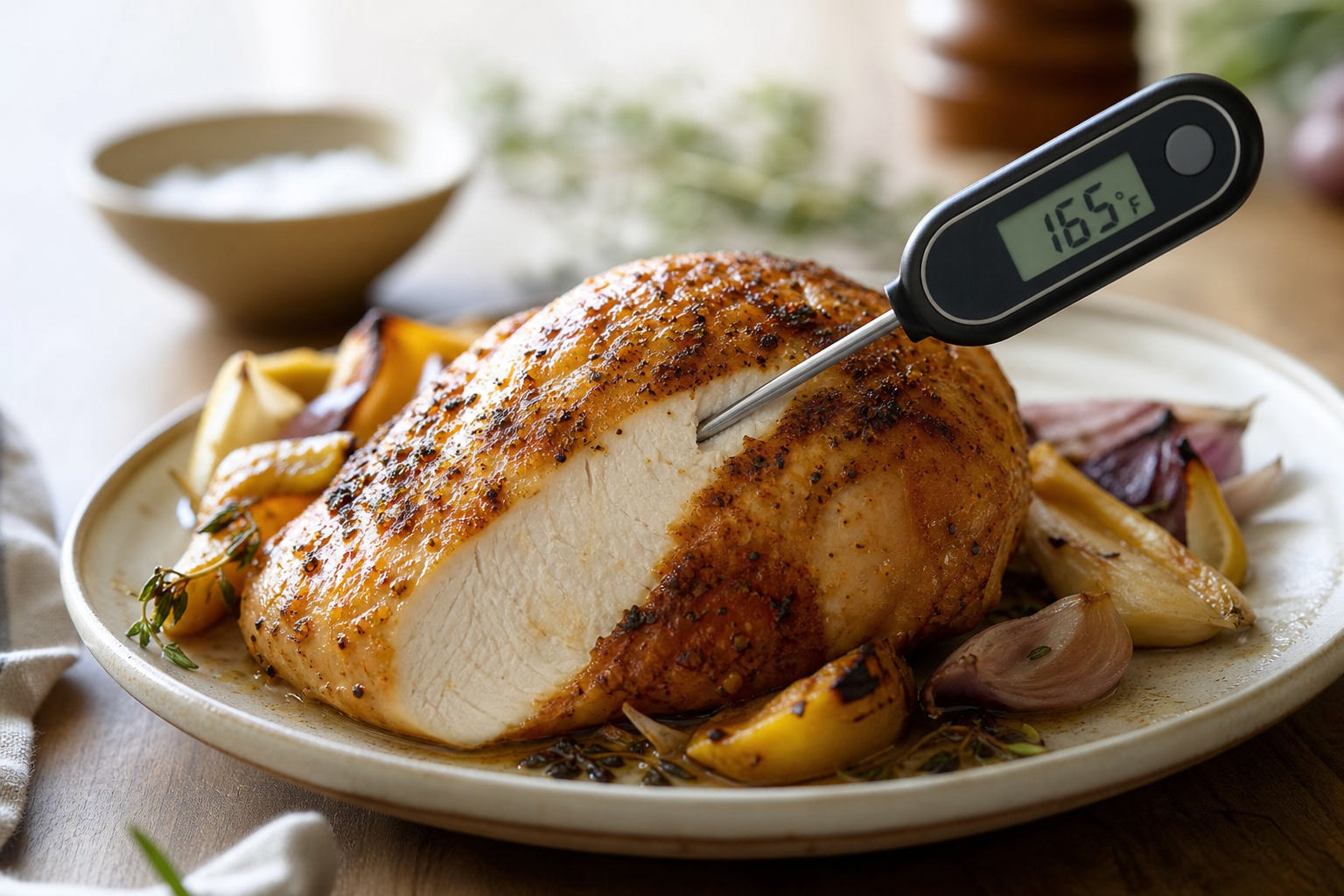
Three numbers cover almost everything on the federal chart: 145°F, 160°F and 165°F. The table below is the FoodSafety.gov chart, last reviewed by the agencies in November 2024, with Celsius next to each line. Temperatures are the minimum internal temperature of the food, read with a food thermometer, not the oven setting.
Why three numbers
The chart is built around where bacteria live. On a whole steak or chop, they sit on the surface, and the surface gets far hotter than the center. Grinding moves the surface inside, so ground meat needs a higher center temperature. Poultry gets one high number for every cut. Anything reheated, mixed or held, from leftovers to casseroles, gets the poultry number too.
Safe minimum internal temperatures
Safe minimum internal temperatures, per the federal chart
| Food | Minimum | Celsius | Rest |
|---|---|---|---|
| Beef, bison, veal, goat, lamb: steaks, roasts, chops | 145°F | 63°C | 3 minutes |
| Pork: steaks, roasts, chops | 145°F | 63°C | 3 minutes |
| Raw ham | 145°F | 63°C | 3 minutes |
| Fish, whole or fillet | 145°F | 63°C | none |
| Ground beef, pork, veal, lamb and sausage | 160°F | 71°C | none |
| Egg dishes, such as frittata or quiche | 160°F | 71°C | none |
| Rabbit and venison, wild or farm-raised | 160°F | 71°C | none |
| Chicken, turkey and other poultry, every cut, ground and stuffing | 165°F | 74°C | none |
| Casseroles, with or without meat | 165°F | 74°C | none |
| Leftovers, any type | 165°F | 74°C | none |
| Precooked ham, reheated | 165°F | 74°C | none |
One exception on the ham line: cooked ham packaged in a USDA-inspected plant only needs reheating to 140°F (60°C).
When the chart uses a cue instead of a number
Doneness cues on the federal chart
| Food | Cook until |
|---|---|
| Fish, if you have no thermometer | The flesh is no longer translucent and separates easily with a fork |
| Shrimp, lobster, crab and scallops | The flesh is pearly or white, and opaque |
| Clams, oysters and mussels | The shells open during cooking |
| Raw eggs, cooked alone | The yolk and white are firm |
Holding and storage temperatures
Temperatures for keeping food, per USDA FSIS
| Setting | Fahrenheit | Celsius | Note |
|---|---|---|---|
| Refrigerator | 40°F or below | 4°C or below | Check with an appliance thermometer |
| Freezer | 0°F or below | −18°C or below | Safe indefinitely; quality drops over time |
| Danger zone | 40 to 140°F | 4 to 60°C | Bacteria can double in as little as 20 minutes |
| Hot holding | 140°F or above | 60°C or above | Chafing dish, slow cooker, warming tray |
| Out of the fridge | 2 hours | — | 1 hour when the air is above 90°F (32°C) |
Oven dial, °F to °C
US ovens are marked in °F. °C = (°F − 32) × 5 ÷ 9, rounded to the nearest degree.
Common oven settings converted
| Oven setting | Celsius |
|---|---|
| 250°F | 121°C |
| 300°F | 149°C |
| 325°F | 163°C |
| 350°F | 177°C |
| 375°F | 191°C |
| 400°F | 204°C |
| 425°F | 218°C |
| 450°F | 232°C |
| 500°F | 260°C |
How to take the reading
- Use a food thermometer. FSIS’s position is that you cannot tell whether meat is safely cooked by looking at it.
- Go to the thickest part. Keep the tip away from bone, fat and gristle.
- Check a whole bird in three places. FSIS names the innermost part of the thigh, the innermost part of the wing and the thickest part of the breast.
- Slide into thin cuts from the side. A burger or chop read from the top puts the tip in the pan.
- Read near the end of cooking, then rest. Whole cuts at 145°F need the 3 minutes before you cut.
- Wash the probe between readings. A probe that touched raw meat carries it.
What the chart says
- Whole muscle is 145°F with a rest. Beef, pork, lamb, veal and raw ham all share the line. The 3-minute rest is part of the rule: the inside keeps climbing and the heat keeps working.
- Grinding raises the number to 160°F. Same animal, different structure. Surface bacteria end up inside.
- Poultry has one number for every cut. 165°F for breast, thigh, wing, ground and stuffing.
- Reheating also has a number. Leftovers and casseroles go back to 165°F.
The cons of a temperature chart
- It is a minimum, not a recipe. Many cooks take thighs and braises well past 165°F on purpose. The chart only sets the floor.
- Placement decides the reading. FSIS says to measure the thickest part, away from bone, fat and gristle. A probe in the wrong spot reads high.
- Overshooting costs weight. Roasted chicken breast keeps about 73% of its raw weight at USDA values, and drier meat weighs less on your scale. The math is in raw to cooked weights.
- Thermometers drift. A probe that reads 2 or 3 degrees off moves you across a line. Check it in ice water, which should read 32°F.
Storage times after cooking are in fridge and freezer times. A store-cooked bird, priced per 100 g of meat, is in the rotisserie chicken file. Terms used here, such as yield and as-prepared, are defined in the calorie tracking glossary.
Every lookup table is filed on the Reference desk.