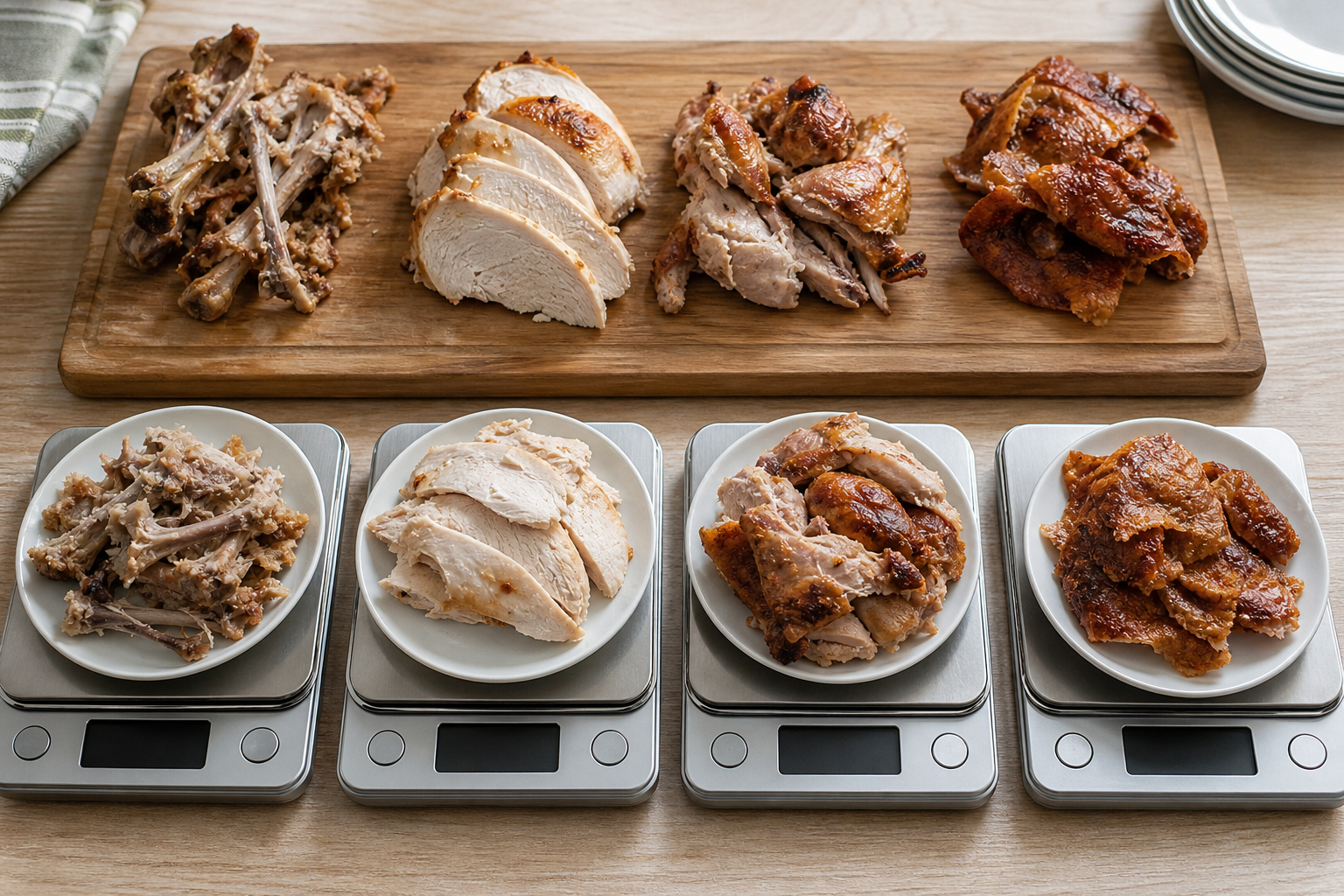
A rotisserie chicken has one price and no serving size. To compare it with anything else, you need two numbers the label does not give you: how many grams of meat come off the bone, and what each gram costs.
The yield
USDA publishes yield factors for roasted chicken. One pound of raw, ready-to-cook chicken gives:
- 178 g of cooked meat and skin, off the bone.
- 146 g of cooked meat without skin.
Rotisserie packages print a cooked weight, when they print one at all, not a raw weight. So the math below starts from a bird that went in at 3 lb raw, a common size. Scale it to yours.
A 3 lb raw bird, roasted, by USDA yield factors
| Part | Weight |
|---|---|
| Meat and skin | 534 g |
| Meat only | 438 g |
| Skin | 96 g |
The rest of the starting weight is bone, cartilage, fat rendered into the pan and water lost in the oven.
The price
Cost per 100 g of meat, 3 lb raw bird, 438 g of meat without skin
| Bird | Price | Per 100 g of meat | Per lb of meat |
|---|---|---|---|
| Rotisserie | $4.99 | $1.14 | $5.17 |
| Raw whole chicken, BLS average | $6.18 | $1.41 | $6.40 |
| Rotisserie | $6.99 | $1.60 | $7.24 |
| Rotisserie | $8.99 | $2.05 | $9.31 |
The raw row uses the BLS US city average for whole fresh chicken, May 2025: $2.061 per lb, times 3 lb. It does not count oven energy or your time.
What the price table says
- A $4.99 bird is cheaper than raw. $1.14 against $1.41 per 100 g of meat.
- The break-even is about $6.18. Above that, a raw bird at the national average costs less per gram of meat.
- At $8.99, meat costs $9.31 a pound. That is still a whole bird; the comparison you care about is the next-cheapest cooked protein in your store.
Per dinner portion
At 4 oz (113 g) of meat per plate, 438 g is just under four portions.
- At $4.99: about $1.29 a portion.
- At $6.99: about $1.81 a portion.
- At $8.99: about $2.32 a portion.
A 4 oz portion of rotisserie breast meat is about 155 kcal, 32 g of protein and 354 mg of sodium at USDA values. Dark meat adds calories and keeps the sodium about the same.
What 3 oz carries
Rotisserie against home-roasted, per 3 oz (85 g), USDA reference values
| Part | Rotisserie kcal | Rotisserie protein | Rotisserie sodium | Home-roasted kcal | Home-roasted sodium |
|---|---|---|---|---|---|
| Breast, meat only | 116 | 23.8 g | 266 mg | 140 | 63 mg |
| Breast, meat and skin | 156 | 23.4 g | 295 mg | 167 | 60 mg |
| Drumstick, meat only | 150 | 24.4 g | 354 mg | 132 | 109 mg |
| Thigh, meat only | 167 | 20.5 g | 286 mg | 152 | 90 mg |
| Thigh, meat and skin | 198 | 19.5 g | 293 mg | 197 | 87 mg |
| Wing, meat and skin | 226 | 20.7 g | 518 mg | 216 | 83 mg |
| Skin only | 345 | 15.0 g | 324 mg | 386 | 55 mg |
What the nutrition table says
- Sodium is the gap. Rotisserie breast meat carries 313 mg per 100 g against 74 mg home-roasted, about four times. Wings are the saltiest cut at 518 mg per 3 oz.
- Rotisserie breast is a little lower in calories per gram. 137 against 165 kcal per 100 g. That pattern fits a bird seasoned with a salt solution: more water in the meat. The ingredient line on the package says what was added.
- Breast meat is the protein cut. About 20 g of protein per 100 kcal for rotisserie breast without skin.
- The skin is a third of the bird’s edible calories. 96 g of skin at the rotisserie value is about 390 kcal. The 438 g of meat is roughly 700 to 830 kcal depending on the mix of white and dark.
The cons, by option
- Rotisserie, $4.99. Cheapest meat here, highest sodium. You do not choose the seasoning.
- Rotisserie, $6.99 and up. Costs more per gram than raw at the BLS average.
- Raw whole chicken. About an hour of oven time and the cleanup.
- Breast, meat only. Least fat, but on a rotisserie bird still 266 mg of sodium per 3 oz.
- Thigh and drumstick. More calories per 3 oz than breast.
- Wing. Most sodium per 3 oz.
- Skin. About 390 kcal on a 3 lb bird.
Storage
FSIS advises refrigerating cooked leftovers within 2 hours and using them within 3 to 4 days, or freezing them. A bird bought warm at 5 pm and pulled apart that night has a clock on it. If you will not finish 438 g of meat in four days, freeze half the day you buy it.
How to do the math on your bird
- Weigh the meat once, without skin, after you pull it.
- Divide the price by that weight in grams, times 100. That is your cost per 100 g.
- Check the ingredient line for “solution” or sodium phosphate. Then read the sodium on the label, if the store prints one.
All figures are estimates from USDA reference values and yield factors. Birds vary in size and in how they are seasoned.
Related files
Pulled rotisserie meat is the alternative to sliced deli turkey; the sodium comparison is in deli meat by sodium. For a wrap, the tortilla file runs 30 to 360 kcal a tortilla. On a salad, the dressing can outweigh the chicken; see salad dressing per tablespoon. If dinner is a tray instead, frozen dinners under 500 kcal ranks them by protein.
All shelf comparisons are on the Grocery desk.