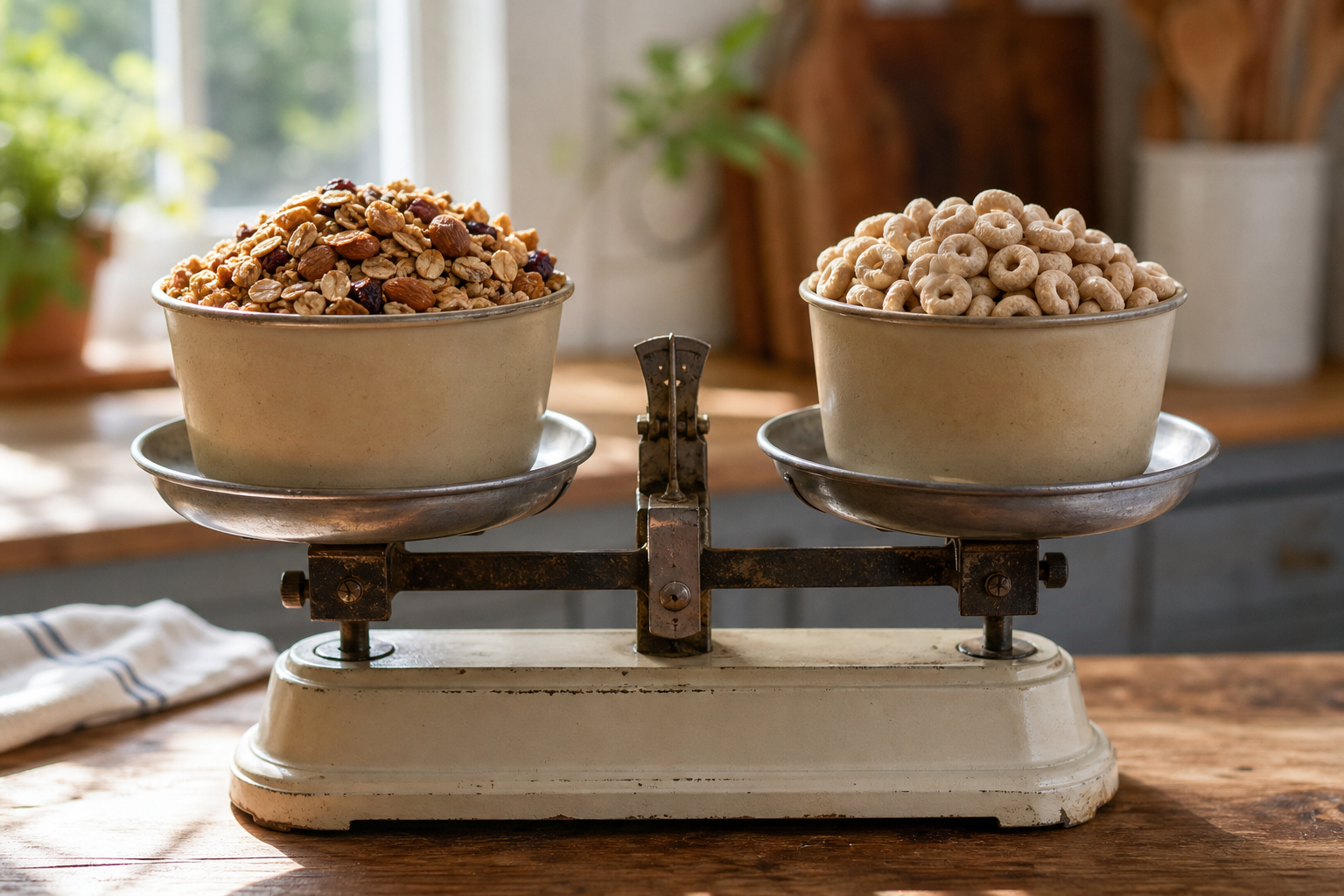
Granola does not have a calorie problem per gram. It has one per spoonful. USDA lists a mainstream oat-and-honey granola at 421 kcal per 100 g and toasted oat rings at 372. That is a 13% gap. A level cup of the granola weighs 96 g. A level cup of the rings weighs 28 g. Per cup, the granola carries nearly four times the calories.
Per cup and per gram
Granolas against flakes and rings, USDA reference values, per level cup
| Cereal | Cup weight | kcal per cup | kcal per 100 g | Sugar per cup | Fat per cup |
|---|---|---|---|---|---|
| Granola, homemade recipe | 122 g | 597 kcal | 489 kcal | 24.2 g | 29.7 g |
| Grape-Nuts | 116 g | 419 kcal | 361 kcal | 10.3 g | 2.1 g |
| Granola, Quaker 100% Natural | 96 g | 404 kcal | 421 kcal | 19.5 g | 11.2 g |
| Granola, Nature’s Path Pumpkin Flax | 73 g | 342 kcal | 467 kcal | 13.3 g | 13.4 g |
| Granola, Quaker Low Fat, raisins | 83 g | 323 kcal | 388 kcal | 21.4 g | 4.6 g |
| Raisin Bran, Post | 59 g | 191 kcal | 324 kcal | 19.4 g | 0.9 g |
| Shredded Wheat, spoon-size | 49 g | 172 kcal | 351 kcal | 0.4 g | 1.0 g |
| Corn flakes | 28 g | 108 kcal | 384 kcal | 2.2 g | 0.3 g |
| Cheerios | 28 g | 104 kcal | 372 kcal | 1.3 g | 1.8 g |
Cup weights are USDA portion weights, scaled to one cup where USDA lists a half or three-quarter cup. Brand rows are USDA records; recipes change, so read the bag in your hand.
Why the cup lies
Granola is baked in clusters. Oats are bound with sugar, honey or syrup and oil, then broken up. Clusters pack a measuring cup. Flakes and rings are mostly air.
- The homemade recipe in USDA’s data weighs 122 g a cup: more than four cups of oat rings by weight.
- Grape-Nuts is the outlier that is not granola. It is low in fat, but 116 g a cup puts it at 419 kcal.
- The low-fat granola saves 81 kcal a cup against the regular, mostly by cutting fat. It carries more sugar per 100 g: 25.7 g against 20.3 g.
The halo words, and what they bind
Front-of-bag terms and what FDA requires
| Word on the bag | What it requires |
|---|---|
| Natural | No formal FDA definition. Policy: nothing artificial or synthetic added that you would not expect in the food. |
| Good source of fiber | At least 2.8 g per reference amount, 10% of the 28 g Daily Value. |
| High fiber | At least 5.6 g per reference amount, and fat disclosed if the food is not low-fat. |
| Whole grain | No defined minimum share on the front of the bag. Check where whole grains fall in the ingredient list. |
| Made with real honey | Honey is an added sugar on the label, like cane sugar. |
None of these terms limits calories. Several granolas earn a fiber claim honestly. USDA’s values give 5.0 to 6.1 g of fiber per 60 g for the granolas above. The same 60 g carries 233 to 293 kcal.
The reference amount
FDA’s reference amount for ready-to-eat cereal weighing 43 g or more per cup is 60 g. For cereal weighing 20 to 43 g a cup it is 40 g. So a granola label is built around about 60 g, about half to three-quarters of a cup depending on clusters, while an oat-ring label is built around 40 g. Neither is your bowl.
The cons, ranked from heaviest cup
- Homemade-style granola. 597 kcal and nearly 30 g of fat a cup. Fat comes from oil and nuts.
- Grape-Nuts. Lowest fat of the heavy cereals, but dense: 419 kcal a cup.
- Quaker 100% Natural. 19.5 g of sugar a cup. Most of it is added.
- Nature’s Path Pumpkin Flax. Lightest granola per cup here, still 342 kcal. Highest fat per 100 g of the brand rows.
- Quaker Low Fat. Lower fat, higher sugar.
- Raisin Bran. 19.4 g of sugar a cup, part from raisins and part added.
- Shredded Wheat. Almost no sugar. If you add a teaspoon of sugar, that is 4 g and 16 kcal.
- Corn flakes and Cheerios. Lightest per cup. Lowest protein per cup: 1.7 and 3.5 g. You may pour two cups.
How to keep granola and know the number
- Use it as a topping, not a base. A quarter cup of the oat-and-honey granola is about 101 kcal. A quarter cup of the homemade style is about 149.
- Weigh your pour once. Fill your usual bowl, tip it onto a scale, multiply by the kcal per gram from the bag.
- Compare per 100 g on the shelf. Under 400 kcal per 100 g is a lean granola. Over 470 is nut-and-oil heavy.
One breakfast, totaled two ways
Same bowl, same yogurt, same fruit. Only the granola pour changes.
- 170 g plain nonfat Greek yogurt, half a cup of the oat-and-honey granola, half a cup of blueberries: about 100 + 202 + 42 = 344 kcal.
- The same yogurt and fruit with a full cup of homemade-style granola: about 100 + 597 + 42 = 739 kcal.
The difference is 395 kcal, all of it in the scoop.
All figures are estimates from USDA reference values. Your bag can differ by 10% or more.
Related files
Granola usually lands on yogurt. Which yogurt carries the most protein for its calories is in the yogurt ranking. For boxes ranked by sugar per 100 g instead of per cup, see the cereal sugar file. Granola pressed into a bar is a different label problem, covered in granola bars against cereal bars.
All shelf comparisons are on the Grocery desk.