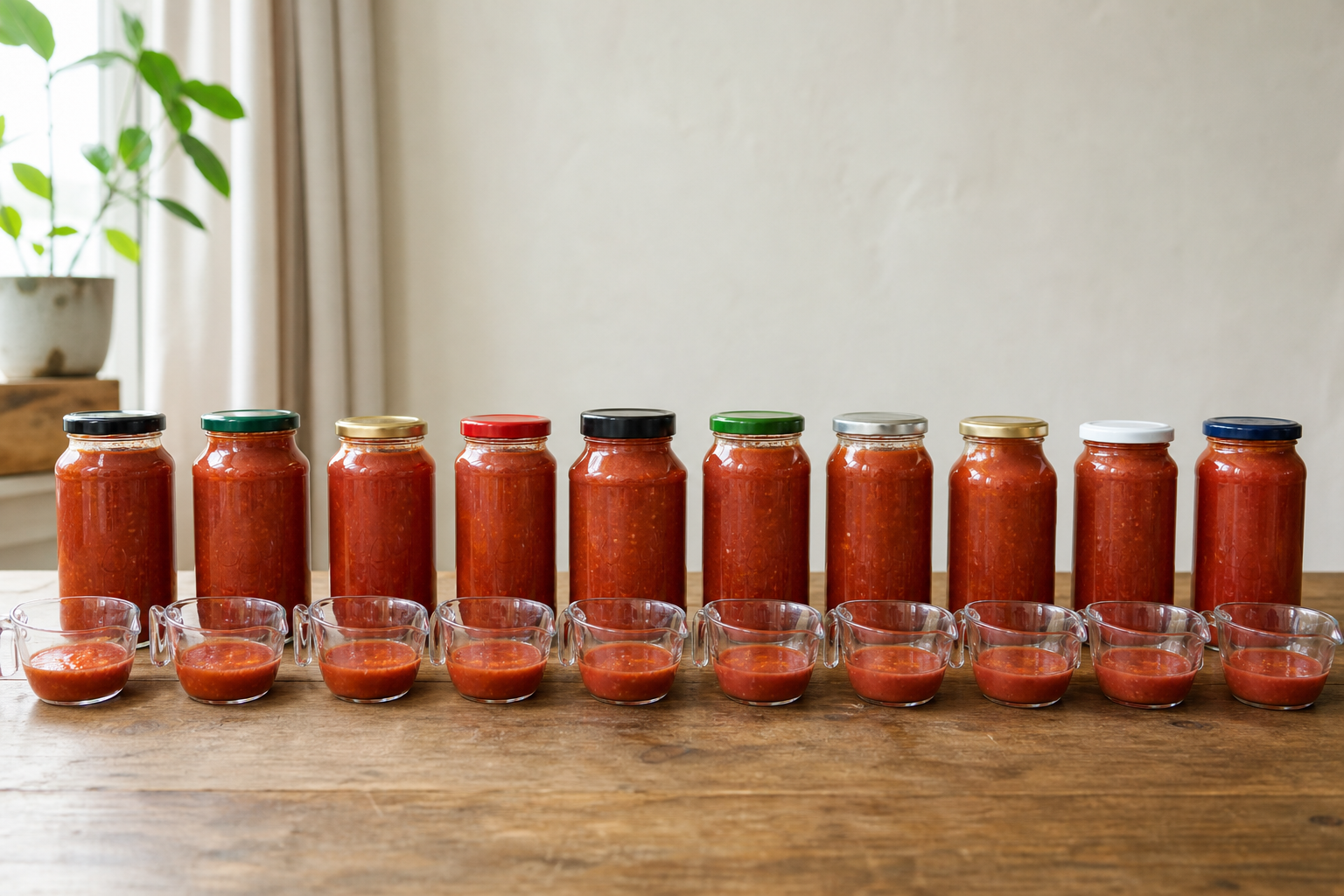
The sugar line on a jar of tomato sauce has two numbers. Total Sugars includes the tomatoes. Includes Added Sugars is the part the maker put in. Since FDA’s label update, the second one is printed separately, so you no longer have to guess from the ingredient list.
FDA’s reference amount for a major main-dish sauce, spaghetti sauce included, is 125 g, about half a cup. Every figure here is per half cup.
What the filed labels show
We read the label data that makers filed with USDA’s Branded Foods database, through mid-June 2025, for products named marinara or traditional pasta sauce. Dishes and specialty sauces, meat, vodka, alfredo and pesto, were excluded. Not every record includes an added-sugars value; older records often do not.
Pasta sauce label records, USDA Branded Foods, per half cup
| Group | Records | List added sugars | List 0 g added | Highest added | Typical total sugar | Typical sodium |
|---|---|---|---|---|---|---|
| Marinara | 169 | 55 | 26 | 4 g | 5 g | 450 mg |
| Traditional pasta sauce | 109 | 59 | 4 | 4 g | 7 g | 470 mg |
“Typical” is the median record. Records are labels, not jars; one product can appear more than once across sizes.
What the table says
- Marinara is the lower-sugar style. Nearly half of the marinara records with an added-sugars value print 0 g. Only 4 of 59 traditional-sauce records do.
- The ceiling is low. No record in either group passes 4 g of added sugar per half cup. That is 8% of the 50 g Daily Value.
- Traditional sauce adds a little. Among traditional records that do add sugar, the median is about 3 g per half cup.
- Total sugar is mostly tomato. About 5 g per half cup for a typical marinara. In a 0 g-added jar, all of it is from the tomatoes and vegetables.
- Sodium is the larger number. About 450 mg per half cup, 20% of the Daily Value, before the pasta water or the cheese.
Ten jars, named
Ten pasta sauces, filed label data, per half cup
| Sauce | Record | kcal | Total sugar | Added sugar | Fat | Sodium |
|---|---|---|---|---|---|---|
| Barilla Traditional | Sep 2023 | 45 | 5 g | 0 g | 0.5 g | 430 mg |
| Hunt’s Traditional | Jul 2021 | 45 | 5 g | 2 g | 0 g | 530 mg |
| Classico Traditional Sweet Basil | Nov 2023 | 60 | 8 g | 3 g | 0 g | 480 mg |
| Newman’s Own Marinara | Nov 2023 | 70 | 7 g | 0 g | 1 g | 490 mg |
| Victoria Marinara | Jul 2023 | 70 | 5 g | 0 g | 4 g | 490 mg |
| Ragú Traditional | Oct 2021 | 80 | 8 g | 1 g | 2 g | 480 mg |
| Carbone Marinara | Jul 2023 | 90 | 5 g | 0 g | 7 g | 410 mg |
| Rao’s Homemade Marinara | Nov 2023 | 100 | 4 g | 0 g | 7 g | 420 mg |
| Ragú Kettle Cooked Marinara | Nov 2023 | 100 | 6 g | 0 g | 6 g | 490 mg |
| Bertolli Marinara d’Italia | Jul 2023 | 120 | 5 g | 0 g | 8 g | 500 mg |
Per-half-cup figures are computed from each record’s per-100 g values at its stated serving weight, and rounded the way a label rounds. Recipes change; the jar wins.
What the second table says
- Calories track oil, not sugar. The 0 g-added marinaras with olive oil, Carbone, Rao’s and Bertolli, are 90 to 120 kcal. The low-fat traditional sauces are 45.
- The two Ragú sauces split. Traditional adds about 1 g of sugar. Kettle Cooked Marinara adds none, and carries 20 more kcal and 4 g more fat.
- Classico Sweet Basil has the most added sugar here. 3 g per half cup.
- Sodium sits in a tight band. 410 to 530 mg, whichever jar you pick.
The cons, by jar
- Barilla Traditional. Lowest calories. 430 mg of sodium.
- Hunt’s Traditional. Most sodium here: 530 mg. 2 g of added sugar.
- Classico Sweet Basil. 3 g of added sugar, 8 g total.
- Newman’s Own Marinara. 7 g of total sugar, all from the vegetables per the record.
- Victoria Marinara. 490 mg of sodium.
- Ragú Traditional. 8 g of total sugar.
- Carbone and Rao’s. 7 g of fat per half cup, from the olive oil in the recipe.
- Ragú Kettle Cooked. 6 g of fat, 490 mg of sodium.
- Bertolli Marinara d’Italia. Most calories and fat: 120 kcal, 8 g.
The plate
Two ounces of dry pasta, about a cup cooked, is about 210 kcal at USDA values. Add a half cup of a 100 kcal marinara and two tablespoons of grated Parmesan, about 42 kcal: about 350 kcal. If your plate takes a full cup of sauce, the sauce line doubles: 200 kcal and, at Rao’s values, about 840 mg of sodium.
How to read the jar
- Find Includes Added Sugars. Marinara at 0 to 2 g is normal.
- Read sodium. Under 400 mg per half cup is the low end.
- Read calories. Over 90 per half cup means oil.
- Ignore “no sugar added” on the front if you have the panel. The panel is more precise.
All figures are estimates from filed label data. Labels round.
Related files
Frozen pasta meals carry the sauce’s sodium into the tray; see frozen dinners under 500 kcal. The cheese on top is ranked in cheese per 30 g. Sauces that are mostly oil, dressings, follow the same rule in salad dressing per tablespoon.
All shelf comparisons are on the Grocery desk.