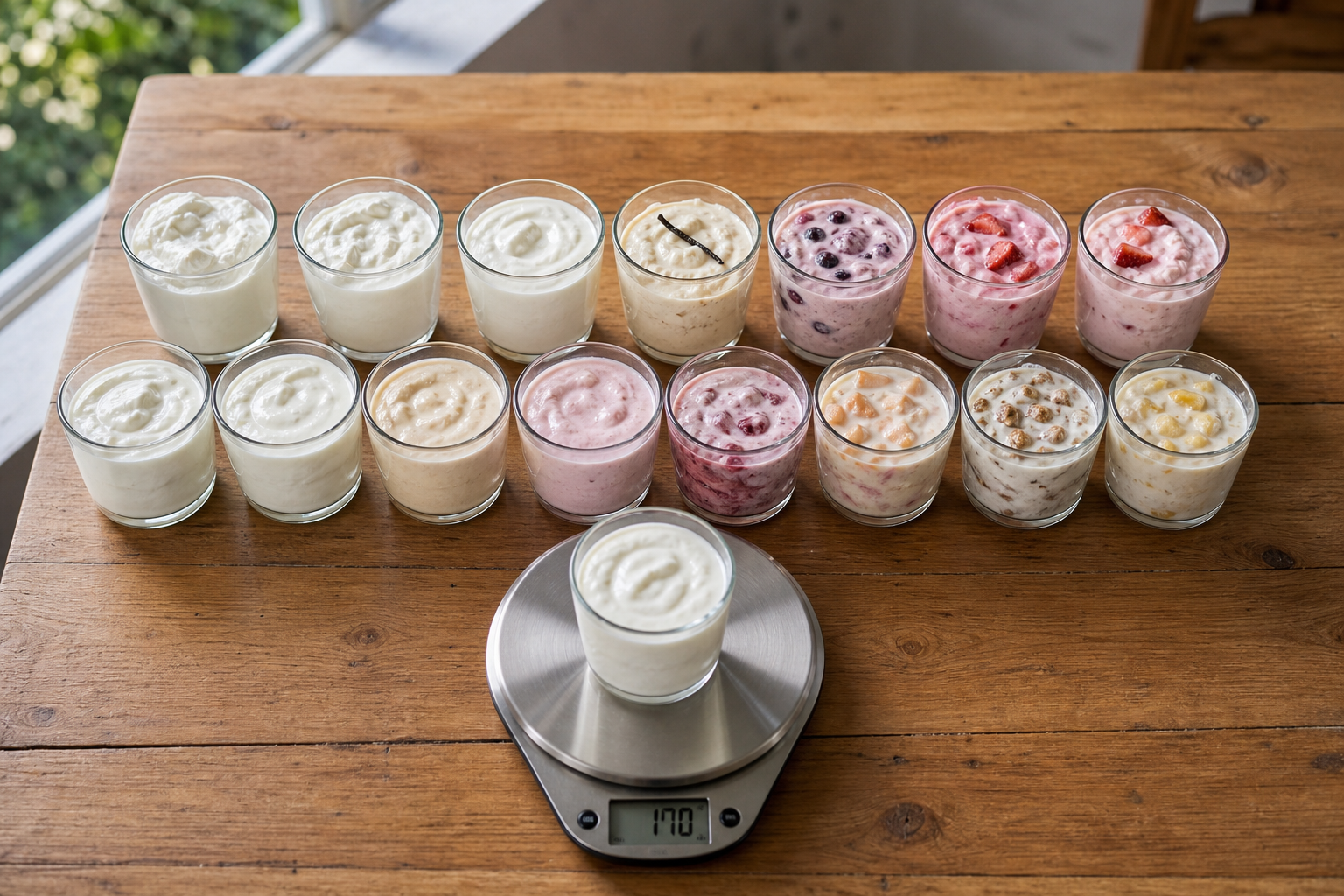
The cup sizes do not line up. A single Greek cup is often 150 g, a regular cup 170 g, a tub 907 g. Protein per serving rewards the bigger serving. So divide instead: grams of protein for every 100 kcal. That number ignores the cup.
The ranking
All rows are USDA reference values, scaled to 170 g, FDA’s reference amount for yogurt.
14 cultured dairy and soy cups, ranked by grams of protein per 100 kcal
| Product | Protein, g per 100 kcal | kcal per 170 g | Protein per 170 g | Sugar per 170 g |
|---|---|---|---|---|
| Greek, plain, nonfat | 17.3 | 100 kcal | 17.3 g | 5.5 g |
| Greek, plain, low-fat | 13.6 | 124 kcal | 16.9 g | 6.1 g |
| Cottage cheese, 2% | 12.9 | 138 kcal | 17.8 g | 6.8 g |
| Greek, vanilla, nonfat | 11.1 | 133 kcal | 14.7 g | 16.2 g |
| Plain, skim | 10.2 | 95 kcal | 9.7 g | 13.1 g |
| Greek, strawberry, nonfat | 9.8 | 139 kcal | 13.7 g | 19.2 g |
| Greek, plain, whole milk | 9.3 | 165 kcal | 15.3 g | 6.8 g |
| Kefir, low-fat, plain | 8.8 | 73 kcal | 6.4 g | 7.8 g |
| Plain, low-fat | 8.3 | 107 kcal | 8.9 g | 12.0 g |
| Greek, fruit, whole milk | 6.9 | 180 kcal | 12.5 g | 20.4 g |
| Plain, whole milk | 5.7 | 104 kcal | 5.9 g | 7.9 g |
| Fruit, nonfat | 4.6 | 162 kcal | 7.5 g | 32.3 g |
| Fruit, low-fat | 4.3 | 173 kcal | 7.4 g | 32.4 g |
| Soy yogurt, plain | 4.0 | 112 kcal | 4.5 g | 9.0 g |
Cottage cheese and kefir are there for comparison. FDA’s reference amount for cottage cheese is 110 g, and kefir is usually poured by the cup. Scaling both to 170 g keeps the columns honest against each other.
What the table says
- Straining is the gap. Greek yogurt is strained, which removes whey and much of the lactose with it. Plain nonfat Greek carries 10.2 g of protein and 3.2 g of sugar per 100 g. Plain skim carries 5.7 g and 7.7 g.
- Fat moves the ratio, not the protein. Plain Greek drops from 17.3 to 13.6 to 9.3 g per 100 kcal as you go from nonfat to low-fat to whole milk. The protein per cup barely changes: 17.3, 16.9, 15.3 g. The calories rise from 100 to 165.
- Flavor costs protein density. Vanilla nonfat Greek keeps 11.1 g per 100 kcal. Strawberry nonfat Greek keeps 9.8. Fruit low-fat regular yogurt falls to 4.3.
- Sugar spreads six-fold. 5.5 g in a plain nonfat Greek cup, 32.4 g in a fruit low-fat cup.
- Soy is last on protein. 4.0 g per 100 kcal for plain soy yogurt in USDA’s data. Some newer plant cups add pea or soy protein isolate; read the panel.
The cons, row by row
- Greek, plain, nonfat. The most tart cup here. If you add a tablespoon of honey, about 64 kcal and 17 g of sugar, the ratio drops to roughly 10.5 g per 100 kcal.
- Greek, plain, low-fat and whole milk. More calories for nearly the same protein. The whole-milk cup carries about 4 g of saturated fat in USDA’s data.
- Cottage cheese. Sodium: about 525 mg per 170 g at USDA’s reference value for 2%.
- Greek, vanilla and strawberry. 16 to 19 g of sugar per cup. Part of it is added; the label’s Added Sugars line gives the split.
- Plain, skim and low-fat regular. Half the protein of Greek at similar calories.
- Kefir. Lowest calories and lowest protein per 170 g in the set.
- Fruit cups, nonfat and low-fat. 32 g of sugar per 170 g, about six times a plain nonfat Greek cup. The Added Sugars line shows how much of it was added, against a 50 g Daily Value.
- Soy, plain. Lowest protein density in the set.
How to read the cup in front of you
- Find protein in grams and calories per serving.
- Divide protein by calories and multiply by 100.
- Above 15: strained, nonfat. 8 to 12: strained with fat or flavor, or unstrained plain. Under 6: fruit-sweetened or plant-based.
Then check Added Sugars. Plain yogurt should read 0 g. Any sugar it lists is lactose. FDA requires the Added Sugars line separately for exactly this reason.
What the label does not show
- The style. FDA’s yogurt standard sets a milkfat floor of 3.25% for plain “yogurt”, milk solids not fat of at least 8.25% and a pH of 4.6 or lower. It does not define “Greek”. Two Greek cups can differ by several grams of protein.
- Live cultures. The standard requires the bacterial cultures in fermentation. A count of live cultures at the time you eat it is not on the panel.
- Your scoop. A cereal bowl filled from a 32 oz tub can hold 250 g or more. At plain nonfat Greek values that is about 148 kcal and 25 g of protein. Weigh it once.
All calorie figures are estimates from USDA reference data. Brand labels will differ by a few grams and a few kcal.
Related files
Yogurt is usually half of a breakfast. The other half is often the problem: a quarter cup of granola adds 100 to 150 kcal, covered in the granola file. For the same protein ranking on plant milks, see plant milks by protein. If you are weighing a cup against a wrapped bar, the protein bar ranking uses the same per-100 kcal math.
More label-by-label comparisons are on the Grocery desk.