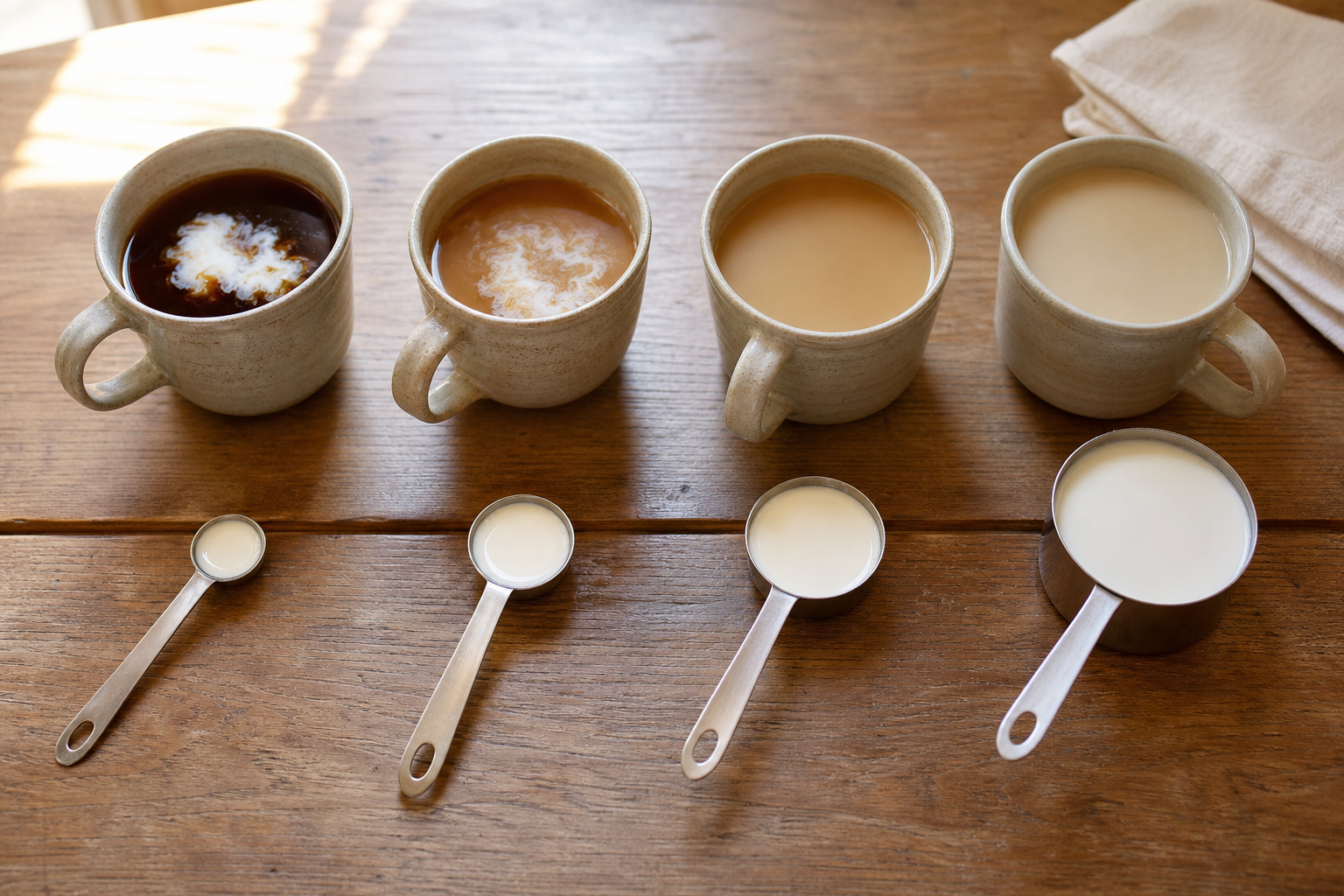
Creamer labels are built on one tablespoon. FDA’s reference amount for fluid cream substitutes is 15 mL. Very few mugs get exactly one. So the label is right, and it describes a smaller pour than most.
There is a second trap. FDA’s reference amount for half-and-half is 30 mL, two tablespoons. So the half-and-half carton prints its calories for twice the amount the creamer bottle prints. Side by side on the shelf, the panels compare 2 tablespoons with 1.
Per tablespoon
Nine coffee additions, per tablespoon, USDA reference values and filed label data
| Addition | kcal | Sugar | Fat |
|---|---|---|---|
| Heavy cream | 51 | 0.4 g | 5.4 g |
| Flavored liquid creamer, USDA generic | 38 | 5.1 g | 2.1 g |
| Flavored liquid creamer, French vanilla | 35 | 5.0 g | 1.5 g |
| Original non-dairy liquid creamer | 20 | 1.7 g | 1.5 g |
| Half-and-half | 20 | 0.6 g | 1.7 g |
| Plant-based creamer, original | 15 | 0 g | 1.0 g |
| Whole milk | 9 | 0.8 g | 0.5 g |
| Fat-free half-and-half | 9 | 0.8 g | 0.2 g |
| 2% milk | 8 | 0.8 g | 0.3 g |
The French vanilla row is label data filed with USDA’s Branded Foods database by Coffee mate, 2021. The plant-based row is USDA’s record for Silk Original Creamer. Other rows are USDA reference values.
What the table says
- Flavored creamer is nearly 80% more than half-and-half per tablespoon. 35 against 20 kcal.
- Its calories are mostly sugar. 5 g of sugar is 20 kcal of the 35. The Coffee mate record lists all 5 g as added.
- Heavy cream is the richest splash. 51 kcal, nearly all fat, almost no sugar.
- Milk is the smallest number. 8 to 9 kcal per tablespoon, whole or 2%.
- Fat-free half-and-half matches whole milk on calories. 9 kcal. It is thickened to keep the texture.
The shelf, side by side
What the three cartons print, and what they mean at the same pour:
Label serving against an equal 2-tablespoon pour
| Carton | Label serving | kcal on the panel | kcal per 2 tbsp |
|---|---|---|---|
| Half-and-half | 2 tbsp | about 40 | about 40 |
| Flavored liquid creamer | 1 tbsp | 35 | 70 |
| Heavy cream | 1 tbsp | about 50 | about 100 |
On the panels, half-and-half looks like the heaviest of the three. At the same pour it is the lightest.
The pour
Calories and sugar by pour, three common additions
| Pour | Flavored creamer | Half-and-half | Heavy cream |
|---|---|---|---|
| 1 tbsp | 35 kcal, 5 g sugar | 20 kcal | 51 kcal |
| 2 tbsp | 70 kcal, 10 g sugar | 39 kcal | 102 kcal |
| 3 tbsp | 105 kcal, 15 g sugar | 59 kcal | 153 kcal |
| 4 tbsp, a quarter cup | 140 kcal, 20 g sugar | 79 kcal | 204 kcal |
A quarter cup of flavored creamer in an iced coffee is 140 kcal and 20 g of added sugar, 40% of the 50 g Daily Value.
Two cups a day, a week
Two mugs a day, three tablespoons of flavored creamer in each, is six tablespoons: about 210 kcal and 30 g of added sugar a day. Over a week that is about 1,470 kcal and 210 g of added sugar. The same habit with half-and-half is about 825 kcal a week and almost no sugar. With 2% milk it is about 320.
Powder
Powdered creamers are labeled by the teaspoon. FDA’s reference amount for powdered cream substitutes is 2 g.
- Original powder. About 10 kcal per 2 g teaspoon at USDA values. A heaped spoon is more than 2 g; weigh one once.
- Flavored powder. A 12 g serving of 4 teaspoons is about 58 kcal and 7 g of sugar at USDA’s value.
What the claims cover
- Zero sugar or sugar free. Under 0.5 g of sugar per reference amount. Nothing about fat or calories.
- Rounding. Calories at or under 50 are rounded to the nearest 5. Fat under 0.5 g can be printed as 0 g. A tablespoon is a small enough serving that rounding is a real share of the number.
- Non-dairy. Not a calorie or sugar claim. Many non-dairy creamers contain a milk-derived protein such as sodium caseinate; the ingredient list says so.
The cons, by addition
- Heavy cream. Most calories per tablespoon. 3.5 g of saturated fat at USDA values.
- Flavored liquid creamers. 5 g of added sugar per tablespoon.
- Original non-dairy liquid. 20 kcal, mostly oil. Not dairy-free by default.
- Half-and-half. Labeled per 2 tablespoons; halve it to compare.
- Plant-based creamer. 15 kcal, mostly oil. Read the oil and the sweetener.
- Whole milk and 2%. Lowest calories here. 0.8 g of sugar per tablespoon, all lactose.
- Fat-free half-and-half. Added thickeners and, in some cartons, sugar. Check the ingredients.
How to know your pour
- Pour your usual amount into a measuring spoon or a shot glass once.
- Multiply by the label’s per-tablespoon figure. A shot glass is about 3 tablespoons.
- Count every mug.
All figures are estimates. Labels round, and creamers change flavors and formulas often.
Related files
If you pour plant milk instead, its protein and sugar are ranked in plant milks by protein. The coffee itself carries about 95 mg of caffeine per 8 fl oz; energy drinks are compared against it in energy drinks by caffeine. Heavy cream is also what the richest ice cream is built on; see ice cream by volume.
All shelf comparisons are on the Grocery desk.