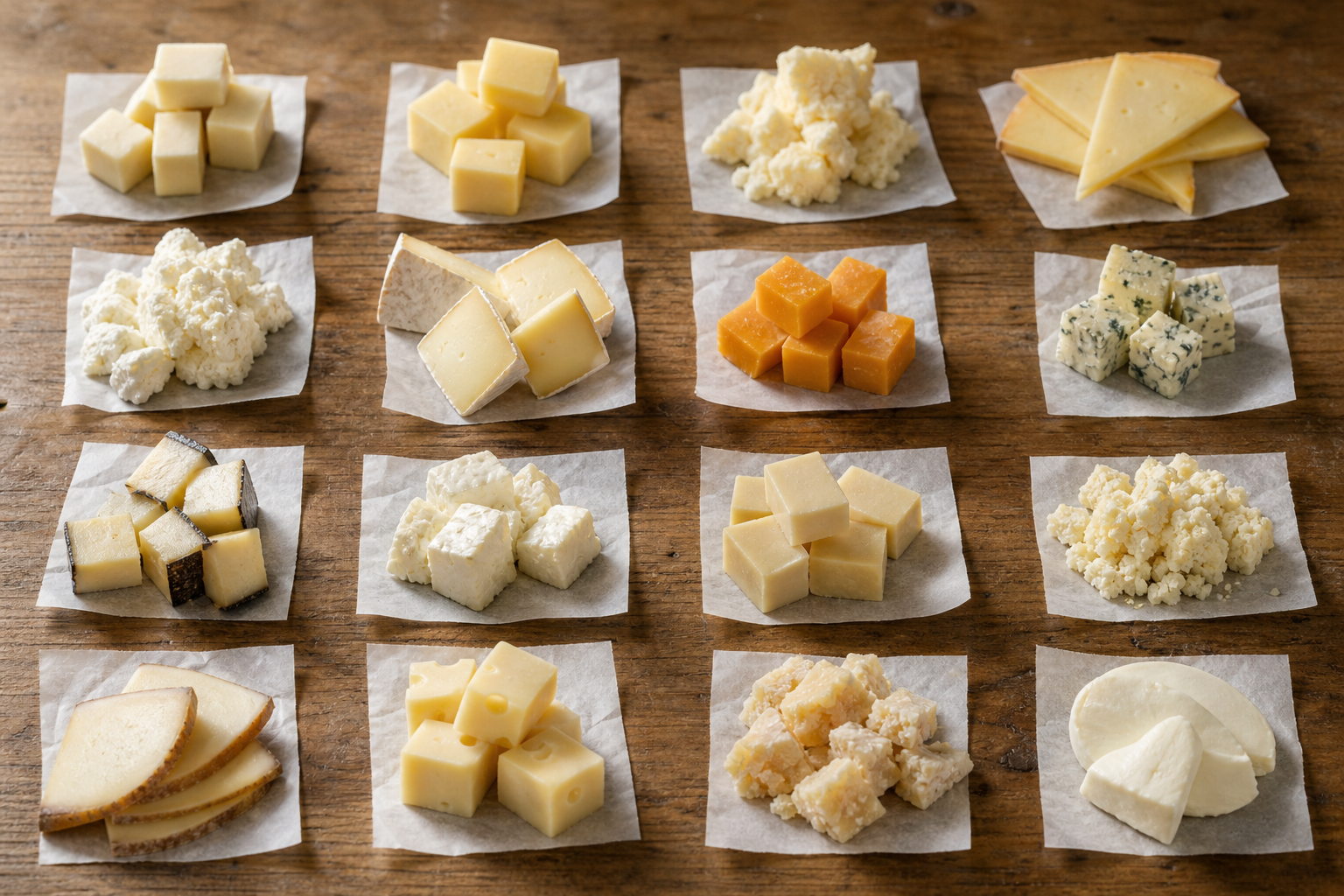
FDA’s reference amount for most cheese is 30 g. Labels state it as a piece, a slice, or “1 oz (28 g)” for bulk cheese. So the panel on a block of cheddar, a log of goat cheese and a tub of cream cheese all describe about the same weight. That makes cheese one of the easiest aisles to compare, once you know what 30 g looks like.
The ranking
Ranked by grams of protein per 100 kcal. All values are USDA reference values for the type.
14 cheeses per 30 g, ranked by protein density
| Cheese | kcal | Protein | Protein, g per 100 kcal | Fat | Sodium |
|---|---|---|---|---|---|
| Parmesan, hard | 118 kcal | 10.7 g | 9.1 | 7.5 g | 352 mg |
| Cheddar, reduced-fat | 95 kcal | 8.2 g | 8.7 | 6.1 g | 188 mg |
| Mozzarella, part-skim, low-moisture | 88 kcal | 7.1 g | 8.1 | 5.9 g | 200 mg |
| Mozzarella, whole milk | 90 kcal | 6.7 g | 7.4 | 6.6 g | 146 mg |
| Provolone | 105 kcal | 7.7 g | 7.3 | 8.0 g | 218 mg |
| Goat, soft | 79 kcal | 5.6 g | 7.0 | 6.3 g | 138 mg |
| Swiss | 118 kcal | 8.1 g | 6.9 | 9.3 g | 56 mg |
| Monterey Jack | 112 kcal | 7.3 g | 6.6 | 9.1 g | 180 mg |
| Brie | 100 kcal | 6.2 g | 6.2 | 8.3 g | 189 mg |
| Blue | 106 kcal | 6.4 g | 6.1 | 8.6 g | 344 mg |
| Cheddar | 121 kcal | 6.9 g | 5.7 | 10.0 g | 196 mg |
| Feta | 80 kcal | 4.3 g | 5.4 | 6.4 g | 342 mg |
| American, processed | 111 kcal | 5.4 g | 4.9 | 9.5 g | 501 mg |
| Cream cheese | 105 kcal | 1.8 g | 1.8 | 10.3 g | 94 mg |
What the table says
- The calorie range is narrow. 79 to 121 kcal per 30 g. Water and fat content do most of the sorting.
- Hard and aged cheeses lead on protein. Parmesan carries 10.7 g in 30 g, because it has the least water.
- Part-skim mozzarella is the everyday high-ratio cheese. 88 kcal and 7.1 g.
- Reduced-fat cheddar keeps the protein. 8.2 g against 6.9 g for regular, for 26 fewer kcal.
- Sodium spreads ninefold. Swiss, 56 mg. Processed American, 501 mg.
- Cream cheese is a spread, not a protein food. 1.8 g of protein in 30 g.
The cons, by cheese
- Parmesan. 352 mg of sodium in 30 g. Grated Parmesan is labeled on a 5 g reference amount, one tablespoon, so the shaker panel looks small.
- Cheddar, reduced-fat. 6.1 g of fat, about 40% less than regular, and 188 mg of sodium. The label must name the regular product it is compared with.
- Mozzarella, part-skim. 200 mg of sodium.
- Mozzarella, whole milk. 146 mg of sodium. Fresh styles carry more water, so 30 g is a bigger piece.
- Provolone. 218 mg of sodium and 8 g of fat.
- Goat, soft. Lowest calories here. 5.6 g of protein.
- Swiss. 118 kcal, among the highest. The sodium is the lowest by far.
- Monterey Jack. 9.1 g of fat.
- Brie. 6.2 g of protein, 8.3 g of fat.
- Blue. 344 mg of sodium.
- Cheddar. Most calories per 30 g: 121.
- Feta. 342 mg of sodium, 4.3 g of protein.
- American, processed. Most sodium: 501 mg, 22% of the Daily Value.
- Cream cheese. Most fat, least protein.
What 30 g looks like
30 g of cheese in kitchen terms, USDA portion weights
| Form | USDA weight | 30 g is about |
|---|---|---|
| Cheddar, 1-inch cube | 17 g | 1.75 cubes |
| Cheddar, shredded | 113 g per cup | a quarter cup, slightly heaped |
| Cheddar or Swiss, 1 oz slice | 28 g | one slice |
| American, thin slice | 21 g | one and a half slices |
| Parmesan, 1-inch cube | 10.3 g | 3 cubes |
A quarter cup of shredded cheddar is 28 g: about 113 kcal. A cup over a casserole is 455 kcal.
Three common portions, counted
- Three 1-inch cubes of cheddar. 51 g: about 206 kcal and 333 mg of sodium.
- One 28 g stick of part-skim mozzarella. About 83 kcal and 6.7 g of protein.
- Two tablespoons of grated Parmesan. 10 g: about 42 kcal and 180 mg of sodium, at USDA’s grated values.
The cubes are where the number grows without notice. Each one is 17 g and about 69 kcal.
Per dollar
BLS publishes two cheese prices, US city average, per pound. April 2025: natural cheddar $5.743, American processed $4.987.
Cheese price per 30 g and calories per dollar, BLS April 2025
| Cheese | Price per lb | Per 30 g | kcal per $1 |
|---|---|---|---|
| Cheddar, natural | $5.74 | $0.38 | 318 kcal |
| American, processed | $4.99 | $0.33 | 337 kcal |
Processed American is 5 cents cheaper per 30 g. It brings 1.5 g less protein and 305 mg more sodium.
How to read the package
- Check that the serving is near 28 to 30 g. Grated cheeses use 5 g; cottage cheese uses 110 g.
- Divide protein by calories, times 100. Over 8 is the top of the case. Under 5 is processed or spread.
- Read sodium. Under 150 mg per 30 g is the low end. Over 300 is brined, aged or processed.
- Weigh shredded cheese once. It is the easiest form to over-pour.
All figures are estimates from USDA reference values. Brands differ.
Related files
A slice of American on a turkey sandwich adds about 350 mg of sodium to the total in deli meat by sodium. Cottage cheese, the high-protein option at 110 g, is compared with yogurt in the yogurt ranking. Blue cheese dressing is 73 kcal a tablespoon, per salad dressing per tablespoon.
All shelf comparisons are on the Grocery desk.