A side salad is lettuce and dressing. Put 150 g of iceberg in a bowl with two tablespoons of oil and vinegar and you have about 200 kcal, and 181 of them are the dressing. The lettuce is close to a rounding error.
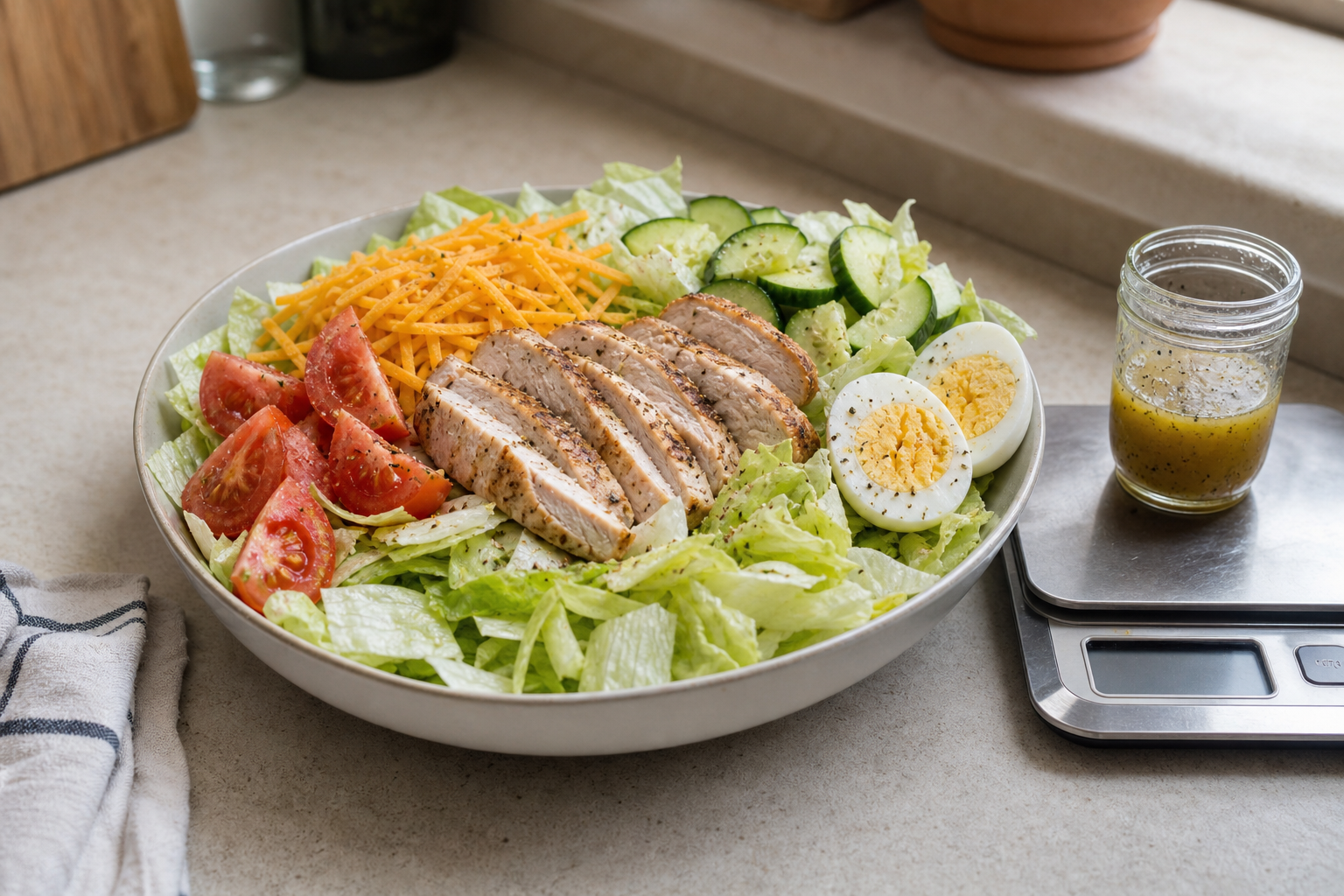
A salad that is the meal is a different plate. It needs protein and something with fat that is not all dressing. Dinner salad calories come from what sits on the lettuce: mine lands at 583 kcal, with the chicken and the dressing each about a third. Here it is to the gram, with what each topping adds if you change it.
The plate
One dinner salad, USDA SR Legacy values and BLS August 2025 prices
| Component | Grams | kcal | Cost | Catch |
|---|---|---|---|---|
| Iceberg, chopped | 150 | 21 | $0.55 | Under 4% of the plate |
| Tomato, wedges | 120 | 22 | $0.51 | BLS prices field-grown, not cherry |
| Cucumber, sliced | 75 | 11 | not priced | No BLS series |
| Red onion, thin | 20 | 8 | not priced | No BLS series |
| Chicken breast, roasted, from 150 g raw | 110 | 182 | $1.39 | 31% of the plate |
| Egg, hard-boiled, 1 large | 50 | 78 | $0.30 | |
| Cheddar, shredded | 20 | 81 | $0.27 | 33 g of fat per 100 g |
| Vinaigrette, about 2 tbsp | 32 | 181 | not priced | Oil is 177 of it |
| Total | 577 | 583 | $3.02 priced |
The vinaigrette is 20 g of olive oil, 7 g of red wine vinegar and 5 g of yellow mustard, shaken in a jar. That is a 3-to-1 oil-to-vinegar dressing, the same math as the dressing file: about 90 kcal a tablespoon.
The chicken is weighed raw. USDA’s raw breast is 120 kcal per 100 g and its roasted breast 165; 150 g raw roasts to about 110 g, so the kcal barely move. Prices are BLS US city averages for August 2025, not a receipt. Olive oil, vinegar, mustard, cucumber and onion have no BLS series and are not in the $3.02.
What moves the number
The lettuce does not. Swap the iceberg for three cups of romaine and you are at 24 kcal instead of 21. Swap it for 90 g of spinach, a full bowl, and you are at 21 again.
The dressing and the toppings do.
The same bowl at four dressing pours, 3-to-1 vinaigrette
| Dressing | Oil, g | Dressing kcal | Plate kcal | Dressing share | Con |
|---|---|---|---|---|---|
| 1 tbsp | 10 | 91 | 492 | 18% | Lower leaves stay bare unless you toss hard |
| 2 tbsp | 20 | 181 | 583 | 31% | Coats 150 g of chopped lettuce |
| 3 tbsp | 30 | 272 | 673 | 40% | Dressing collects in the bottom |
| 4 tbsp | 40 | 362 | 764 | 47% | Close to half the plate is oil |
Each extra tablespoon is about 90 kcal. The difference between a light pour and a heavy one is bigger than the chicken.
Toppings, at the amount that usually lands on a bowl, USDA values
| Topping | Amount | kcal | Con |
|---|---|---|---|
| Olive oil, extra pour | 1 tbsp, 13.5 g | 119 | The most kcal per gram on the board |
| Cheddar | 30 g | 121 | Easy to add twice |
| Avocado, California | half, 68 g | 114 | 15 g of fat per 100 g |
| Chickpeas, canned, rinsed | 1/2 cup, 76 g | 105 | Adds 5 g of protein and 5 g of fiber |
| Walnuts | 15 g | 98 | A small handful |
| Croutons, seasoned | 1/2 cup, 20 g | 93 | 267 mg of sodium |
| Bacon, cooked | 2 slices, 18 g | 87 | 325 mg of sodium |
| Feta | 30 g | 80 | 342 mg of sodium |
| Parmesan, grated | 2 tbsp, 10 g | 42 | Strong enough that 10 g reads as a lot |
Add the three heaviest on top of my plate and it passes 930 kcal. Put any one of them in place of the cheddar and it stays under 650.
The cook
Chicken: one 150 g breast, salted an hour ahead, on a sheet pan at 425°F for 18 to 22 minutes. FSIS puts poultry at 165°F, and I take it there at the thickest point with a probe, then rest it 5 minutes before slicing across the grain.
Egg: into boiling water straight from the fridge, 11 minutes, then into ice water for 5. FSIS’s line for eggs is 160°F; a hard-boiled yolk is well past it.
Dressing: weigh the jar, pour, weigh it again. The difference is what went on the salad. I toss the lettuce with the dressing in a big bowl first and put the toppings on after, so the dressing goes on leaves instead of sliding off the chicken.
Lettuce: dry it. Water on the leaves keeps the oil from sticking, and wet leaves are how two tablespoons start to look like not enough.
What it costs
The priced part of the plate is $3.02 at August 2025 averages. The chicken is $1.39 of it, 46%. The iceberg is $0.55, the tomato $0.51, the egg $0.30 and the cheddar $0.27. Iceberg was $1.673 a pound in August, up from $1.378 in June; lettuce prices swing more than the chicken does. The oil, vinegar and mustard are left out because BLS does not track them, so the real number is a little higher.
Side or meal
The same bowl, read two ways:
- As a side: lettuce, tomato, cucumber, onion and 2 tbsp of dressing. 243 kcal, and 75% of it is dressing.
- As the meal: add the chicken, the egg and the cheddar. 583 kcal, with 34 g of protein from the chicken and 6 g from the egg.
The protein is what makes it dinner. The dressing is what makes it heavy.
What this file does not cover
- Restaurant and salad bar bowls. The ladle and scoop math is in the salad bar bowl.
- Creamy dressings. Ranch, blue cheese and Caesar per tablespoon are in the dressing file.
- Grain bowls. Rice or quinoa under the greens is a different plate.
- The oil in a sauté or roast that goes into a warm salad. That is in the hidden 120 kcal tablespoon.
Every recipe on this desk is on the Cooking desk.
How these numbers were built
Values are from USDA FoodData Central, SR Legacy, multiplied by the grams shown. The chicken uses USDA’s roasted breast at 165 kcal per 100 g and a 73% roasted yield implied from its raw and roasted lines. Temperatures are FSIS’s. Prices are BLS US city averages for August 2025, the latest month published before this date, not a receipt. Consulted Oct 8, 2025. Calorie figures are estimates.