A tablespoon of olive oil is 13.5 g and 119 kcal, per USDA. Oil is 884 kcal per 100 g. Cooked white rice is 130. Chicken breast, raw, is 120. Gram for gram, the oil in the pan is the densest thing on the plate.
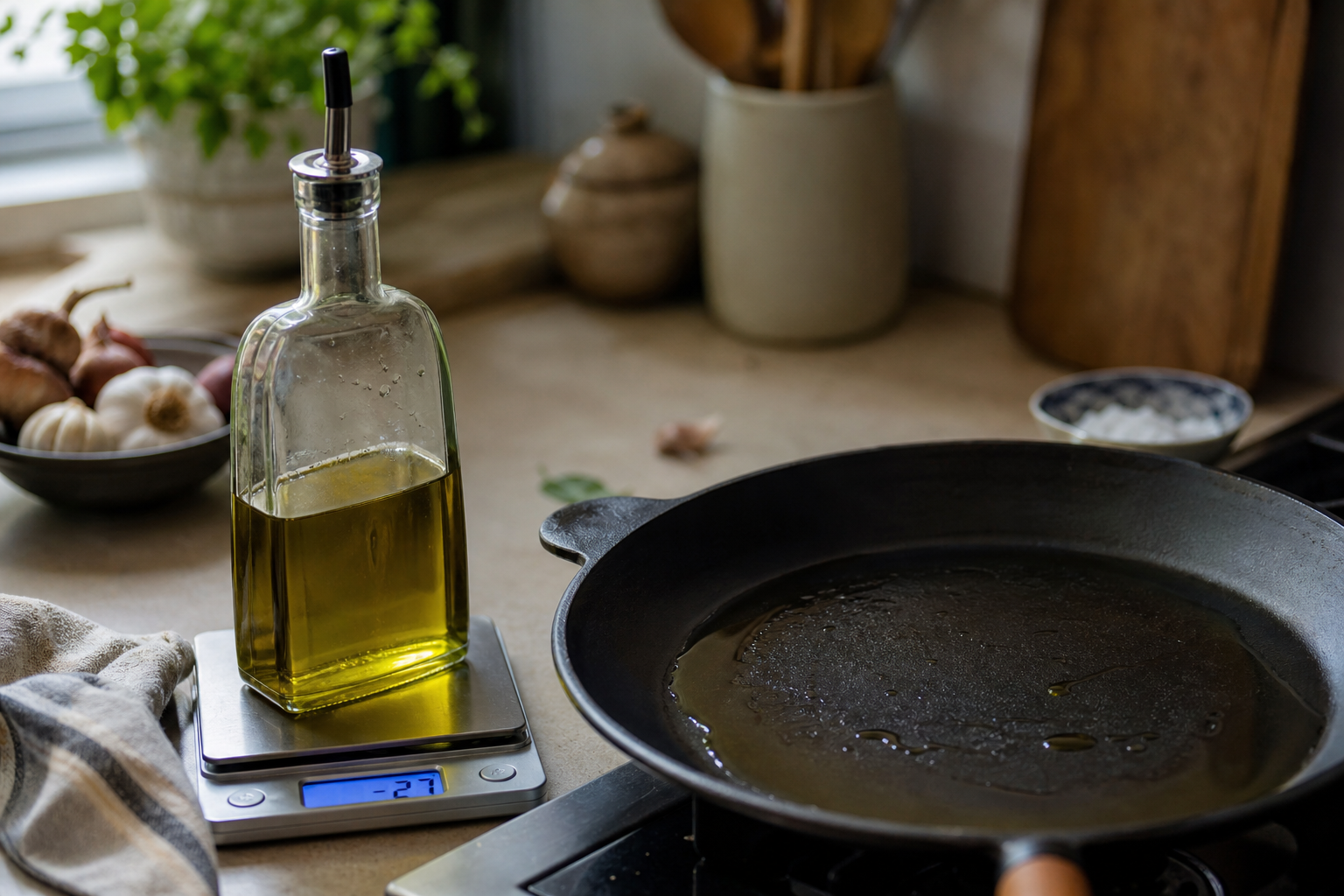
I cook on a scale. The oil goes on the scale too. This file is the arithmetic behind that habit: what a tablespoon is, what a pour is, what a spray is, and how to count what you actually used.
One tablespoon, by fat
USDA weighs a tablespoon of each fat. The figures are close. The one that differs is butter, because butter is about 81% fat and the rest is water and milk solids.
One tablespoon of fat, USDA figures
| Fat | Grams per tbsp | kcal per tbsp | Con |
|---|---|---|---|
| Canola oil | 14 | 124 | Heaviest tablespoon of the oils |
| Avocado oil | 14 | 124 | Same kcal as canola, higher shelf price |
| Coconut oil | 13.6 | 121 | 892 kcal per 100 g, solid below about 76°F |
| Soybean oil | 13.6 | 120 | Sold as “vegetable oil”; same kcal as the rest |
| Olive oil | 13.5 | 119 | Same kcal as canola within 5 |
| Peanut oil | 13.5 | 119 | Allergen; label it if you cook for others |
| Lard | 12.8 | 115 | 902 kcal per 100 g, the densest fat here |
| Ghee (butter oil) | 12.8 | 112 | Butter with the water cooked out |
| Butter | 14.2 | 102 | 643 mg sodium per 100 g if salted |
The spread across the oils is 5 kcal a tablespoon. The short version of cooking oil calories: about 120 a tablespoon, 8.84 a gram, whatever the bottle says on the front. Picking one oil over another does not move the plate. The amount does.
What a pan holds
On the line, nobody measures the oil into a sauté pan. You pour until the floor looks coated. Here is what “coated” means in tablespoons, by geometry. A pan with a 10-inch flat floor has about 507 square centimeters of surface. Oil weighs about 0.91 g per mL.
Oil film on a 10-inch pan floor, by thickness
| Film | mL | Tablespoons | Grams | kcal |
|---|---|---|---|---|
| 0.2 mm, a sheen | 10 | 0.7 | 9 | 82 |
| 0.5 mm, a thin coat | 25 | 1.7 | 23 | 204 |
| 1 mm, moves when you tilt | 51 | 3.4 | 46 | 409 |
One tablespoon covers a 10-inch floor at a little under a third of a millimeter. A film thick enough to run when you tilt the pan is over three tablespoons. That is the gap between the recipe and the stove.
The same pours, counted out:
- 1 tsp, 4.5 g: 40 kcal.
- 1 tbsp, 13.5 g: 119 kcal.
- 2 tbsp, 27 g: 239 kcal.
- 3 tbsp, 40.5 g: 358 kcal.
- 1/4 cup, 54 g: 477 kcal.
Where the oil goes
Some of the oil stays in the pan. Most of it leaves on the food. How much depends on the food, the heat and how long it sits.
USDA’s survey database gives one anchor. Its entries for fresh vegetables cooked with fat, such as broccoli, carrots and green beans, carry about 3 g of fat per 100 g of cooked vegetable. Fresh broccoli cooked with fat is 63 kcal per 100 g against 41 without. At 3 g per 100 g, one tablespoon of oil covers about 450 g of cooked vegetables. If you put a tablespoon on a 200 g side, you are running at more than twice USDA’s assumption.
Eggs give a smaller one. USDA’s fried large egg carries 6.8 g of fat. A hard-boiled large egg carries 5.3 g. The fried egg picked up about 1.5 g, a third of a teaspoon, from the pan.
My working assumption for a sauté is simple: count everything that went into the pan, minus anything you pour off. Vegetables and meat carry most of it out. To check, wipe the empty pan with a paper towel, and weigh the towel before and after. The difference is what stayed behind.
The 0 kcal spray
Cooking spray labels often print 0 kcal. They are allowed to.
FDA’s labeling rule lets any serving under 5 kcal be declared as zero. FDA’s reference amount for spray fats is 0.25 g, with the label left to state how many seconds of spray that is. USDA lists one spray of PAM, about a third of a second, at 0.3 g. At 792 kcal per 100 g, that is about 2 kcal. Under 5, so 0 on the label.
The can does not stop at a third of a second.
- 1 second: about 0.9 g, 7 kcal.
- 5 seconds: about 4.5 g, 36 kcal.
Those are arithmetic from USDA’s serving weight, not a reading from your can. Spray rates vary by nozzle and by how full the can is. Count the seconds and weigh the can once, before and after a 5-second coat, if you want your own number.
Weigh the bottle
This is the method I use for every recipe on this desk.
- Put the oil bottle on the scale. Zero it.
- Pour into the pan.
- Read the negative number. That is what went in.
- Multiply by 8.84 for any oil, 7.17 for butter.
Butter is easier, because the wrapper is marked in tablespoons. At the February 2025 BLS average of $4.869 per pound, a tablespoon of butter costs about 15 cents. The calories cost more attention than the money.
One plate, three pours
A weeknight plate: 150 g of raw chicken breast and 200 g of broccoli, cooked in one pan. Chicken breast is 120 kcal per 100 g raw, broccoli 34. The base is 248 kcal. At the February 2025 BLS average of $4.079 per pound, the chicken is about $1.35.
The same plate at three pours, olive oil
| Pour | Oil kcal | Plate kcal | Oil share of the plate | Con |
|---|---|---|---|---|
| 1 tsp | 40 | 288 | 14% | Chicken sticks unless the pan is nonstick |
| 1 tbsp | 119 | 367 | 32% | Fine in a well-seasoned steel or cast-iron pan |
| 3 tbsp | 358 | 606 | 59% | Oil is most of the plate |
The food did not change. The plate went from 288 to 606 kcal on the pour alone.
What this file does not cover
- Deep frying. Absorption there depends on batter, cut and oil temperature. The fries and wings math is in air fryer or sheet pan, 500 g at a time.
- Fat that comes out of the food. Chicken skin and ground beef render fat into the pan. That is not oil you added, but it is on the plate if you spoon it back.
- Dressings. Oil in a bottle of dressing is a label question, covered in salad dressing per tablespoon.
- Your spray can. The 0.3 g is USDA’s figure for one product.
For the oil hidden in a pot of sauce, see how much of five sauces makes 200 kcal. For skin-on chicken and the fat it renders, see chicken thighs, skin on or off. Every recipe on this desk is on the Cooking desk.
How these numbers were built
Fat figures and tablespoon weights are from USDA FoodData Central, SR Legacy. The fat-added and no-added-fat vegetable figures are from FoodData Central’s survey database, FNDDS 2021-2023. The pan table is geometry: a 10-inch circle, 0.91 g per mL. The spray math uses USDA’s 0.3 g serving and FDA’s rounding rule in 21 CFR 101.9. Prices are BLS US city averages for February 2025, not a receipt. Consulted Mar 19, 2025. Calorie figures are estimates.