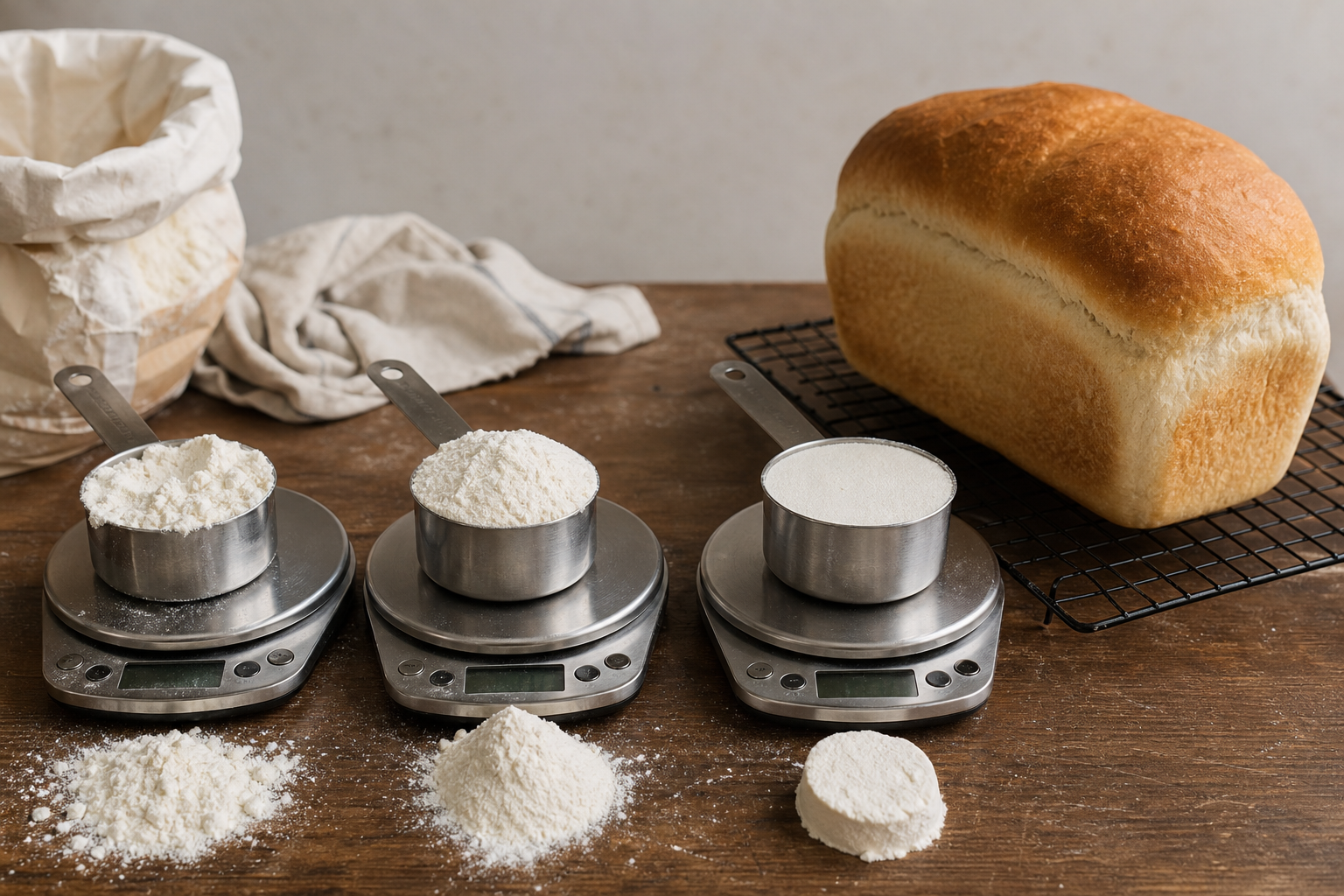
USDA’s nutrient database counts a cup of all-purpose flour as 125 g and 455 kcal. USDA’s own kitchen lab once weighed that cup hundreds of times and got a different answer for each way of filling it: 116 g sifted, 126 g spooned, 143 g dipped straight from the bag. Same cup, 27 g apart.
A recipe that says four cups can put 464 g of flour in the bowl or 572 g. I bake by weight because of that gap. Here is what it does to a sandwich loaf.
What USDA weighed
The numbers are from USDA’s Home Economics Research Report No. 41, Average Weight of a Measured Cup of Various Foods. The lab filled a standard 1-cup measure, leveled it with the edge of a spatula and weighed it, hundreds of times per method. Unless the method said otherwise, the flour was spooned in lightly.
One US cup of flour, three ways, USDA measured-cup study
| Flour and method | Grams per cup | Std. dev., g | Samples | kcal per cup | Con |
|---|---|---|---|---|---|
| All-purpose, dipped and leveled | 143 | 4.8 | 300 | 521 | Most flour, most scatter |
| All-purpose, spooned, not sifted | 126 | 2.8 | 510 | 459 | Close to the 125 g in FoodData Central |
| All-purpose, sifted, then spooned | 116 | 1.9 | 500 | 422 | Extra step, and few recipes say which |
| Bread flour, dipped | 136 | 6.5 | 40 | 491 | Small sample |
| Bread flour, spooned | 123 | 3.5 | 40 | 444 | Small sample |
| Bread flour, sifted, spooned | 117 | 4.2 | 41 | 422 | Small sample |
Kcal per cup use FoodData Central’s 364 kcal per 100 g for all-purpose and 361 for bread flour. The standard deviation is the spread inside one method. Dipping scatters most: 4.8 g either way, and that was in a lab.
These are USDA’s lab figures from the 1970s, not a test from my kitchen. Your cup, your flour and your hand will land somewhere in or near that range. The range is the point.
Four cups, one loaf
My sandwich loaf, written the way a recipe card writes it:
- 4 cups all-purpose flour
- 1 1/3 cups warm water, 315 g
- 2 tbsp butter, 28 g
- 1 tbsp sugar, 13 g
- 1 packet active dry yeast, 7 g
- 1 1/2 tsp salt, 9 g
Everything but the flour adds up to 276 kcal. The flour is the rest of the loaf, and the cup decides how much of it there is.
The same recipe card, three ways to fill the cup
| Method | Flour, g | Loaf kcal | Per slice, 16 slices | Water as % of flour | Con |
|---|---|---|---|---|---|
| Sifted, spooned | 464 | 1,965 | 123 | 68% | Slack dough; needs a stronger hand |
| Spooned | 504 | 2,110 | 132 | 63% | The card’s likely intent |
| Dipped | 572 | 2,358 | 147 | 55% | Stiff dough, tight crumb, short rise |
Dipping instead of spooning adds 68 g of flour: 248 kcal per loaf, 15 per slice. Dipping instead of sifting adds 108 g and 393 kcal.
The kcal are the smaller problem. At 55% water, the dough is stiff, the yeast works slower, and the loaf comes out dense and low. The usual fix is more water until the dough feels right, which keeps the extra flour in the loaf. The bread is bigger and the slices carry more.
The loaf by weight
I write the same loaf in grams and skip the cups.
- 500 g all-purpose flour. That is FoodData Central’s 125 g times four.
- 315 g water at about 105°F.
- 28 g soft butter, 13 g sugar, 7 g active dry yeast, 9 g salt.
Mix, knead 8 to 10 minutes until the dough is smooth and springs back, and let it double, about an hour at 75°F. Shape into a greased 9 by 5-inch pan, rise 45 minutes until it crowns an inch over the rim, and bake at 375°F for 35 to 40 minutes. I pull it at 190°F in the center and let it cool an hour before I cut.
As built: 2,096 kcal. Water carries none and the yeast eats a trace of sugar, so the baked loaf holds what went in.
Count it by the slice or by the gram
Two ways to get a number off the board.
- By the slice. Cut the loaf into a known count. 16 slices: 131 kcal each. 20 slices: 105.
- By the gram. Weigh the cooled loaf and divide 2,096 by its weight. If it weighs about 790 g, it is about 265 kcal per 100 g, in line with USDA’s 266 for commercial white bread.
The oven drives water out of the crust and crumb, so the loaf weighs less than the dough. How much less depends on your oven and pan. Weigh yours; do not assume mine.
What it costs
At BLS US city averages for August 2025: 500 g of flour is $0.61, 28 g of butter $0.30, 13 g of sugar $0.03. That is $0.95 a loaf before yeast and salt, which have no BLS series. About 6 cents a slice in 16. The 68 g of flour that dipping adds costs 8 cents.
What this file does not cover
- Whole-wheat flour. USDA weighed it stirred and spooned at 120 g a cup. It drinks more water; the swap math is in six baking swaps, ranked.
- Sugar, oats, cocoa and the rest of the pantry. Those cup weights are in cups to grams for 44 ingredients.
- Store bread. Per-slice figures for 13 loaves are in calories in bread per slice.
- High altitude, sourdough and enriched doughs with eggs and milk.
- Your cup. Fill it the way you always do, weigh it once, and use that number.
Every recipe on this desk is on the Cooking desk.
How these numbers were built
Cup weights are from USDA’s Average Weight of a Measured Cup of Various Foods, Home Economics Research Report No. 41, issued 1977. Kcal per 100 g are from USDA FoodData Central, SR Legacy. Loaf and slice figures are arithmetic on those values. Prices are BLS US city averages for August 2025, the latest month published before this date, not a receipt. Consulted Oct 5, 2025. Calorie figures are estimates.