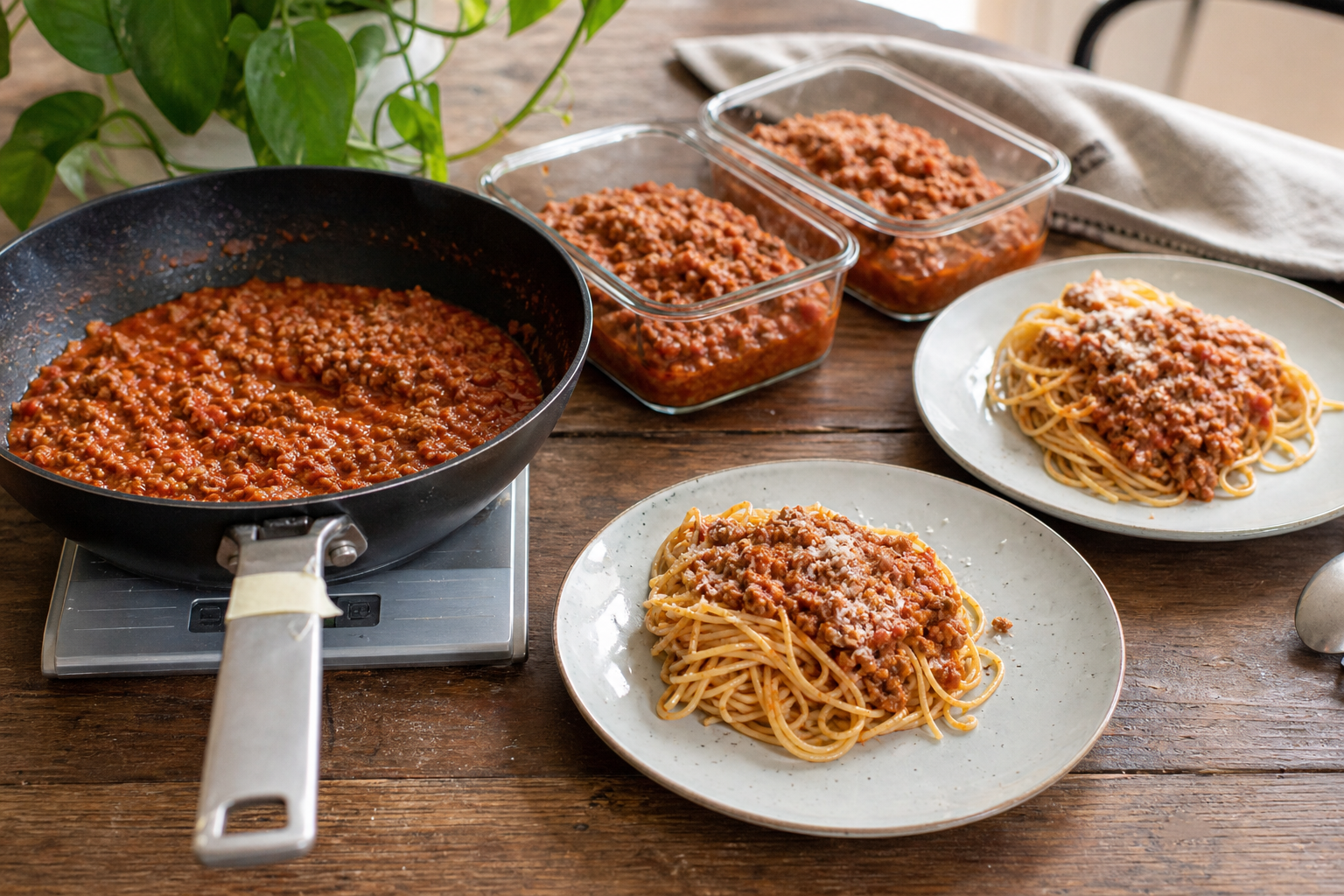
Most recipes are written for four. Cooking for two, you have two choices: halve it, or make all four and keep two. I usually make all four. The math is easier and so is the pan.
Here is the one I make most weeknights: meat sauce and spaghetti for four, 2,680 kcal and $10.94 of priced ingredients. Two plates tonight, two containers in the fridge. Each is 670 kcal, but only if the sauce gets split by weight.
The recipe for four
Meat sauce and spaghetti for four, USDA SR Legacy values and BLS August 2025 prices
| Ingredient | Grams | kcal | Cost | Catch |
|---|---|---|---|---|
| Spaghetti, dry | 340 | 1,261 | $0.97 | 85 g dry a plate |
| Ground beef, 85% lean, raw | 450 | 968 | $6.58 | Priced on BLS’s all-ground-beef average |
| Tomatoes, fresh, chopped | 800 | 144 | $3.40 | Most of the water in the pan |
| Onion | 150 | 60 | not priced | No BLS series |
| Tomato paste, 2 tbsp | 32 | 26 | not priced | |
| Garlic, 4 cloves | 12 | 18 | not priced | |
| Olive oil, 1 tbsp | 13.5 | 119 | not priced | Same tablespoon whatever the batch size |
| Parmesan, grated, 4 tbsp | 20 | 84 | not priced | 1 tbsp a plate |
| Total | 1,818 | 2,680 | $10.94 priced |
Per plate: 670 kcal and $2.74 of the priced ingredients. Prices are BLS US city averages for August 2025, not a receipt. The beef price is BLS’s average for all uncooked ground beef, used here as a proxy for 85% lean.
The beef is counted with all its fat. If you pour off fat after browning, weigh what you pour off and subtract 9 kcal a gram.
The cook
12-inch skillet, medium-high. Oil in, beef in, broken up and left alone until it browns, about 6 minutes. FSIS’s line for ground beef is 160°F; browned crumbles are past it. Onion and garlic in for 4 minutes, then the paste for 1, then the tomatoes. Simmer uncovered at a low bubble for 25 to 30 minutes, stirring every 5, until a spoon dragged across the pan leaves a trail.
The pasta goes in salted boiling water for the time on the box. I cook only what we eat tonight: 170 g dry for two. The other 170 g stays in the box for the night the containers come out, because cooked spaghetti held in sauce goes soft.
Weigh the pan, split by weight
Before I start, the empty skillet goes on the scale. The weight is on a strip of tape on the handle. When the sauce is done:
- Put the skillet on the scale. Subtract the tape number. That is the sauce.
- Divide by four. Spoon one quarter onto each plate and one into each container, by weight.
The sauce goes in at 1,458 g of raw ingredients. How much it weighs at the end depends on how long it simmered and how hard. The calories in it do not change.
The sauce, 1,335 kcal, at four finished weights
| Finished sauce, g | kcal per 100 g | One quarter, g | kcal per quarter | kcal per 250 g ladle | Catch |
|---|---|---|---|---|---|
| 1,458, nothing lost | 92 | 365 | 334 | 229 | Not possible uncovered |
| 1,100 | 121 | 275 | 334 | 303 | Loose sauce |
| 1,000 | 133 | 250 | 334 | 334 | Thick enough to hold a trail |
| 900 | 148 | 225 | 334 | 371 | Reduced hard |
A quarter by weight is 334 kcal at every row. A ladle is not: the same 250 g scoop runs from 229 to 371 kcal depending on how far the sauce reduced. These rows are arithmetic, not readings from my stove.
Add a quarter of the pasta, 85 g dry and 315 kcal, and a tablespoon of parmesan, 21 kcal, and the plate is 670.
Halving it instead
Halving the ingredients is the easy part. Use weights, not cups, and an egg is about 50 g if a recipe calls for one.
The pan is the hard part. Water leaves a simmering sauce through its surface. In the same pan at the same heat, half a batch loses roughly the same grams per minute as a full one, but it has half as much to lose. It thickens in about half the time and catches on the bottom.
Half a batch, by pan size, against a full batch in a 12-inch
| Pan, floor diameter | Floor area, sq cm | Depth of a half batch | Con |
|---|---|---|---|
| 12-inch | 730 | 50% | Reduces about twice as fast; scorches |
| 10-inch | 507 | 72% | Shorten the simmer and watch it |
| 9-inch | 410 | 89% | Closest to the full batch’s behavior |
| 8-inch | 324 | 112% | Slightly deeper; simmer a few minutes more |
The areas are circle math on the floor. Some things do not halve with the recipe:
- The oil. A pan floor needs a film whatever is on it. Brown a half batch in the same 12-inch and it still takes the full tablespoon, 119 kcal; in a 9-inch, about 56% of it. The film arithmetic is in the hidden 120 kcal tablespoon.
- Salt. Halve it, then taste before adding more.
- The pasta water. A smaller pot of water still needs to come back to a boil fast.
Containers and the clock
FSIS wants cooked leftovers in shallow containers and in the fridge within 2 hours. It gives them 3 to 4 days in the fridge, or 3 to 4 months in the freezer for best quality. Reheat to 165°F.
Each container gets a strip of tape: the date, the grams and the kcal. 365 g of loose sauce or 250 g of thick, it is 334 kcal of sauce either way. That is why I write the kcal and not just the weight.
What this file does not cover
- Dry versus cooked pasta weights. That is in the dry pasta file.
- A full week of portions. The five-container version is five days of meal prep.
- Slow-cooked batches with the lid on, where little water leaves. That is in the slow cooker file.
- Baking. Halving a cake changes pan depth and bake time in ways this table does not cover.
Every recipe on this desk is on the Cooking desk.
How these numbers were built
Ingredient values are from USDA FoodData Central, SR Legacy, multiplied by the grams shown. The finished-weight and pan rows are arithmetic. Food safety times and temperatures are from FSIS. Prices are BLS US city averages for August 2025, the latest month published before this date, not a receipt. Consulted Oct 14, 2025. Calorie figures are estimates.