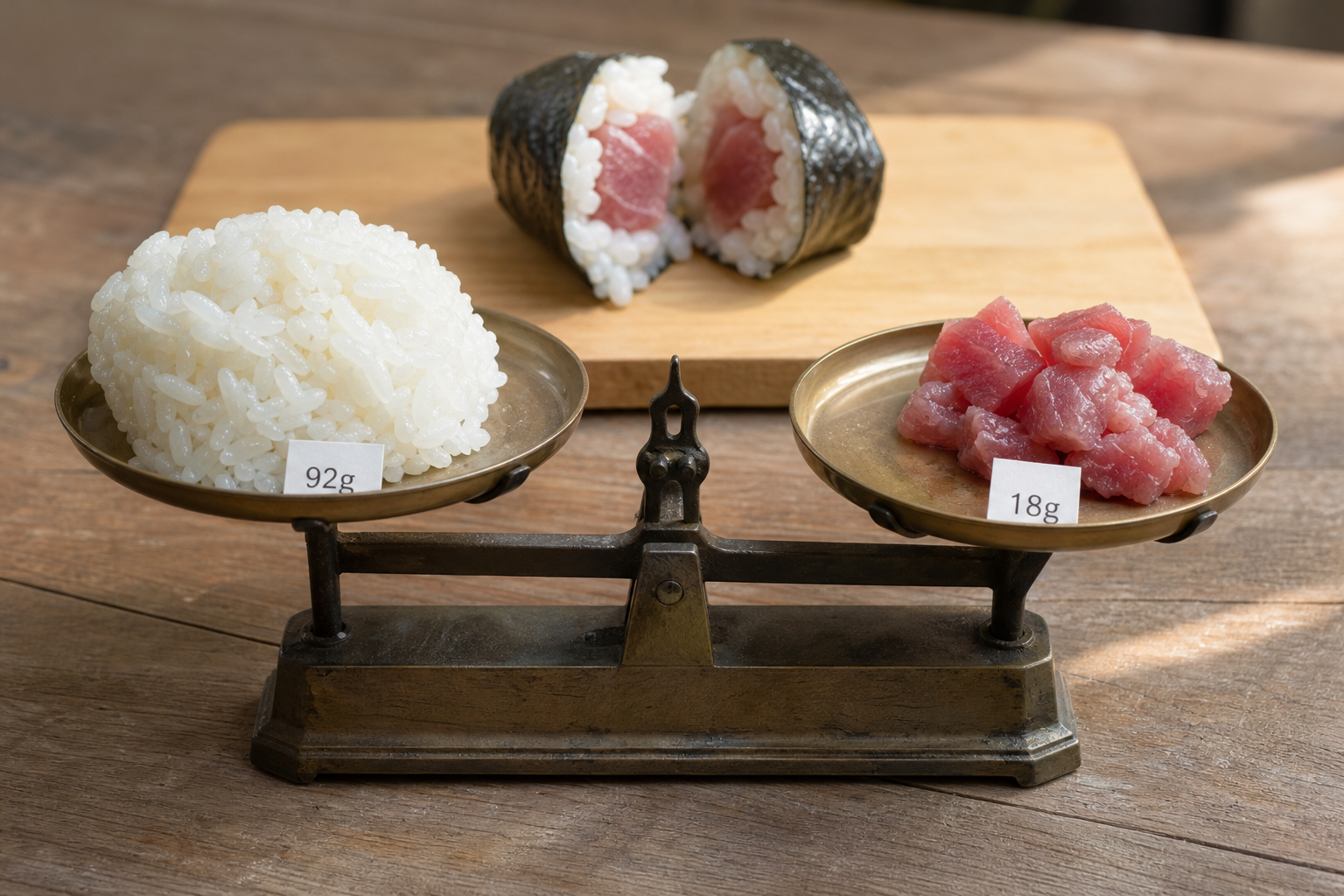
A 6-piece tuna roll is about 175 kcal in USDA’s survey database. The tuna in it weighs 44 g. The rice weighs 123 g. The rice, with its sugar and vinegar, is 72% of the kcal.
You order sushi by the fish. You eat it by the rice. Every figure below comes from USDA FoodData Central, including the recipe USDA uses to build each roll. Nothing was ordered or weighed for this file. Calories are estimates.
The roll, by weight
USDA’s survey database builds its rolls from one rice recipe: 290 g of cooked rice, 19.5 g of vinegar, 3.75 g of sugar, 3.6 g of salt and 5.2 g of nori. To that it adds 104 g of filling. For nigiri, the same rice carries 168 g of fish.
USDA’s roll portion is 180 g, 6 pieces of 30 g. Scaled to that roll:
- 123 g of rice, plus about 11 g of vinegar, sugar and salt.
- 44 g of fish or filling.
- 2 g of nori.
That is 74% seasoned rice by weight. The fish is under a quarter of the roll.
Piece by piece
Sushi by piece and portion, USDA figures
| Order | Portion | Rice, g | Fish or filling, g | kcal | Rice share of kcal |
|---|---|---|---|---|---|
| Eel roll | 6 pieces, 180 g | 123 | 44 | 209 | 61% |
| Salmon roll, sockeye | 6 pieces, 180 g | 123 | 44 | 185 | 68% |
| Tuna roll | 6 pieces, 180 g | 123 | 44 | 175 | 72% |
| California roll | 6 pieces, 180 g | 123 | 44 | 169 | 75% |
| Avocado roll | 6 pieces, 180 g | 133 | 32 | 167 | 83% |
| Salmon sashimi, farmed Atlantic | 3 oz, 85 g | 0 | 85 | 177 | 0% |
| Tuna sashimi, yellowfin | 3 oz, 85 g | 0 | 85 | 93 | 0% |
| Salmon nigiri, sockeye | 1 piece, 35 g | 21 | 12 | 37 | 58% |
| Tuna nigiri | 1 piece, 35 g | 21 | 12 | 35 | 62% |
The rolls land within 42 kcal of each other because the rice is the same in all of them. The fish moves the number at the edges. Eel, at 184 kcal per 100 g raw, is the heaviest filling. Yellowfin tuna, at 109, is one of the lightest.
Rice share counts the rice, the sugar and the vinegar. The California roll’s filling is imitation crab, avocado and cucumber.
The rice is the variable
USDA’s recipe uses glutinous rice, 97 kcal per 100 g cooked. Sushi kitchens generally use short-grain white rice, which USDA lists at 130. The gap is 33 kcal per 100 g, about 41 kcal per roll.
- Tuna roll with short-grain rice: about 216 kcal, 77% from the rice.
- California roll with short-grain rice: about 209, 80% from the rice.
- Tuna nigiri with short-grain rice: about 42 a piece, 68% from the rice.
Read the roll as a range: 175 to 216 for tuna. The weight of rice matters more than the type. Three rolls hold 369 g of rice, about 1.8 cups of cooked short-grain rice at USDA’s 205 g cup. For the dry-to-cooked math behind that cup, see rice weighed dry vs. cooked.
Sashimi is the fish alone
Three ounces of sashimi is 85 g of fish and nothing else.
- Yellowfin tuna: 93 kcal.
- Sockeye salmon: 111.
- Bluefin tuna: 122.
- Yellowtail: 124.
- Farmed Atlantic salmon: 177.
Salmon is the one to check. USDA’s salmon rolls use sockeye, 131 kcal per 100 g. Farmed Atlantic salmon is 208. Built with farmed salmon, the 6-piece salmon roll is about 218 kcal, not 185.
FDA’s fish advice sorts by mercury, not kcal. Salmon, shrimp and crab are on its Best Choices list. Yellowfin tuna is a Good Choice. Bigeye tuna is on its list of choices to avoid.
The specialty lines
Specialty rolls add fat on top of the same rice. USDA has no specialty roll, so these are built from USDA ingredients. Spicy mayo is counted as mayonnaise, 94 kcal a tablespoon. Eel sauce is counted as teriyaki sauce, USDA’s closest entry, 16 kcal a tablespoon.
Specialty rolls, built from USDA figures, 6 pieces
| Roll | Built as | kcal | Added |
|---|---|---|---|
| Shrimp tempura roll | Shrimp roll, 60 g breaded fried shrimp in place of 44 g boiled, 1 tbsp spicy mayo, 1 tbsp eel sauce | 383 | +203 |
| Spicy tuna, heavy | Tuna roll, 2 tbsp mayo | 363 | +188 |
| Philadelphia roll | Salmon roll, 1 oz cream cheese | 284 | +99 |
| Spicy tuna | Tuna roll, 1 tbsp mayo | 269 | +94 |
| California, spicy mayo on top | California roll, 1 tbsp mayo | 263 | +94 |
| Tuna roll, plain | USDA roll | 175 | 0 |
One tablespoon of mayo adds more than half a tuna roll. The shrimp tempura roll is more than two plain tuna rolls.
Three orders
- Sashimi, 3 oz of yellowfin and 3 oz of farmed salmon: 270 kcal, no rice. With a cup of short-grain rice: 537.
- Ten nigiri, five tuna and five salmon: 360 kcal, 210 g of rice.
- Three rolls, tuna, California and shrimp tempura: 727 kcal, 369 g of rice.
The nigiri plate has 57% of the rice in the three rolls. The sashimi plate has none until you order it.
Sodium
USDA lists a tuna roll at 616 mg of sodium and a California roll at 770. Soy sauce is 879 mg a tablespoon. Two rolls and one tablespoon of soy sauce come to 2,265 mg, 98% of the 2,300 mg Daily Value.
What the tables do not show
- Your kitchen’s rice. Rolls with a thick rice layer, or rice on the outside, carry more than USDA’s 123 g.
- Piece size. USDA’s pieces are 30 g for rolls and 35 g for nigiri. Big pieces scale up.
- Ginger, wasabi and miso soup. Small, not counted.
- Specialty builds. Restaurant recipes vary. These are this file’s stated builds.
- Fish fat by season and farm. USDA’s figures are averages.
On sushi roll calories, the rice is the line to read: 123 g in every roll, before anything on top. For another dish where one ingredient sets the number, see Thai curry and the coconut milk. For takeout containers measured in cups, see takeout vs. home plates. All restaurant files are on the Eating Out desk.
How these numbers were built
Roll and nigiri figures are from USDA FoodData Central, FNDDS 2021-2023, including the ingredient weights in each USDA recipe. Rice share is each recipe’s rice, sugar and vinegar kcal over its total, using SR Legacy values for each ingredient. Sashimi, short-grain rice, mayonnaise, cream cheese, breaded fried shrimp, soy sauce and teriyaki sauce are from SR Legacy. Specialty rolls are this file’s builds. Sources were consulted May 25, 2025. Calorie figures are estimates.