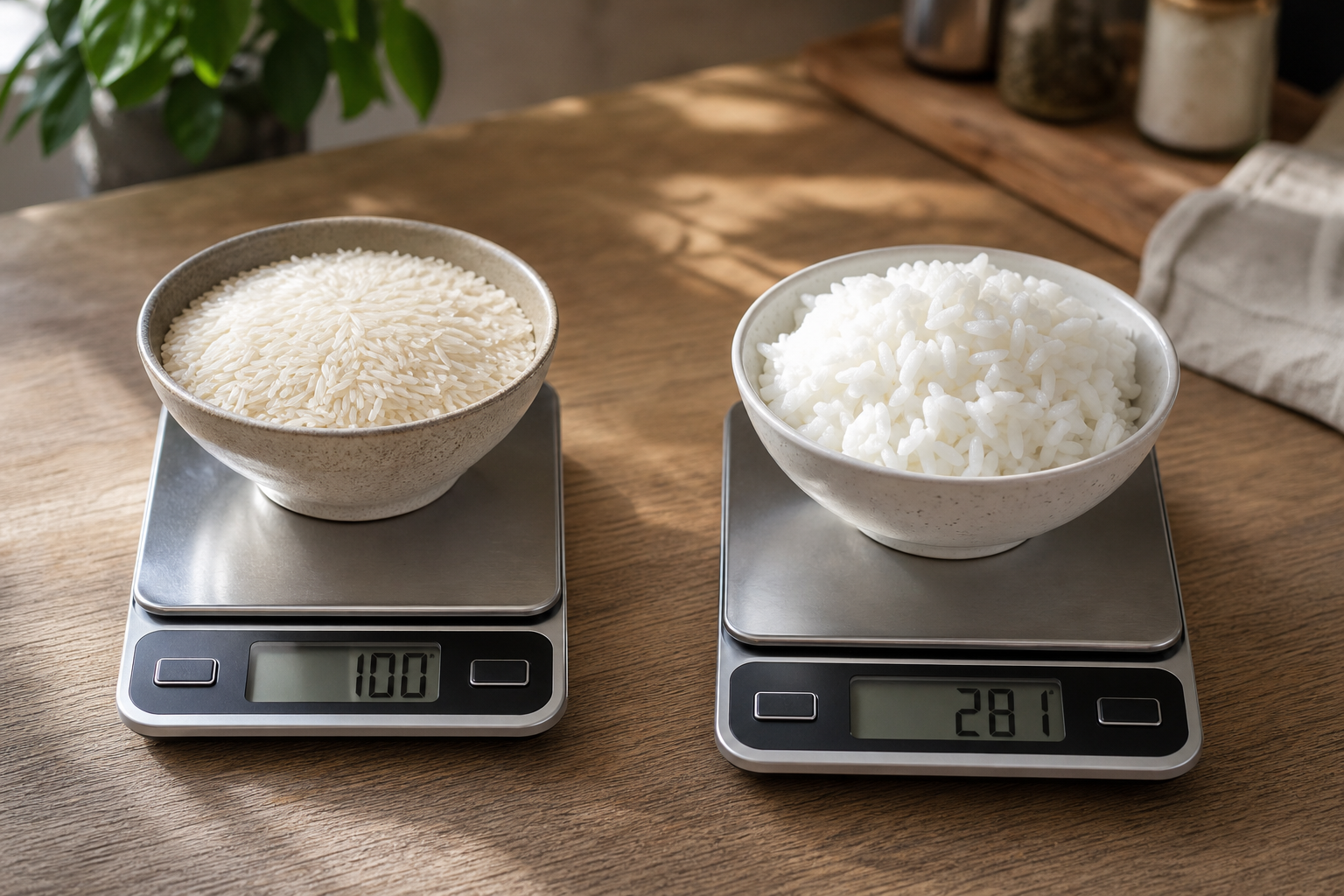
USDA lists long-grain white rice at 365 kcal per 100 g dry and 130 kcal per 100 g cooked. Same rice. The water is the difference. The ratio between the two is 2.8: 100 g of dry rice becomes about 281 g cooked, and the 365 kcal goes with it.
I cook rice by the kilo for the week. Every portion starts from a dry weight. Here is why, and how to do it when you only have the cooked rice in front of you.
Same rice, two numbers
Rice dry and cooked, USDA figures
| Rice | Dry, kcal per 100 g | Cooked, kcal per 100 g | Dry to cooked | Cooked cup, g | kcal per cooked cup | Con |
|---|---|---|---|---|---|---|
| White, long-grain | 365 | 130 | 2.81 | 158 | 205 | Package water ratios vary |
| White, medium-grain | 360 | 130 | 2.77 | 186 | 242 | Same kcal per gram, heavier cup |
| White, short-grain | 358 | 130 | 2.75 | 186 | 242 | Sticky grains pack the cup |
| Brown, long-grain | 367 | 123 | 2.98 | 202 | 248 | Longer cook, more water |
| Parboiled, long-grain | 374 | 123 | 3.04 | 158 | 194 | Firm; takes the most water |
| Glutinous, sticky | 370 | 97 | 3.81 | 174 | 169 | Steamed; weight swings with method |
“Dry to cooked” is the ratio of USDA’s two figures. It is what the weight would do if your pot matched USDA’s. Mine does not always, and yours won’t either.
Dry, the rices are within 16 kcal per 100 g of each other. Cooked, they are 33 apart. The water decides.
The error
Apply the dry figure to cooked rice and you count 2.8 times too much. Do the reverse and you count about a third of it.
- 200 g of cooked white rice, logged with the dry figure: 730 kcal. The real number is about 260. That’s 470 kcal over.
- 75 g of dry white rice, logged with the cooked figure: 98 kcal. The real number is 274. That’s 176 kcal under.
Both mistakes are common because a bag lists dry figures and a plate holds cooked rice. Getting cooked rice calories right means knowing which one is on the scale.
Cups lie
A cup of dry long-grain white weighs 185 g and is 675 kcal. A cup of cooked long-grain is 158 g and 205 kcal. A cup of cooked short-grain is 186 g and 242 kcal: the same 130 kcal per 100 g, but more grams fit in the cup. Pack the cup and the gram count goes up again.
Run it backward and a cooked cup has a dry weight. This is the number I use when I want to know what a cup on the plate started as.
One cooked cup, in dry grams, by USDA’s ratios
| Rice | Cooked cup, g | Dry rice in it, g | kcal | Con |
|---|---|---|---|---|
| Brown, long-grain | 202 | 68 | 248 | Heaviest cooked cup here |
| White, short-grain | 186 | 68 | 242 | Packs tight; weigh it |
| White, medium-grain | 186 | 67 | 242 | Same as short-grain within 1 g |
| White, long-grain | 158 | 56 | 205 | The cup most labels assume |
| Parboiled, long-grain | 158 | 52 | 194 | Fluffs up; cup varies most by scoop |
| Glutinous, sticky | 174 | 46 | 169 | Steam time moves it |
The label reference amounts do not line up either. FDA’s reference amount for plain rice is 45 g dry or 140 g prepared. By USDA’s ratio, 45 g dry is 164 kcal and comes to about 126 g cooked. 140 g cooked is 182 kcal, about 50 g dry. Two serving sizes for one bag, 18 kcal apart.
Weigh the pot
This is how I portion a batch without guessing.
- Weigh the empty pot. Write the number on a strip of tape on the handle. It doesn’t change.
- Weigh the dry rice. 500 g of long-grain white is 1,825 kcal.
- Cook it: rinse twice, 500 g rice to 1,000 g water, boil, lid on, lowest flame for 15 minutes, 10 minutes off the heat.
- Weigh the full pot. Subtract the tape number. That is your cooked weight.
- Divide 1,825 by the cooked weight. That is your kcal per gram, for this pot only.
500 g of dry white rice, 1,825 kcal, at three cooked weights
| Pot nets | kcal per 100 g cooked | 150 g portion, kcal | Con |
|---|---|---|---|
| 1,300 g | 140 | 211 | Firm rice, lid off too long |
| 1,405 g | 130 | 195 | Matches USDA’s cooked figure |
| 1,500 g | 122 | 183 | Wet rice; more water, same kcal |
The kcal in the pot never moved. Only the grams did. A drier pot makes every 100 g heavier in kcal.
Leftover rice keeps drying in the fridge, so the cooked weight drops over the week. If you portion on day one into containers, the kcal per container holds. FSIS says to refrigerate leftovers within 2 hours and use them within 3 to 4 days.
Brown, parboiled and sticky
Brown long-grain is 367 kcal per 100 g dry, 2 more than white. Cooked, it is 123 against 130, because it takes on more water. A cooked cup of brown is still heavier in kcal, 248 against 205, because the cup holds 202 g.
Parboiled rice is the thirstiest of the long grains: 374 dry, 123 cooked, a 3.04 ratio. Glutinous rice is the extreme. USDA’s cooked figure is 97 per 100 g, but steamed sticky rice varies with the soak and the steam. For sticky rice I weigh dry, every time.
Butter in the pot
One tablespoon of butter in a 200 g dry batch adds 102 kcal. That batch comes to about 148 kcal per 100 g cooked. USDA’s survey database lists white rice cooked with fat at the same 148, against 129 without. The rule from the hidden 120 in a tablespoon of oil applies here too: count what went into the pot.
What it costs
At the March 2025 BLS average of $1.038 per pound, dry long-grain white rice is cheap per kcal. One pound dry is 1,656 kcal and, by USDA’s ratio, about 1,274 g cooked, or 8.1 cups.
- Per cooked cup, 158 g: about 13 cents.
- Per 75 g dry portion: about 17 cents.
- Per 100 g cooked: about 8 cents.
What this file does not cover
- Fried rice. The oil makes it a different dish. Count it separately.
- Restaurant rice. Sushi rice is seasoned with sugar; see why the rice, not the fish, decides a sushi order.
- Rice cookers. They change the water loss, which changes the cooked weight. The dry total stays the same.
- Salt. USDA’s “with salt” cooked rice carries 382 mg of sodium per 100 g. Unsalted is 1 mg.
For portioning a week of rice with chicken and vegetables, see meal prep for five days. Every recipe on this desk is on the Cooking desk.
How these numbers were built
Rice figures and cup weights are from USDA FoodData Central, SR Legacy. The fat-added rice figure is from FoodData Central’s survey database, FNDDS 2021-2023. Dry-to-cooked ratios are USDA’s dry kcal divided by its cooked kcal. Reference amounts are from 21 CFR 101.12. The price is the BLS US city average for March 2025, not a receipt. Consulted Apr 14, 2025. Calorie figures are estimates.