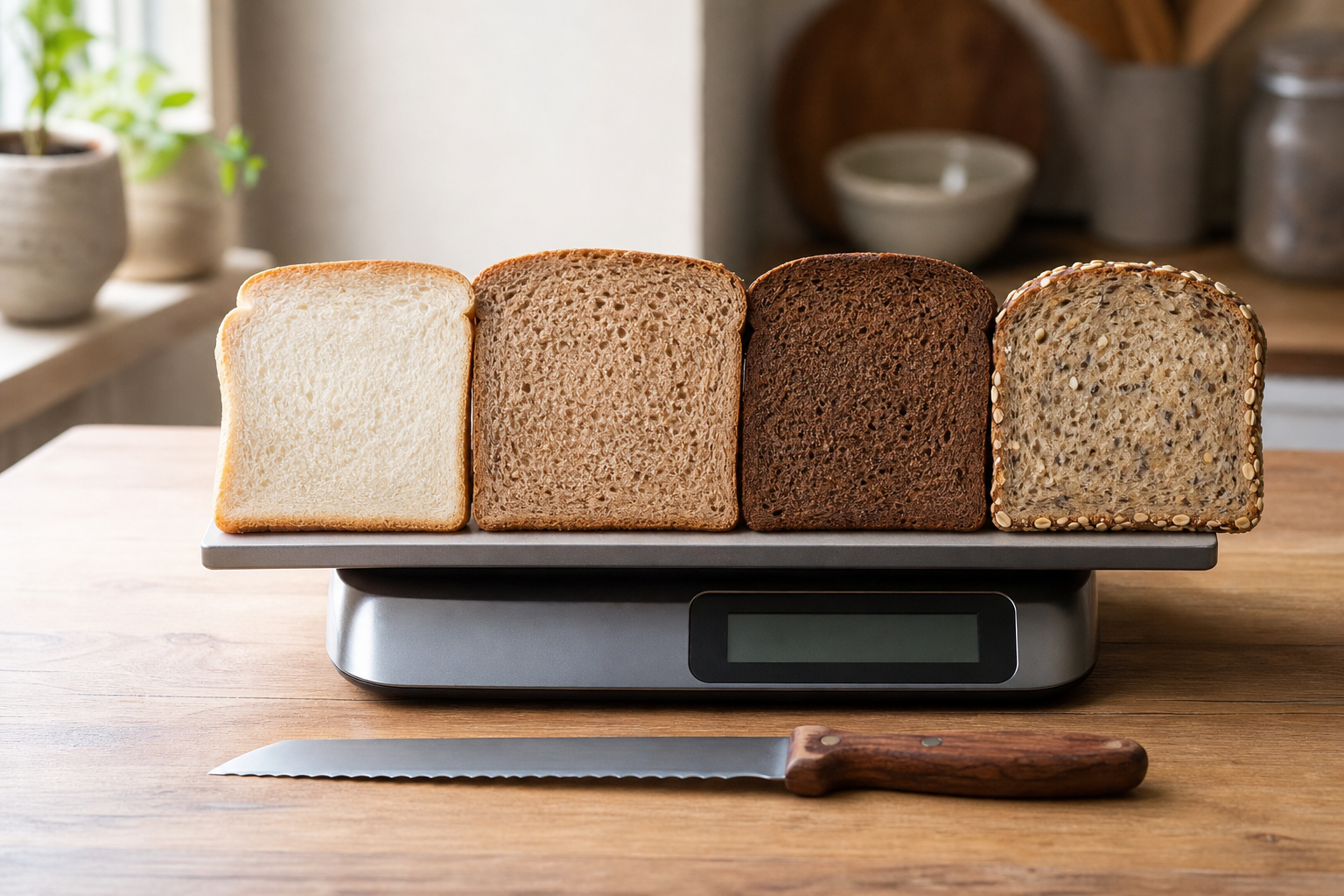
Bread is one of the few shelf foods where the per-100 g figure barely moves and the per-slice figure swings. White, whole-wheat, rye, oatmeal and multigrain all land between 252 and 274 kcal per 100 g in USDA’s reference data. What changes is how thick the bakery cuts.
The rule behind the label
FDA sets one reference amount for sliced bread: 50 g. The label serving is the number of slices closest to that. One maker prints “1 slice (45 g)”. The next prints “2 slices (52 g)”. Both are legal. They are not comparable until you divide.
Three numbers on the panel do the work:
- Calories per serving.
- Grams per serving, in parentheses next to the slice count.
- Slices per serving.
Calories divided by slices gives kcal per slice. Calories divided by grams, times 100, gives kcal per 100 g. The second number tells you what the dough is. The first tells you what you eat.
Per slice, lowest first
13 breads, USDA reference values, ranked by kcal per slice
| Bread | Slice | kcal per slice | kcal per 100 g | Protein | Fiber |
|---|---|---|---|---|---|
| Reduced-calorie wheat | 21 g | 46 kcal | 217 kcal | 2.8 g | 2.3 g |
| Reduced-calorie white | 23 g | 48 kcal | 207 kcal | 2.0 g | 2.2 g |
| White, thin-sliced | 20 g | 53 kcal | 266 kcal | 1.8 g | 0.5 g |
| White, regular | 25 g | 66 kcal | 266 kcal | 2.2 g | 0.7 g |
| Multigrain, regular | 26 g | 69 kcal | 265 kcal | 3.5 g | 1.9 g |
| Raisin | 26 g | 71 kcal | 274 kcal | 2.1 g | 1.1 g |
| Sprouted wheat | 38 g | 71 kcal | 188 kcal | 5.0 g | 2.0 g |
| Oatmeal | 27 g | 73 kcal | 269 kcal | 2.3 g | 1.1 g |
| Italian | 29 g | 75 kcal | 259 kcal | 2.8 g | 0.6 g |
| White, large | 30 g | 80 kcal | 266 kcal | 2.7 g | 0.8 g |
| Whole-wheat | 32 g | 81 kcal | 252 kcal | 4.0 g | 1.9 g |
| Rye | 32 g | 83 kcal | 259 kcal | 2.7 g | 1.9 g |
| Multigrain, large | 41 g | 109 kcal | 265 kcal | 5.5 g | 3.0 g |
Slice weights are USDA portion weights. Your loaf will not match them exactly. Fiber and protein are per slice.
What the table says
- Same dough, three answers. White bread is 53, 66 or 80 kcal a slice depending only on the cut: 20, 25 or 30 g.
- The large multigrain slice tops the list at 109 kcal. That is more than two thin white slices.
- Reduced-calorie loaves get there two ways. The dough carries more water and added fiber, 207 to 217 kcal per 100 g. The slices are also small, 21 to 23 g. About half the saving is the knife.
- Sprouted wheat is the only bread under 200 kcal per 100 g in this set. It is cut thick, so per slice it lands mid-table.
- Toasting does not remove calories. USDA lists toasted white at 290 kcal per 100 g against 266 untoasted. The slice lost water, not energy.
The cons, loaf by loaf
Every ranking here prints its downside.
- Reduced-calorie white and wheat. Small slices. Much of the fiber is added as an isolated ingredient; the ingredient list will name it.
- Thin-sliced white. Lowest fiber in the set: 0.5 g a slice.
- Regular and large white. 0.7 to 0.8 g of fiber a slice. Same dough as thin-sliced, more of it.
- Sprouted wheat. Dense, thick slices. 180 mg of sodium a slice.
- Rye. The most sodium per slice here: 193 mg.
- Italian. 179 mg of sodium in a 29 g slice, and 0.6 g of fiber.
- Multigrain. The word means more than one grain. It does not mean whole grain. The large slice is the heaviest on the list.
- Whole-wheat. Costs more per pound. See below.
Per dollar
BLS publishes two bread prices, US city average, per pound. November 2024: white pan bread $1.916, whole-wheat pan bread $2.724.
Bread price per pound, per slice and per dollar, BLS November 2024
| Bread | Price per lb | Price per slice | kcal per $1 |
|---|---|---|---|
| White pan | $1.92 | $0.11 | 630 kcal |
| Whole-wheat pan | $2.72 | $0.19 | 420 kcal |
Per-slice prices use the USDA slice weights above: 25 g white, 32 g whole-wheat. Whole-wheat costs 42% more per pound. Per slice it brings 4.0 g of protein against 2.2 g, and per 100 g it carries 6.0 g of fiber against 2.7 g.
Cheap calories are not the goal for everyone. The column is there so you can see what each extra gram of fiber costs you.
Check your own loaf in under a minute
- Find grams per serving on the panel.
- Divide calories by grams and multiply by 100. If the answer sits far outside 240 to 280 kcal per 100 g, the loaf is unusual: reduced-calorie, heavily seeded, enriched with fat or sweetened.
- Weigh one slice once on a kitchen scale. Multiply its grams by your per-gram figure. That is your slice, not the bakery’s.
Calories are estimates. Labels round to the nearest 10 kcal above 50, and FDA allows a tolerance on the declared figure.
What goes on it
The loaf is rarely the biggest number in the sandwich. Two level tablespoons of peanut butter add about 190 kcal; the label math is in the peanut butter file. A 2 oz portion of sliced turkey adds about 60 kcal and roughly 500 mg of sodium, per the deli meat file. If you are choosing between two slices and a wrap, the tortilla file runs the same per-gram test on flour, corn and high-fiber tortillas.
Every other shelf comparison is on the Grocery desk.