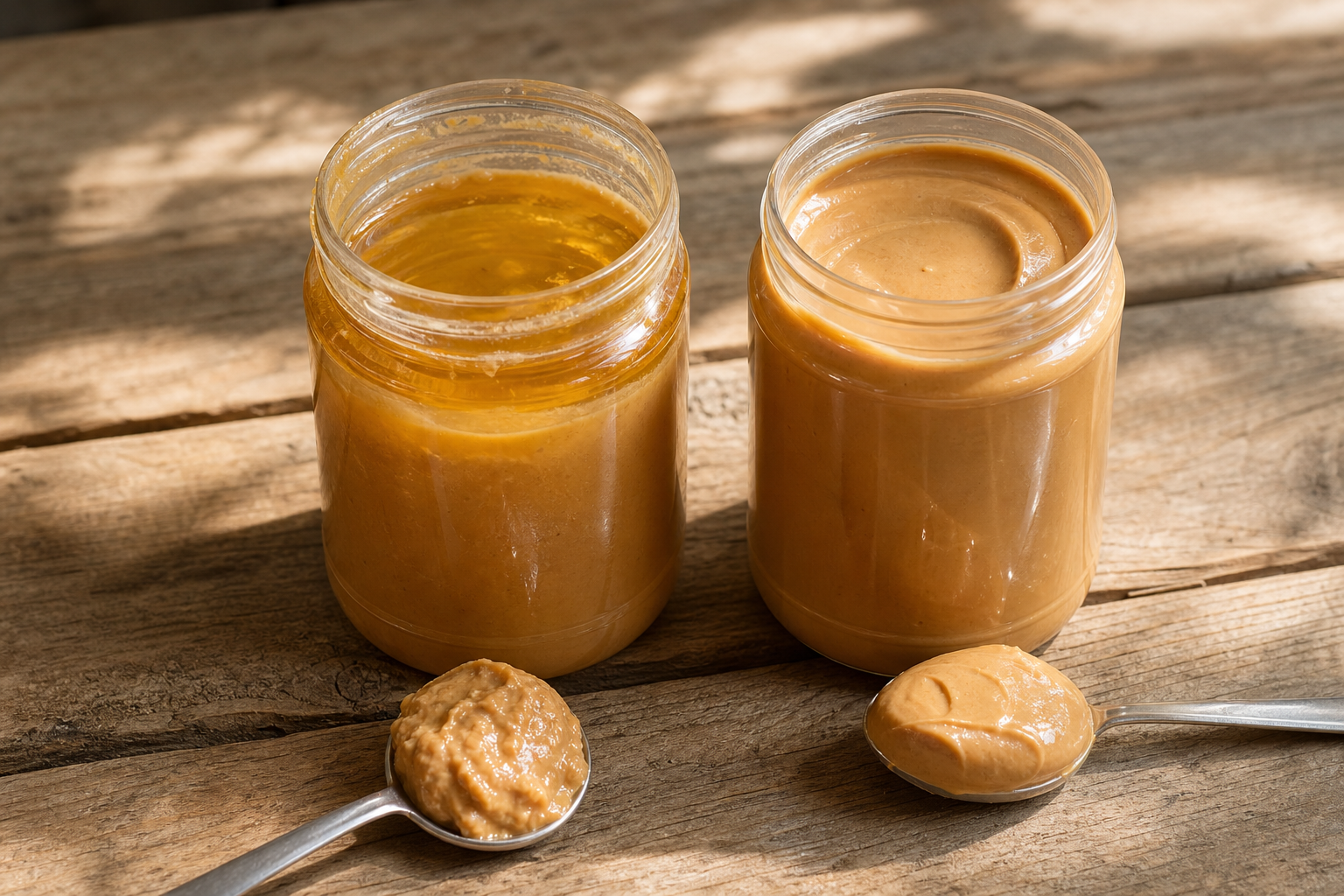
Peanut butter has a federal recipe. FDA’s standard of identity says it is ground roasted peanuts, at least 90% of the weight. Everything else, salt, sweeteners and stabilizing oils, is capped at 10% combined. Fat in the finished jar cannot exceed 55%.
So every jar labeled peanut butter is mostly the same food. The two-ingredient jar, peanuts and salt, uses none of the 10% for sugar or oil. The no-stir jar uses some of it. Here is what that changes.
The jars, per 2 tablespoons
FDA’s reference amount for nut butters is 2 tablespoons. USDA weighs 2 level tablespoons of smooth peanut butter at 32 g.
Peanut butters and spreads, USDA reference values, per 2 level tablespoons
| Jar | Weight | kcal | Protein | Sugar | Saturated fat | Sodium |
|---|---|---|---|---|---|---|
| Peanuts and salt, two ingredients | 32 g | 188 kcal | 7.8 g | 1.6 g | 2.5 g | about 130 mg |
| Peanuts only, unsalted | 32 g | 188 kcal | 7.8 g | 1.6 g | 2.5 g | 2 mg |
| Conventional smooth, with salt | 32 g | 191 kcal | 7.1 g | 3.4 g | 3.3 g | 136 mg |
| Conventional chunky, with salt | 32 g | 188 kcal | 7.7 g | 2.7 g | 2.4 g | 156 mg |
| Reduced-fat peanut spread | 36 g | 187 kcal | 9.3 g | 3.3 g | 2.1 g | 194 mg |
| Almond butter, unsalted | 32 g | 196 kcal | 6.7 g | 1.4 g | 1.3 g | 2 mg |
The two-ingredient rows use USDA’s dry-roasted peanut values, since that jar is ground peanuts. The salted row assumes salt in line with conventional salted jars; your label prints the actual figure.
What the table says
- Calories are flat. 187 to 196 kcal across every row. Every jar except the reduced-fat spread is about half fat by weight.
- Reduced-fat saves nothing by the spoon. The spread is denser: 36 g per 2 tablespoons against 32 g. Per 100 g it is lower, 520 kcal against 598. Per spoonful it is 187 against 191.
- Sugar doubles in the conventional smooth jar. 3.4 g against 1.6 g from the peanuts alone. The difference is mostly added sugar.
- Saturated fat rises by about 0.8 g. Conventional smooth carries 3.3 g per serving against 2.5 g for peanuts. Stabilizing oils account for most of it.
- Protein is 7 to 9 g everywhere. The reduced-fat spread carries the most, 9.3 g, partly because its 2 tablespoons weigh 36 g instead of 32.
The cons, jar by jar
- Peanuts and salt. The oil separates. Stir it in fully the first time or the bottom of the jar dries out and the top pours.
- Peanuts only, unsalted. Same separation. If you add salt yourself, you control the number.
- Conventional smooth. About 2 g of added sugar and the most saturated fat per serving here.
- Conventional chunky. 156 mg of sodium, more than smooth.
- Reduced-fat spread. Not peanut butter under the federal standard. Twice the sugar of peanuts alone, and the most sodium here: 194 mg.
- Almond butter. Most calories per serving, least protein. There is no federal standard for it like the one for peanut butter, so the ingredient list is the only check.
What the 10% can hold
The standard allows “seasoning and stabilizing ingredients” up to 10% of the jar, combined. On US labels that usually means some mix of:
- Salt.
- Sugar, molasses, honey or corn syrup solids. All count as added sugars on the panel.
- Fully hydrogenated vegetable oils or palm oil. These keep the peanut oil from separating, which is what makes a jar no-stir.
The standard also lets a maker add or remove peanut oil during grinding. So a smooth jar and a two-ingredient jar can sit at the same fat level and still differ in which fat it is.
What “natural” on the jar means
FDA has no formal definition of natural. Its long-standing policy is that nothing artificial or synthetic has been added that you would not expect in the food. A jar labeled natural can still list palm oil and sugar. If you want two ingredients, the ingredient list is the only place that tells you.
The spoon is the variable
The label says 2 tablespoons. The spoon in your drawer is not a measuring spoon.
Conventional smooth peanut butter by spoon weight, USDA reference value of 598 kcal per 100 g
| Two spoons of | Weight | kcal |
|---|---|---|
| 16 g each, level | 32 g | 191 kcal |
| 20 g each | 40 g | 239 kcal |
| 24 g each, rounded | 48 g | 287 kcal |
A 16 oz jar is 454 g: about 2,715 kcal and roughly 14 servings of 32 g. If a jar lasts you one week, that is about 390 kcal a day from the jar.
How to read a jar in the aisle
- Read the name. “Peanut butter” means at least 90% peanuts. “Peanut spread” means less.
- Read the ingredients. Two items, peanuts and salt, or one. Anything after salt is part of the 10%.
- Read Added Sugars. A two-ingredient jar reads 0 g.
- Read the grams per serving. Then weigh your usual spoonful once.
Calories are estimates. Labels round to the nearest 10 kcal above 50.
Related files
On toast, the bread can be 46 to 109 kcal a slice depending on the cut; see bread per slice. Peanut butter carries about 3.7 g of protein per 100 kcal; the bars that do better are in protein bars, ranked. Stirred into yogurt, a tablespoon adds about 95 kcal to the cups ranked in the yogurt file.
All shelf comparisons are on the Grocery desk.