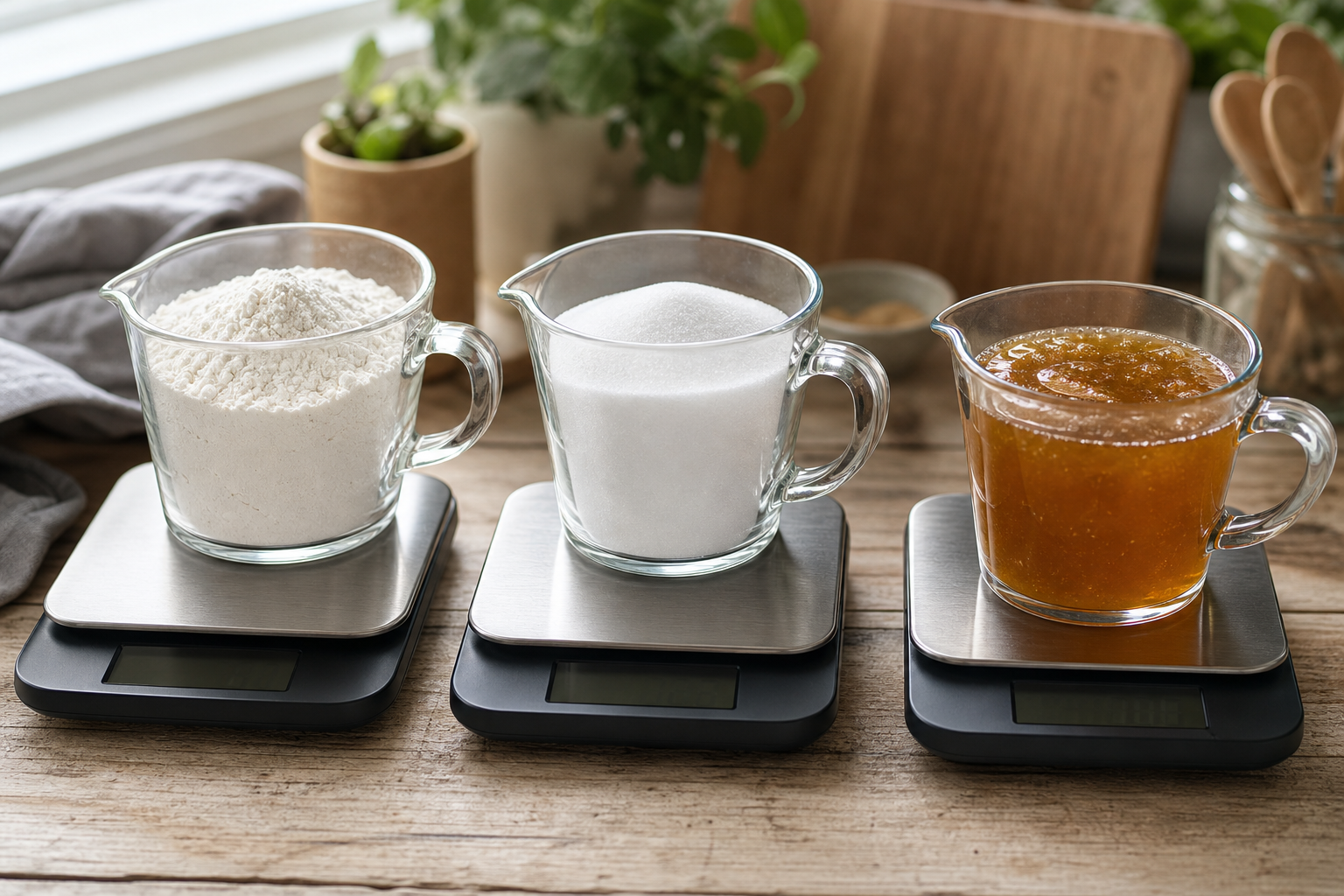
A cup measures volume. Grams measure weight. The two only agree for water. A cup of flour weighs 125 g, a cup of sugar 200 g, a cup of honey 339 g. If a recipe or a label gives cups and you weigh, you need the weight of that ingredient, not a general rule.
This file lists 44 staples by USDA portion weight. Kcal per cup come from the same USDA rows. Every weight is an average and every kcal figure an estimate.
Two cups, both legal
- The US customary cup is 8 fl oz, 236.6 mL, per NIST. Measuring cups in US kitchens are sized to it.
- The label cup is 240 mL. FDA rounds the household measures for Nutrition Facts panels: 1 cup = 240 mL, 1 tbsp = 15 mL, 1 tsp = 5 mL.
The gap is 1.4%. It does not matter for a recipe. It explains why a label’s “1 cup” and your measuring cup can disagree by a few grams.
Fixed ratios: 1 cup = 16 tbsp = 48 tsp. 1 oz by weight = 28.35 g. 1 lb = 453.6 g.
The tables
Tablespoon and teaspoon columns are the cup weight divided by 16 and 48. Spoons pack differently from cups, so where USDA weighs a spoon directly, use the last table.
Flours and dry goods: grams per US cup, USDA portion weights
| Ingredient | 1 cup | 1 tbsp | 1 tsp | kcal per cup |
|---|---|---|---|---|
| All-purpose flour | 125 g | 7.8 g | 2.6 g | 455 kcal |
| Bread flour | 137 g | 8.6 g | 2.9 g | 495 kcal |
| Whole-wheat flour | 120 g | 7.5 g | 2.5 g | 408 kcal |
| Cornstarch | 128 g | 8.0 g | 2.7 g | 488 kcal |
| Cornmeal, yellow | 122 g | 7.6 g | 2.5 g | 442 kcal |
| Cocoa powder, unsweetened | 86 g | 5.4 g | 1.8 g | 196 kcal |
| Rolled oats, dry | 81 g | 5.1 g | 1.7 g | 307 kcal |
| White rice, dry | 185 g | 11.6 g | 3.9 g | 675 kcal |
| Quinoa, dry | 170 g | 10.6 g | 3.5 g | 626 kcal |
| Lentils, dry | 192 g | 12.0 g | 4.0 g | 676 kcal |
| Pasta, elbows, dry | 122 g | 7.6 g | 2.5 g | 453 kcal |
| Spaghetti, dry, broken | 91 g | 5.7 g | 1.9 g | 338 kcal |
Sugars and syrups: grams per US cup, USDA portion weights
| Ingredient | 1 cup | 1 tbsp | 1 tsp | kcal per cup |
|---|---|---|---|---|
| White sugar | 200 g | 12.5 g | 4.2 g | 774 kcal |
| Brown sugar, packed | 220 g | 13.8 g | 4.6 g | 836 kcal |
| Brown sugar, loose | 145 g | 9.1 g | 3.0 g | 551 kcal |
| Powdered sugar, unsifted | 120 g | 7.5 g | 2.5 g | 467 kcal |
| Honey | 339 g | 21.2 g | 7.1 g | 1,031 kcal |
| Maple syrup | 315 g | 19.7 g | 6.6 g | 819 kcal |
Fats, dairy and liquids: grams per US cup, USDA portion weights
| Ingredient | 1 cup | 1 tbsp | 1 tsp | kcal per cup |
|---|---|---|---|---|
| Water | 237 g | 14.8 g | 4.9 g | 0 kcal |
| Whole milk | 244 g | 15.2 g | 5.1 g | 149 kcal |
| Heavy cream | 238 g | 14.9 g | 5.0 g | 809 kcal |
| Half-and-half | 242 g | 15.1 g | 5.0 g | 317 kcal |
| Plain yogurt | 245 g | 15.3 g | 5.1 g | 154 kcal |
| Sour cream | 230 g | 14.4 g | 4.8 g | 455 kcal |
| Butter | 227 g | 14.2 g | 4.7 g | 1,628 kcal |
| Olive oil | 216 g | 13.5 g | 4.5 g | 1,909 kcal |
| Canola oil | 218 g | 13.6 g | 4.5 g | 1,927 kcal |
| Mayonnaise | 220 g | 13.8 g | 4.6 g | 1,496 kcal |
| Peanut butter | 258 g | 16.1 g | 5.4 g | 1,543 kcal |
Cooked, chopped and loose: grams per US cup, USDA portion weights
| Ingredient | 1 cup | 1/2 cup | 1/4 cup | kcal per cup |
|---|---|---|---|---|
| White rice, cooked | 158 g | 79 g | 40 g | 205 kcal |
| Spaghetti, cooked, not packed | 124 g | 62 g | 31 g | 196 kcal |
| Quinoa, cooked | 185 g | 93 g | 46 g | 222 kcal |
| Black beans, cooked | 172 g | 86 g | 43 g | 227 kcal |
| Lentils, cooked | 198 g | 99 g | 50 g | 230 kcal |
| Cheddar, shredded | 113 g | 57 g | 28 g | 455 kcal |
| Parmesan, grated | 100 g | 50 g | 25 g | 420 kcal |
| Almonds, whole | 143 g | 72 g | 36 g | 828 kcal |
| Walnuts, chopped | 117 g | 59 g | 29 g | 765 kcal |
| Chocolate chips, semisweet | 168 g | 84 g | 42 g | 806 kcal |
| Raisins, not packed | 145 g | 73 g | 36 g | 434 kcal |
| Blueberries | 148 g | 74 g | 37 g | 84 kcal |
| Strawberries, sliced | 166 g | 83 g | 42 g | 53 kcal |
| Onion, chopped | 160 g | 80 g | 40 g | 64 kcal |
| Spinach, raw | 30 g | 15 g | 8 g | 7 kcal |
Spoon measures USDA weighs directly
| Ingredient | Measure | Grams | kcal |
|---|---|---|---|
| Salt, table | 1 tsp | 6 g | 0 kcal |
| Baking soda | 1 tsp | 4.6 g | 0 kcal |
| Baking powder | 1 tsp | 4.6 g | 2 kcal |
| White sugar | 1 tsp | 4.2 g | 16 kcal |
| Powdered sugar | 1 tsp | 2.5 g | 10 kcal |
| Butter | 1 tbsp | 14.2 g | 102 kcal |
| Olive oil | 1 tbsp | 13.5 g | 119 kcal |
| Honey | 1 tbsp | 21 g | 64 kcal |
| Maple syrup | 1 tbsp | 20 g | 52 kcal |
| Mayonnaise | 1 tbsp | 13.8 g | 94 kcal |
| Peanut butter | 2 tbsp | 32 g | 191 kcal |
| Ketchup | 1 tbsp | 17 g | 17 kcal |
| Cocoa powder | 1 tbsp | 5.4 g | 12 kcal |
| Sour cream | 1 tbsp | 12 g | 24 kcal |
| Ground flaxseed | 1 tbsp | 7 g | 37 kcal |
What the tables say
- Liquids sit near 240 g. Water 237, milk 244, cream 238, yogurt 245.
- Fats are lighter than water. A cup of olive oil weighs 216 g and canola 218. Oil floats for a reason.
- Syrups are heavier. Maple syrup is 315 g a cup and honey 339. A tablespoon of honey is 21 g and 64 kcal.
- Packing changes brown sugar by half. 220 g packed against 145 g loose. Recipes that say “packed” mean the first number.
- Flour depends on the scoop. USDA’s 125 g is one cup filled one way. Scooping straight from the bag presses more in.
- Shape changes dry pasta. A cup of elbows weighs 122 g. A cup of broken spaghetti weighs 91 g.
- Leafy greens barely register. A cup of raw spinach is 30 g and 7 kcal.
The cons of cup conversions
- Volume is loose. Two people filling the same cup with flour or shredded cheese will not get the same weight. A scale removes the argument.
- Brands differ. A fine-milled flour or a dense peanut butter can sit away from the USDA weight.
- Cooked foods compress. Packed cooked spaghetti is 151 g a cup against 124 g loose.
- The spoon column is arithmetic. It is a fair estimate for liquids. For powders and sticky foods, the USDA spoon weights are better.
Use it in three steps
- Find the ingredient and its form: packed or loose, dry or cooked.
- Multiply the cup weight by your cups. 3/4 cup of all-purpose flour is 125 × 0.75 = 94 g.
- For kcal, use the per-cup column the same way, or the per-100 g figure in the 120-food table.
Dressing by the tablespoon is in the dressing file, and peanut butter by the level tablespoon in the peanut butter file. For dry-to-cooked weights, use raw to cooked weights. No scale on hand: portion sizes by hand gives the rough version.
Every lookup table is filed on the Reference desk.