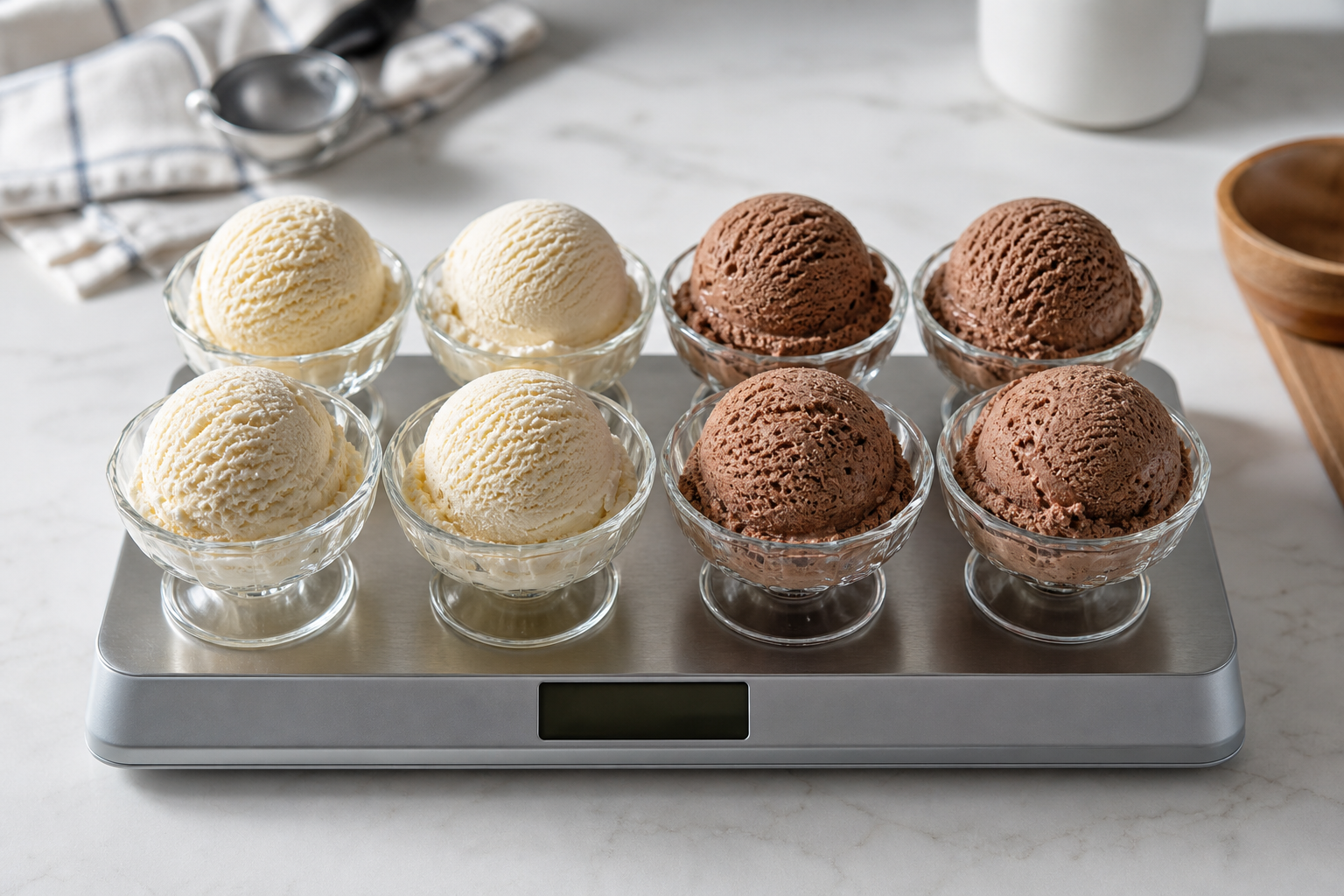
Ice cream is sold by volume, served by volume and labeled by volume. FDA’s reference amount is two-thirds of a cup. But part of every carton is air, whipped in during freezing. So a gram-based comparison misleads, and a scoop-based one tells you what you eat.
The numbers below convert USDA’s per-100 g values to per-100 mL using USDA’s own half-cup weights.
Per 100 mL, highest first
Eight frozen desserts, USDA reference values converted to volume
| Dessert | Density | kcal per 100 mL | kcal per 2/3 cup | kcal per pint | Sugar per 100 mL | Fat per 100 mL |
|---|---|---|---|---|---|---|
| French vanilla, soft-serve | 0.73 g/mL | 161 | 255 | 763 | 15.4 g | 9.5 g |
| Chocolate, rich | 0.63 g/mL | 157 | 248 | 743 | 10.9 g | 10.6 g |
| Vanilla, light | 0.64 g/mL | 116 | 182 | 547 | 14.2 g | 3.1 g |
| Vanilla, regular | 0.56 g/mL | 115 | 182 | 546 | 11.8 g | 6.1 g |
| Vanilla, light, no sugar added | 0.57 g/mL | 97 | 153 | 460 | 3.7 g | 4.3 g |
| Breyers Natural Light Vanilla | 0.57 g/mL | 93 | 147 | 440 | 13.1 g | 2.6 g |
| Vanilla, light, soft-serve | 0.73 g/mL | 92 | 144 | 433 | 13.6 g | 1.9 g |
| Breyers 98% Fat Free Vanilla | 0.57 g/mL | 79 | 124 | 373 | 12.0 g | 1.3 g |
Density is USDA’s half-cup weight divided by 118 mL. Breyers rows are USDA records; recipes change. Soft-serve is not sold by the pint; the column is there for scale.
What the table says
- Light vanilla equals regular vanilla by volume. 116 and 115 kcal per 100 mL. Per 100 g, light is 180 kcal and regular is 207. The light product is denser: 76 g per half cup against 66 g. Less air, same calories per scoop.
- Light qualifies on fat. USDA’s light vanilla carries 3.7 g of fat per half cup against 7.3 g for regular. That is the 50% fat cut the claim allows. The calories did not follow.
- Soft-serve is the densest. 0.73 g per mL. It is served closer to its frozen weight with less whipped air, so a cone of it carries more than the same cone of hard-packed regular.
- Rich chocolate is the heavy carton. 157 kcal per 100 mL and 10.6 g of fat.
- No-sugar-added is the low-sugar row. 3.7 g of sugar per 100 mL against 11.8 for regular.
- The 98% fat-free carton is the lowest by volume. 79 kcal per 100 mL, 373 per pint.
The air rule
The federal standard for ice cream sets three floors:
- At least 10% milkfat.
- At least 1.6 pounds of total food solids per gallon.
- A finished weight of at least 4.5 pounds per gallon, about 0.54 g per mL.
The third rule caps the air. Regular vanilla at 0.56 g per mL sits just above it. Products that miss the standard, on fat or on weight, are sold as “frozen dairy dessert” instead of ice cream. That name tells you something about the recipe; it does not tell you the calories. Read the panel.
The pint
Since FDA’s label update, the reference amount for ice cream is two-thirds of a cup, up from a half cup. A pint is now 3 servings, not 4. If you finish a pint of regular vanilla in one sitting, that is about 546 kcal. A pint is exactly 300% of the reference amount, so FDA requires a second column on the panel for the whole container.
The cons, carton by carton
- French vanilla, soft-serve. Most calories per 100 mL. 15.4 g of sugar.
- Chocolate, rich. Most fat per 100 mL.
- Vanilla, light. Same calories as regular by volume. More sugar per 100 mL: 14.2 g against 11.8.
- Vanilla, regular. Lightest by weight, which means the most air in the carton.
- Light, no sugar added. Sweetened with sugar alcohols or other sweeteners; the ingredient list names them.
- Breyers Natural Light Vanilla. 13.1 g of sugar per 100 mL.
- Light soft-serve. Low fat, 13.6 g of sugar per 100 mL.
- Breyers 98% Fat Free. Lowest calories here. 12.0 g of sugar per 100 mL, and the fat was replaced with carbohydrate.
Per dollar
BLS publishes an average price for prepackaged regular ice cream, per half gallon, US city average. April 2025: $6.229. A half gallon is 1.89 L, so that is about $0.33 per 100 mL and $0.52 per two-thirds-cup serving. At regular vanilla’s 115 kcal per 100 mL, that is about 350 kcal per dollar.
How to read a carton
- Grams per serving divided by the volume on the label. Under 0.6 g per mL is airy. Over 0.7 is dense.
- Calories per serving, then times 3 for a pint.
- If the front says light, check which it cut: fat or calories.
- Scoop two-thirds of a cup into a measuring cup once, then tip it into your usual bowl. That is what the label means.
All figures are estimates from USDA reference values. Brands and flavors differ.
Related files
A splash of heavy cream in coffee is about 51 kcal a tablespoon; the full ranking is in the coffee creamer file. The other per-volume trap on the dessert shelf is soda, compared in soda against sparkling water. For dairy with a better protein ratio, see cheese per 30 g.
All shelf comparisons are on the Grocery desk.