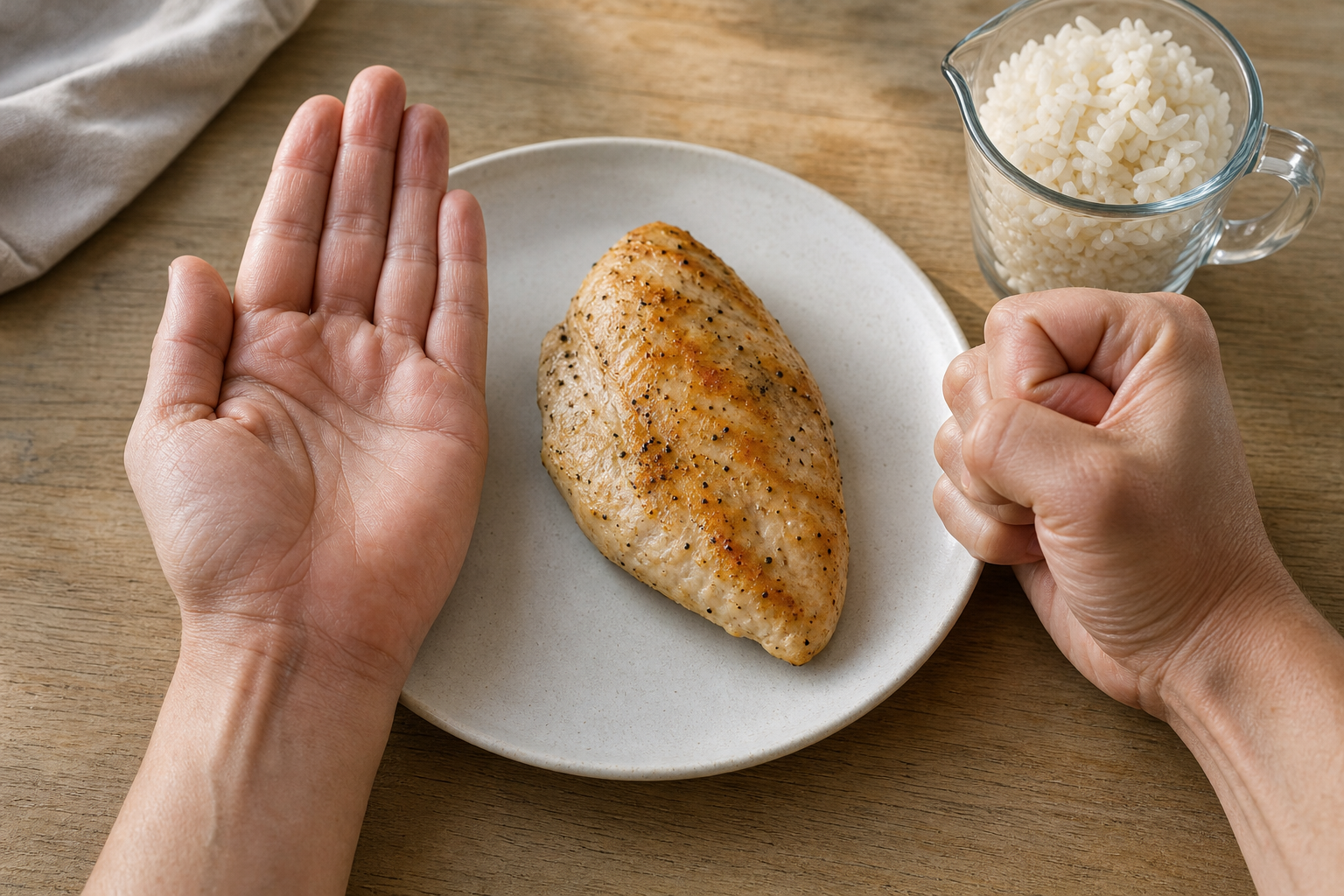
You do not carry a scale to dinner. You carry two hands. Hand measures turn a plate into rough cups, ounces and spoons, and the tables below turn those into grams and kcal with USDA values.
Every figure here is an estimate twice over: once for the hand, once for the food. Use it to get within range, not to the gram.
The four hand measures
- Fist is about 1 cup. Rice, pasta, cereal, cut fruit, a baked potato.
- Cupped palm is about 1/2 cup. Beans, cooked grains, a scoop of ice cream.
- Palm, without the fingers, is about 3 oz of cooked meat, fish or poultry, as thick as the palm.
- Thumb, tip to base, is about 1 tablespoon; the thumb tip is about 1 teaspoon. Oil, butter, peanut butter, mayonnaise.
A small handful is about 1 oz of nuts.
What each measure holds
Hand measures, the amount each stands for, and what it holds, USDA values
| Hand | Stands for | Food | Grams | kcal |
|---|---|---|---|---|
| Fist | 1 cup | Cooked white rice | 158 g | 205 kcal |
| Fist | 1 cup | Cooked spaghetti | 124 g | 196 kcal |
| Fist | 1 cup | Blueberries | 148 g | 84 kcal |
| Cupped palm | 1/2 cup | Cooked black beans | 86 g | 114 kcal |
| Cupped palm | 1/2 cup | Cooked white rice | 79 g | 103 kcal |
| Cupped palm | 1/2 cup | Vanilla ice cream | 66 g | 137 kcal |
| Palm, no fingers | 3 oz cooked | Chicken breast, roasted | 85 g | 140 kcal |
| Palm, no fingers | 3 oz cooked | Ground beef 80/20, pan-browned | 85 g | 231 kcal |
| Palm, no fingers | 3 oz cooked | Salmon, farmed, cooked | 85 g | 175 kcal |
| Thumb, tip to base | 1 tbsp | Peanut butter | 16 g | 96 kcal |
| Thumb, tip to base | 1 tbsp | Olive oil | 13.5 g | 119 kcal |
| Thumb, tip to base | 1 tbsp | Mayonnaise | 13.8 g | 94 kcal |
| Thumb tip | 1 tsp | Butter | 4.7 g | 34 kcal |
| Thumb tip | 1 tsp | Olive oil | 4.5 g | 40 kcal |
| Thumb tip | 1 tsp | White sugar | 4.2 g | 16 kcal |
| Small handful | 1 oz nuts | Almonds | 28.35 g | 164 kcal |
| Small handful | 1 oz nuts | Peanuts, dry-roasted | 28.35 g | 166 kcal |
| Small handful | 1 oz nuts | Walnuts | 28.35 g | 185 kcal |
The object version
NHLBI’s serving size card uses household objects instead of hands. The objects are fixed sizes, so they do not depend on who is holding the fork.
Objects on NHLBI’s serving size card, with a USDA example
| Object | Stands for | Example | Grams | kcal |
|---|---|---|---|---|
| Fist | 1 cup of cereal flakes | Corn flakes | 28 g | 108 kcal |
| Baseball | 1 cup of salad greens | Romaine, shredded | 47 g | 8 kcal |
| Baseball | 1 medium fruit | Apple, medium | 182 g | 95 kcal |
| Half a baseball | 1/2 cup cooked rice, pasta or potato | Cooked white rice | 79 g | 103 kcal |
| Large egg | 1/4 cup of raisins | Raisins | 36 g | 108 kcal |
| Four stacked dice | 1.5 oz cheese | Cheddar | 42.5 g | 171 kcal |
| Deck of cards | 3 oz meat, fish or poultry | Chicken breast, roasted | 85 g | 140 kcal |
| Checkbook | 3 oz grilled or baked fish | Cod, cooked | 85 g | 89 kcal |
| Ping-pong ball | 2 tbsp peanut butter | Peanut butter | 32 g | 191 kcal |
| One die | 1 tsp margarine or spread | Butter | 4.7 g | 34 kcal |
What the tables say
- The thumb is the expensive measure. One thumb of olive oil is about 119 kcal; a palm of roasted chicken breast is 140. A thumb of peanut butter is 96.
- A fist of grains is about 200 kcal. Cooked rice 205, cooked spaghetti 196. A fist of blueberries is 84.
- The palm varies by cut. 3 oz of chicken breast is 140 kcal, farmed salmon 175, 80/20 ground beef 231.
- A handful of nuts is about 165 to 185 kcal. Almonds and peanuts near 165, walnuts 185.
- Fat is in the small measures. Butter, oil and mayonnaise all sit in the thumb rows. Those are the ones to measure with a real spoon when you can.
MyPlate’s ounce-equivalents
USDA’s MyPlate counts grains and protein in ounce-equivalents. The units line up with the hand measures:
- 1 oz-equivalent of grains: 1 slice of bread, 1 cup of ready-to-eat cereal, or 1/2 cup of cooked rice, pasta or cereal.
- 1 oz-equivalent of protein: 1 oz of cooked meat, poultry or fish, 1 egg, 1 tbsp of peanut butter, 1/4 cup of cooked beans, or 1/2 oz of nuts or seeds.
A palm of chicken is 3 protein ounce-equivalents. A fist of rice is 2 grain ounce-equivalents.
The cons of hand portions
- Hands are not standard. A large hand holds more than a small one. That is why the last section exists.
- Piling changes volume. A heaped fist of pasta holds more than a level cup. Packed food weighs more than loose.
- Thickness is a guess. A palm-sized steak an inch thick is not a palm-sized steak half an inch thick.
- It is worst where kcal are densest. A thumb of oil off by a third is about 40 kcal. A fist of salad off by a third is a few.
Calibrate once
- Fill a measuring cup with cooked rice and tip it out next to your fist.
- Weigh a cooked chicken breast portion the size of your palm.
- Measure a tablespoon of peanut butter and compare it to your thumb.
If your hand runs large or small, adjust every row by the same share. Exact cup and spoon weights are in cups to grams, and how a label’s serving compares with the package in the serving size reality check. Cheese at its 30 g label serving is in the cheese file, and peanut butter by the level tablespoon in the peanut butter file.
Every lookup table is filed on the Reference desk.