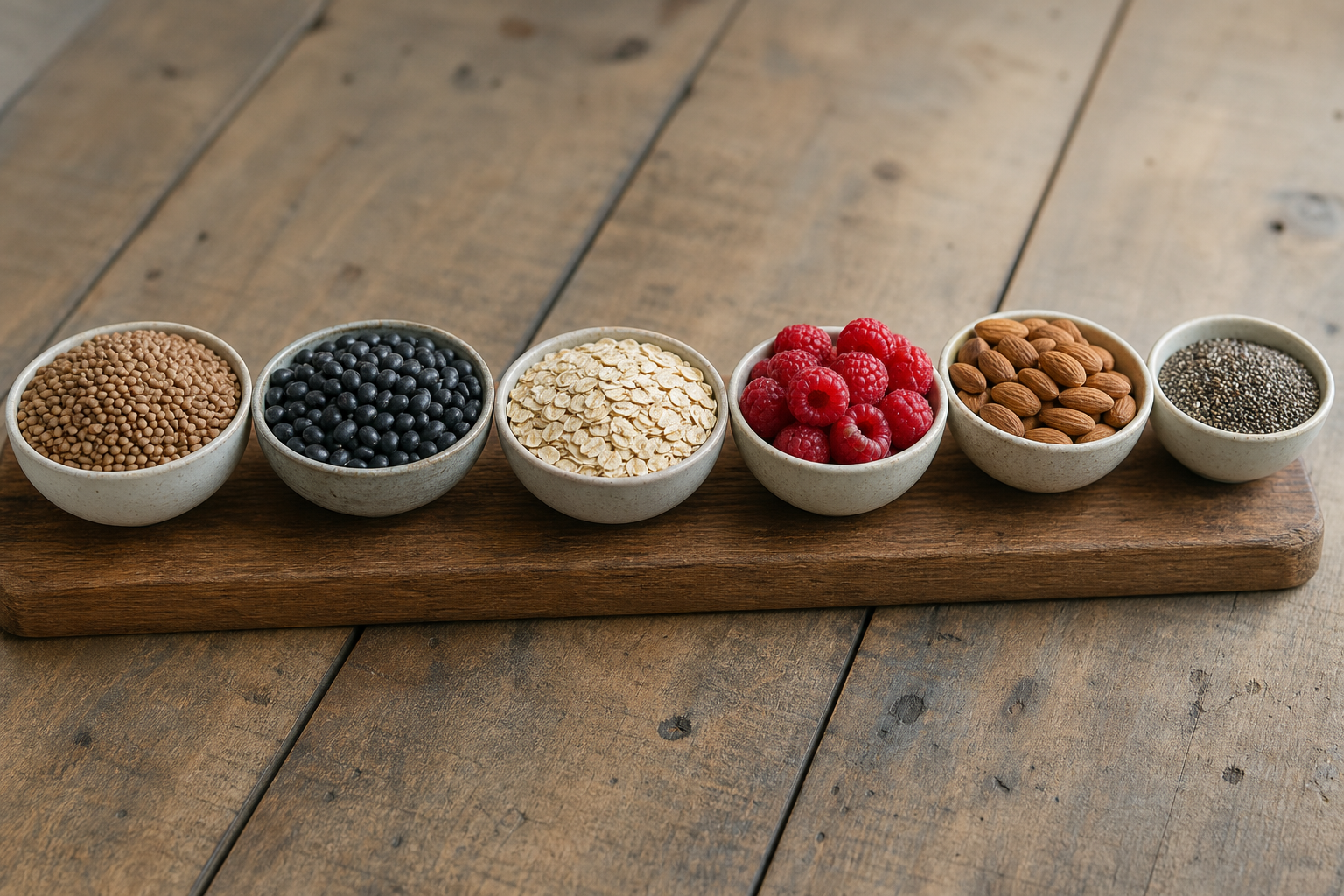
Fiber is the line on the label most people read last and need most. FDA’s Daily Value is 28 g for a 2,000 kcal reference diet, and the Dietary Guidelines put the target at 14 g per 1,000 kcal. This file ranks 60 foods by fiber per 100 g, with fiber per 100 kcal next to it.
Every row is USDA SR Legacy total dietary fiber. Grains, beans and vegetables are cooked where the row says so, raw otherwise. Label figures for a specific product can differ, especially where fiber is added as an ingredient. Every figure is an estimate.
How to read the columns
- Fiber is grams of total dietary fiber per 100 g.
- kcal is energy per 100 g.
- Fiber per 100 kcal is fiber ÷ kcal × 100. At 1.4 g per 100 kcal, a food matches the 14 g per 1,000 kcal target on its own.
Label claims use the reference amount, not 100 g. “Good source of fiber” means at least 2.8 g per serving, 10% of the Daily Value. “High fiber” means 5.6 g or more, 20%.
The tables
10 g of fiber or more per 100 g: 14 foods, highest first
| Food | Fiber | kcal | Fiber per 100 kcal |
|---|---|---|---|
| Wheat bran | 42.8 g | 216 kcal | 19.8 g |
| Cocoa powder, unsweetened | 37.0 g | 228 kcal | 16.2 g |
| Chia seeds | 34.4 g | 486 kcal | 7.1 g |
| Flaxseed | 27.3 g | 534 kcal | 5.1 g |
| Bran flakes cereal | 18.3 g | 328 kcal | 5.6 g |
| Coconut, dried, unsweetened | 16.3 g | 660 kcal | 2.5 g |
| Air-popped popcorn | 14.5 g | 387 kcal | 3.7 g |
| Almonds | 12.5 g | 579 kcal | 2.2 g |
| Sunflower kernels, dry-roasted | 11.1 g | 582 kcal | 1.9 g |
| Dark chocolate, 70-85% cacao | 10.9 g | 598 kcal | 1.8 g |
| Navy beans, boiled | 10.5 g | 140 kcal | 7.5 g |
| Pistachios, dry-roasted | 10.3 g | 572 kcal | 1.8 g |
| Rolled oats, dry | 10.1 g | 379 kcal | 2.7 g |
| Toasted oat cereal (Cheerios) | 10.1 g | 372 kcal | 2.7 g |
5 to 9.9 g per 100 g: 24 foods, highest first
| Food | Fiber | kcal | Fiber per 100 kcal |
|---|---|---|---|
| Figs, dried | 9.8 g | 249 kcal | 3.9 g |
| Hazelnuts | 9.7 g | 628 kcal | 1.5 g |
| Pecans | 9.6 g | 691 kcal | 1.4 g |
| Pinto beans, boiled | 9.0 g | 143 kcal | 6.3 g |
| Black beans, boiled | 8.7 g | 132 kcal | 6.6 g |
| Peanuts, dry-roasted | 8.4 g | 587 kcal | 1.4 g |
| Split peas, boiled | 8.3 g | 118 kcal | 7.0 g |
| Lentils, boiled | 7.9 g | 116 kcal | 6.8 g |
| Chickpeas, boiled | 7.6 g | 164 kcal | 4.6 g |
| Kidney beans, boiled | 7.4 g | 127 kcal | 5.8 g |
| Apricots, dried | 7.3 g | 241 kcal | 3.0 g |
| Prunes | 7.1 g | 240 kcal | 3.0 g |
| Avocado | 6.7 g | 160 kcal | 4.2 g |
| Medjool dates | 6.7 g | 277 kcal | 2.4 g |
| Walnuts | 6.7 g | 654 kcal | 1.0 g |
| Raspberries | 6.5 g | 52 kcal | 12.5 g |
| Corn tortilla | 6.3 g | 218 kcal | 2.9 g |
| Pumpkin seeds, dried | 6.0 g | 559 kcal | 1.1 g |
| Whole-wheat bread | 6.0 g | 252 kcal | 2.4 g |
| Artichoke, boiled | 5.7 g | 53 kcal | 10.8 g |
| Hummus | 5.5 g | 237 kcal | 2.3 g |
| Guava | 5.4 g | 68 kcal | 7.9 g |
| Blackberries | 5.3 g | 43 kcal | 12.3 g |
| Edamame, prepared | 5.2 g | 121 kcal | 4.3 g |
Under 5 g per 100 g: 22 foods, highest first
| Food | Fiber | kcal | Fiber per 100 kcal |
|---|---|---|---|
| Bulgur, cooked | 4.5 g | 83 kcal | 5.4 g |
| Green peas, boiled | 4.5 g | 78 kcal | 5.8 g |
| Raisins | 4.5 g | 299 kcal | 1.5 g |
| Kale, raw | 4.1 g | 35 kcal | 11.7 g |
| Barley, pearled, cooked | 3.8 g | 123 kcal | 3.1 g |
| Sweet potato, baked | 3.3 g | 90 kcal | 3.7 g |
| Pear | 3.1 g | 57 kcal | 5.4 g |
| Kiwifruit | 3.0 g | 61 kcal | 4.9 g |
| Carrots, raw | 2.8 g | 41 kcal | 6.8 g |
| Quinoa, cooked | 2.8 g | 120 kcal | 2.3 g |
| White bread | 2.7 g | 266 kcal | 1.0 g |
| Banana | 2.6 g | 89 kcal | 2.9 g |
| Broccoli, raw | 2.6 g | 34 kcal | 7.6 g |
| Brussels sprouts, boiled | 2.6 g | 36 kcal | 7.2 g |
| Apple, with skin | 2.4 g | 52 kcal | 4.6 g |
| Blueberries | 2.4 g | 57 kcal | 4.2 g |
| Orange | 2.4 g | 47 kcal | 5.1 g |
| Potato, baked, with skin | 2.2 g | 93 kcal | 2.4 g |
| Spinach, raw | 2.2 g | 23 kcal | 9.6 g |
| Strawberries | 2.0 g | 32 kcal | 6.2 g |
| Brown rice, cooked | 1.6 g | 123 kcal | 1.3 g |
| White rice, cooked | 0.4 g | 130 kcal | 0.3 g |
Ranked the other way
The 12 foods in this file with the most fiber per 100 kcal
| Food | Fiber per 100 kcal | Fiber per 100 g | kcal per 100 g |
|---|---|---|---|
| Wheat bran | 19.8 g | 42.8 g | 216 kcal |
| Cocoa powder, unsweetened | 16.2 g | 37.0 g | 228 kcal |
| Raspberries | 12.5 g | 6.5 g | 52 kcal |
| Blackberries | 12.3 g | 5.3 g | 43 kcal |
| Kale, raw | 11.7 g | 4.1 g | 35 kcal |
| Artichoke, boiled | 10.8 g | 5.7 g | 53 kcal |
| Spinach, raw | 9.6 g | 2.2 g | 23 kcal |
| Guava | 7.9 g | 5.4 g | 68 kcal |
| Broccoli, raw | 7.6 g | 2.6 g | 34 kcal |
| Navy beans, boiled | 7.5 g | 10.5 g | 140 kcal |
| Brussels sprouts, boiled | 7.2 g | 2.6 g | 36 kcal |
| Chia seeds | 7.1 g | 34.4 g | 486 kcal |
What the tables say
- Bran and seeds top the per-gram list. Wheat bran is 42.8 g per 100 g, cocoa powder 37, chia 34.4, flaxseed 27.3. All of them are eaten by the spoonful.
- Beans are the plate-sized leaders. Cooked navy beans are 10.5 g per 100 g, pinto 9.0, black 8.7, split peas 8.3, lentils 7.9, chickpeas 7.6.
- Berries and greens top the per-kcal list. Raspberries and blackberries carry about 12 g of fiber per 100 kcal, kale 11.7, cooked artichoke 10.8. They are low per 100 g only because they are mostly water.
- Nuts are high per gram, low per kcal. Almonds are 12.5 g per 100 g and 2.2 per 100 kcal. Pecans and walnuts sit near 1.
- Refining shows up in grains. Whole-wheat bread is 6.0 g per 100 g, white bread 2.7. Brown rice is 1.6 cooked, white rice 0.4.
- Popcorn is a whole grain. Air-popped, it is 14.5 g per 100 g. A cup weighs 8 g, so the per-cup figure is about 1.2 g.
The cons of this table
- Total fiber is one number. USDA’s row does not separate soluble from insoluble fiber, or naturally occurring from added.
- Per 100 g favors dry foods. Nobody eats 100 g of wheat bran. Scale to your portion.
- Cooked and dry do not mix. Pinto beans are 15.5 g per 100 g dry and 9.0 cooked. Use the row in the state you weighed.
- Labels add isolated fibers. Some breads, bars and tortillas reach high-fiber claims with added fiber ingredients. The ingredient list names them.
Wraps that reach a high-fiber claim, and how, are in the tortilla fiber file. Cereal boxes, with fiber next to sugar, are in cereal with the least sugar. Bread by the slice is in the bread file. The same 100 g base for protein is in the 80-food protein table, and for energy in the 120-food table.
Every lookup table is filed on the Reference desk.