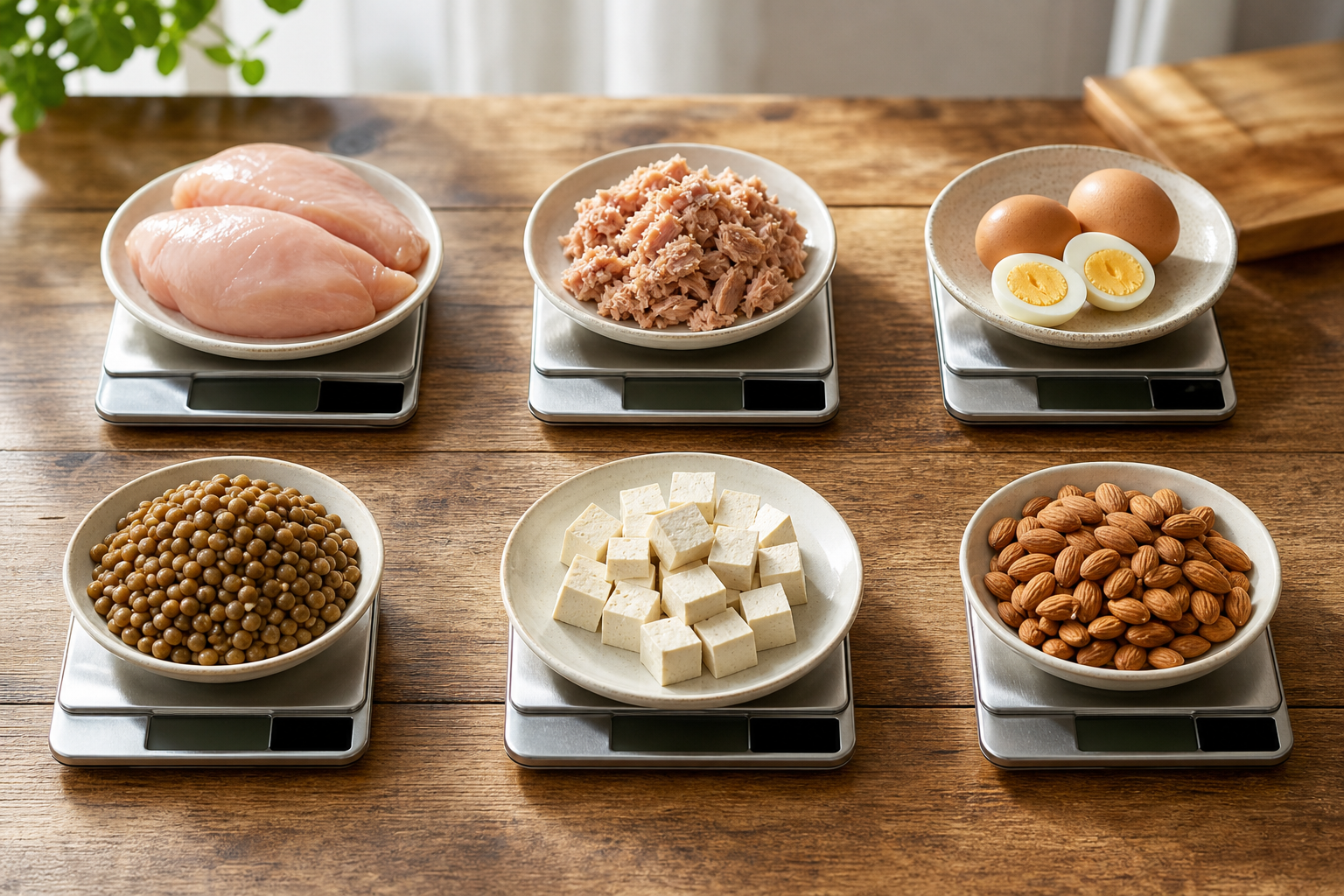
Protein lists usually rank by grams per 100 g. That favors anything dry: powders, jerky, hard cheese, seeds. A second ranking, grams per 100 kcal, favors lean foods with water in them. This file prints both for 80 foods, so you can see where each one sits on each list.
Every row is a USDA SR Legacy value. Meat, fish and grains are cooked unless the row says raw or dry, because that is how they are usually weighed on the plate. Brands vary, and every figure is an estimate.
How to read the columns
- Protein is grams per 100 g of the food in the state named.
- kcal is energy per 100 g.
- Protein per 100 kcal is protein ÷ kcal × 100. It answers a different question: how much protein comes with a fixed amount of energy.
FDA’s Daily Value for protein is 50 g, set for a 2,000 kcal reference diet. Most labels print grams of protein without a percent; a %DV is required only when the label makes a protein claim or the food is for young children.
The tables
20 g of protein or more per 100 g: 40 foods, highest first
| Food | Protein | kcal | Protein per 100 kcal |
|---|---|---|---|
| Whey protein powder | 78.1 g | 352 kcal | 22.2 g |
| Vital wheat gluten | 75.2 g | 370 kcal | 20.3 g |
| Pork rinds, plain | 61.3 g | 544 kcal | 11.3 g |
| Spirulina, dried | 57.5 g | 290 kcal | 19.8 g |
| Peanut flour, defatted | 52.2 g | 327 kcal | 16.0 g |
| Soybeans, dry-roasted | 43.3 g | 449 kcal | 9.6 g |
| Parmesan, hard | 35.8 g | 392 kcal | 9.1 g |
| Bacon, pan-fried | 33.9 g | 468 kcal | 7.2 g |
| Beef jerky | 33.2 g | 410 kcal | 8.1 g |
| Hemp seeds, hulled | 31.6 g | 553 kcal | 5.7 g |
| Chicken breast, roasted, no skin | 31.0 g | 165 kcal | 18.8 g |
| Pumpkin seeds, dried | 30.2 g | 559 kcal | 5.4 g |
| Turkey breast, roasted | 30.1 g | 147 kcal | 20.5 g |
| Top sirloin, broiled, lean | 29.4 g | 178 kcal | 16.5 g |
| Tuna, yellowfin, cooked | 29.1 g | 130 kcal | 22.4 g |
| Ground beef 93/7, pan-browned | 28.9 g | 209 kcal | 13.8 g |
| Ground turkey 93/7, pan-broiled | 27.1 g | 213 kcal | 12.7 g |
| Ground beef 80/20, pan-browned | 27.0 g | 272 kcal | 9.9 g |
| Swiss cheese | 27.0 g | 393 kcal | 6.9 g |
| Pork loin chop, broiled, lean | 26.8 g | 180 kcal | 14.9 g |
| Beef liver, pan-fried | 26.5 g | 175 kcal | 15.2 g |
| Pork tenderloin, roasted | 26.2 g | 143 kcal | 18.3 g |
| Tilapia, cooked | 26.1 g | 128 kcal | 20.4 g |
| Ground pork, cooked | 25.7 g | 297 kcal | 8.6 g |
| Chicken thigh, roasted, no skin | 24.8 g | 179 kcal | 13.8 g |
| Lamb, ground, broiled | 24.8 g | 283 kcal | 8.7 g |
| Sardines, canned in oil, with bone | 24.6 g | 208 kcal | 11.8 g |
| Peanuts, dry-roasted | 24.4 g | 587 kcal | 4.1 g |
| Mozzarella, part-skim | 24.3 g | 254 kcal | 9.6 g |
| Chicken drumstick, roasted, no skin | 24.2 g | 155 kcal | 15.6 g |
| Shrimp, cooked | 24.0 g | 99 kcal | 24.2 g |
| Tuna, white, canned in water | 23.6 g | 128 kcal | 18.5 g |
| Salmon, pink, canned | 23.1 g | 138 kcal | 16.7 g |
| Cheddar | 22.9 g | 403 kcal | 5.7 g |
| Cod, cooked | 22.8 g | 105 kcal | 21.7 g |
| Peanut butter, smooth | 22.2 g | 598 kcal | 3.7 g |
| Salmon, Atlantic, farmed, cooked | 22.1 g | 206 kcal | 10.7 g |
| Almonds | 21.1 g | 579 kcal | 3.7 g |
| Pistachios, dry-roasted | 21.1 g | 572 kcal | 3.7 g |
| Tempeh | 20.3 g | 192 kcal | 10.6 g |
10 to 19.9 g per 100 g: 23 foods, highest first
| Food | Protein | kcal | Protein per 100 kcal |
|---|---|---|---|
| Tuna, light, canned in water | 19.4 g | 86 kcal | 22.6 g |
| Sunflower kernels, dry-roasted | 19.3 g | 582 kcal | 3.3 g |
| Flaxseed | 18.3 g | 534 kcal | 3.4 g |
| Tofu, firm | 17.3 g | 144 kcal | 12.0 g |
| Ham, sliced | 16.6 g | 164 kcal | 10.1 g |
| Chia seeds | 16.5 g | 486 kcal | 3.4 g |
| Wheat bran | 15.6 g | 216 kcal | 7.2 g |
| Cashews, dry-roasted | 15.3 g | 574 kcal | 2.7 g |
| Walnuts | 15.2 g | 654 kcal | 2.3 g |
| Turkey breast, deli, sliced | 14.8 g | 106 kcal | 14.0 g |
| Feta | 14.2 g | 265 kcal | 5.4 g |
| Rolled oats, dry | 13.2 g | 379 kcal | 3.5 g |
| Pasta, dry | 13.0 g | 371 kcal | 3.5 g |
| Air-popped popcorn | 12.9 g | 387 kcal | 3.3 g |
| Egg, whole, raw | 12.6 g | 143 kcal | 8.8 g |
| Whole-wheat bread | 12.4 g | 252 kcal | 4.9 g |
| Edamame, prepared | 11.9 g | 121 kcal | 9.8 g |
| Beef hot dog, heated | 11.7 g | 322 kcal | 3.6 g |
| Ricotta, part-skim | 11.4 g | 138 kcal | 8.3 g |
| Egg white, raw | 10.9 g | 52 kcal | 21.0 g |
| Bagel, plain | 10.6 g | 264 kcal | 4.0 g |
| Cottage cheese, 2% | 10.4 g | 81 kcal | 12.9 g |
| Greek yogurt, plain, nonfat | 10.2 g | 59 kcal | 17.3 g |
Under 10 g per 100 g: 17 foods, highest first
| Food | Protein | kcal | Protein per 100 kcal |
|---|---|---|---|
| Lentils, boiled | 9.0 g | 116 kcal | 7.8 g |
| Pinto beans, boiled | 9.0 g | 143 kcal | 6.3 g |
| Black beans, boiled | 8.9 g | 132 kcal | 6.7 g |
| Chickpeas, boiled | 8.9 g | 164 kcal | 5.4 g |
| Hummus | 7.8 g | 237 kcal | 3.3 g |
| Pasta, cooked | 5.8 g | 158 kcal | 3.7 g |
| Green peas, boiled | 5.2 g | 78 kcal | 6.6 g |
| Quinoa, cooked | 4.4 g | 120 kcal | 3.7 g |
| Yogurt, plain, whole milk | 3.5 g | 61 kcal | 5.7 g |
| Skim milk | 3.4 g | 34 kcal | 9.9 g |
| Soymilk, unfortified | 3.3 g | 54 kcal | 6.1 g |
| Whole milk | 3.1 g | 61 kcal | 5.2 g |
| Spinach, raw | 2.9 g | 23 kcal | 12.4 g |
| Broccoli, raw | 2.8 g | 34 kcal | 8.3 g |
| White rice, cooked | 2.7 g | 130 kcal | 2.1 g |
| Potato, baked, with skin | 2.5 g | 93 kcal | 2.7 g |
| Banana | 1.1 g | 89 kcal | 1.2 g |
Ranked the other way
The 15 foods in this file with the most protein per 100 kcal
| Food | Protein per 100 kcal | Protein per 100 g | kcal per 100 g |
|---|---|---|---|
| Shrimp, cooked | 24.2 g | 24.0 g | 99 kcal |
| Tuna, light, canned in water | 22.6 g | 19.4 g | 86 kcal |
| Tuna, yellowfin, cooked | 22.4 g | 29.1 g | 130 kcal |
| Whey protein powder | 22.2 g | 78.1 g | 352 kcal |
| Cod, cooked | 21.7 g | 22.8 g | 105 kcal |
| Egg white, raw | 21.0 g | 10.9 g | 52 kcal |
| Turkey breast, roasted | 20.5 g | 30.1 g | 147 kcal |
| Tilapia, cooked | 20.4 g | 26.1 g | 128 kcal |
| Vital wheat gluten | 20.3 g | 75.2 g | 370 kcal |
| Spirulina, dried | 19.8 g | 57.5 g | 290 kcal |
| Chicken breast, roasted, no skin | 18.8 g | 31.0 g | 165 kcal |
| Tuna, white, canned in water | 18.5 g | 23.6 g | 128 kcal |
| Pork tenderloin, roasted | 18.3 g | 26.2 g | 143 kcal |
| Greek yogurt, plain, nonfat | 17.3 g | 10.2 g | 59 kcal |
| Salmon, pink, canned | 16.7 g | 23.1 g | 138 kcal |
What the tables say
- Dry foods top the per-gram list. Whey powder, vital wheat gluten, spirulina and defatted peanut flour all clear 50 g per 100 g. You eat them by the spoonful, not the plate.
- Lean seafood tops the per-kcal list. Shrimp, light tuna, yellowfin and cod give 21 to 24 g of protein per 100 kcal.
- Nuts and seeds split the two lists. Peanuts are 24.4 g per 100 g, high on the first list, and 4.1 g per 100 kcal, low on the second. Almonds, pistachios and peanut butter sit at 3.7.
- Fat moves meat down the second list. Ground beef 93/7 is 13.8 g per 100 kcal. 80/20 is 9.9. Bacon is 7.2.
- Soy leads the whole plant foods. Dry-roasted soybeans are 43 g per 100 g, tempeh 20, tofu 17. Cooked lentils and beans sit at 8.7 to 9.0.
- Dairy runs wide. Parmesan is 35.8 g per 100 g. Nonfat Greek yogurt is 10.2, but 17.3 per 100 kcal. Milk is about 3.
The cons of this table
- Per 100 g favors powders. 100 g of whey or spirulina is not a realistic serving. Use the per-100 kcal column, or scale to what you eat.
- Cooked and raw do not mix. Roasted chicken breast is 31.0 g per 100 g. Raw, it is 22.5. Use the row in the state you weighed. The conversion is in raw to cooked weights.
- Grams are not quality. This table counts protein. It does not score amino acids or digestibility.
- Labels can differ. A brand’s jerky, bar or yogurt can sit well away from the USDA row. Read the panel when you have it.
Yogurt cups ranked by the same per-100 kcal measure are in the yogurt file, wrappers in protein bars ranked, and cartons in plant milks by protein. Protein per dollar, with grocery prices, is in kcal per dollar.
Every lookup table is filed on the Reference desk.