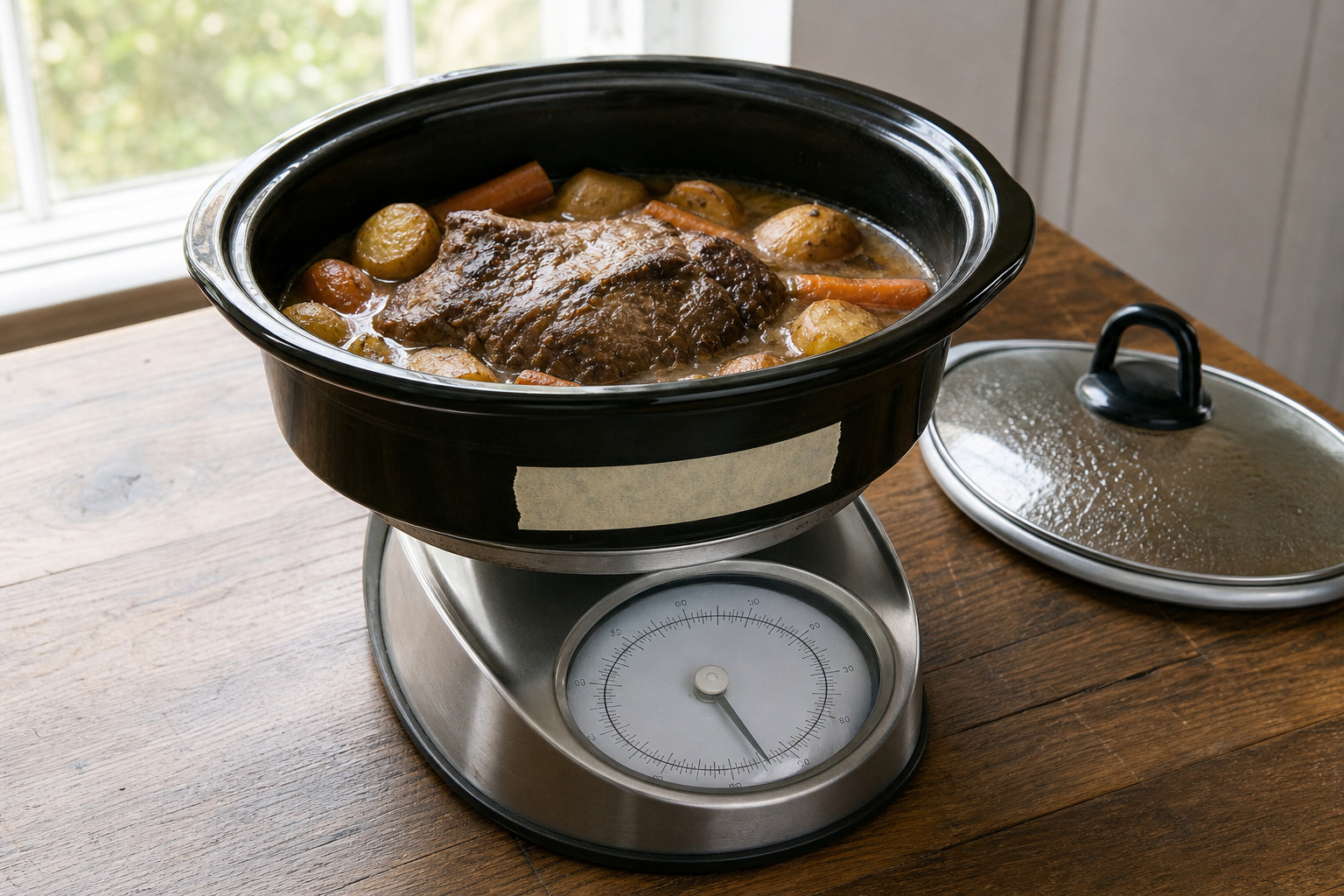
A 3 lb boneless chuck roast, potatoes, carrots, onion and two cups of broth go into my slow cooker at 3,634 kcal. Eight hours later, the insert holds 3,634 kcal, minus whatever fat I lift off the top. Water moves around in there. Calories do not leave.
What changes is the weight. The roast gives up about a third of its weight as juice, a little steam escapes under the lid, and the pot ends up a different size than you think. If you portion by the ladle, that matters. If you portion by weight, it does not.
The pot, as built
Chuck pot roast for six, USDA SR Legacy values and BLS August 2025 prices
| Ingredient | Grams in | kcal | Cost | Catch |
|---|---|---|---|---|
| Boneless chuck roast, raw | 1,360 | 2,747 | $26.52 | 76% of the pot’s kcal |
| Potatoes, skin on | 600 | 462 | $1.32 | Soak up the fat that renders |
| Carrots | 300 | 123 | not priced | No BLS series |
| Onion | 250 | 100 | not priced | No BLS series |
| Beef broth, ready to serve | 480 | 34 | not priced | 372 mg sodium per 100 g |
| Tomato paste, 2 tbsp | 32 | 26 | not priced | |
| Garlic, 4 cloves | 12 | 18 | not priced | |
| Canola oil, 1 tbsp, for the sear | 14 | 124 | not priced | Count it even if the pan keeps some |
| Total | 3,048 | 3,634 | $27.84 priced |
One sixth is 606 kcal and $4.64 of the priced ingredients. The roast price is BLS’s US city average for boneless USDA Choice chuck, August 2025, $8.845 per lb. It is not a receipt.
The meat is USDA’s under blade pot roast, boneless, trimmed to 0 inches of fat, Choice grade: 202 kcal per 100 g raw. It is the closest USDA line to the boneless chuck roast in a store case.
Where the weight goes
USDA’s cooking-yield table measured 33 braised under blade roasts. On average they came out at 64% of their raw weight, with a range of 61 to 78%. The same table splits the loss: water down 34.8% of the raw weight, fat down 0.8%.
For a 1,360 g roast, that is about 490 g of weight off the meat, and about 473 g of it is water. In a pot on the stove, a lot of that would leave as steam. In a slow cooker with the lid on, most of it lands in the liquid. FSIS describes the cooker as a tightly covered container where the steam does part of the work, and its advice is to keep the lid in place except to stir or check doneness.
So the 480 g of broth you started with is not what you serve. The roast added close to the weight it shed, as juice. The vegetables add some of theirs. Some escapes under the rim. How much escapes depends on the cooker and the fit of the lid, which is why I weigh instead of guessing.
The meat itself gets denser, not bigger. USDA’s raw roast is 202 kcal per 100 g; the braised one is 306. Its paired weights show a 949 g raw roast braising to 658 g. Nothing was added. Water left.
Weigh the insert, then the pot
- Weigh the empty insert once. Write the weight on a strip of tape on the side.
- Build the pot and add up the ingredients as you go. The table above is that sheet.
- When it is done, put the full insert on the scale. Subtract the tape number. That is the food.
- Divide the total kcal by the grams of food. That is kcal per 100 g for this pot, this time.
My scale reads to 5 kg, and a full 6-quart insert can run past that with the ceramic. If yours tops out, lift the roast and vegetables onto a tared sheet pan, weigh them, then weigh the insert with the liquid, and add the two.
Here is why it matters. The same pot, at four possible finished weights:
The same 3,634 kcal at four finished weights
| Finished food, g | kcal per 100 g | One sixth, g | kcal per sixth | kcal per 240 g scoop | Catch |
|---|---|---|---|---|---|
| 3,048, nothing escaped | 119 | 508 | 606 | 286 | Lid fits tight |
| 2,948, 100 g escaped | 123 | 491 | 606 | 296 | A small loss, for scale |
| 2,748, 300 g escaped | 132 | 458 | 606 | 317 | Lid lifted often |
| 2,448, 600 g escaped | 148 | 408 | 606 | 356 | Lid off to reduce |
Split the pot into six by weight and every sixth is 606 kcal whatever the steam did. Serve by the scoop and the same scoop runs 286 to 356 kcal. These rows are arithmetic, not readings from my cooker.
Fat rises, so chill it
The fat that leaves the meat goes into the liquid and floats. For a 0-inch trim roast, USDA’s 0.8% drop in fat is about 11 g on a 1,360 g roast, roughly 98 kcal. Add whatever part of the searing oil came along.
A roast with its fat cap on is a different pot. USDA’s braised arm pot roast with 1/8 inch of trim gave up 8.3 g of fat per 100 g raw. On the same 1,360 g, that is about 113 g of fat and 1,000 kcal sitting on top of the liquid. That figure comes from a single sample, so treat it as a direction, not a constant.
FSIS wants leftovers in shallow covered containers and in the fridge within two hours. That is also the best way to get the fat off. Pour the liquid into a shallow container, chill it, and the fat sets in a disc. Lift it, weigh it, and subtract 9 kcal per gram. Beef tallow is 902 kcal per 100 g; your disc carries some gel underneath, so 9 a gram is the most it can be.
The cook
Sear: 12-inch cast-iron, 1 tbsp of oil, medium-high, about 4 minutes a side until the roast lets go of the pan. Vegetables go in the insert first, since FSIS notes they cook slower than meat, then the roast, broth and paste on top.
Heat: FSIS puts slow cookers between 170 and 280°F and suggests high for the first hour when you can, then low. I run high for an hour and low for seven. Chuck is done when a fork turns in it without pushing back, around 200°F in the center. FSIS’s safety line for a whole beef roast is 145°F with a 3-minute rest; the extra heat is for texture.
Reheat leftovers on the stove or in the microwave to 165°F. FSIS does not recommend reheating in the slow cooker.
What this file does not cover
- Your lid. The 100 to 600 g rows are scenarios. Weigh your own pot once and you will know where it sits.
- Bone-in cuts. Bone weight goes into the insert and comes back out; weigh the bones and subtract them.
- Beans and grains. They take up water, the opposite of a roast. The weigh-and-divide method still works.
- Sodium. Broth is most of it; low-sodium broth is 225 mg per 100 g against 372.
For the same weigh-and-divide method on a week of lunches, see five days of meal prep. For fat that renders out of chicken skin, see chicken thighs, skin on or off. For the oil in the sear, see the hidden 120 kcal tablespoon. Every recipe on this desk is on the Cooking desk.
How these numbers were built
Ingredient values, roast weights and the tallow figure are from USDA FoodData Central, SR Legacy. The yield, moisture and fat-loss figures are from USDA’s Table of Cooking Yields for Meat and Poultry. Temperatures and handling are from FSIS’s slow cooker page and its minimum temperature chart. Prices are BLS US city averages for August 2025, the latest month published before this date, not a receipt. The finished-weight rows are arithmetic on the total. Consulted Oct 3, 2025. Calorie figures are estimates.