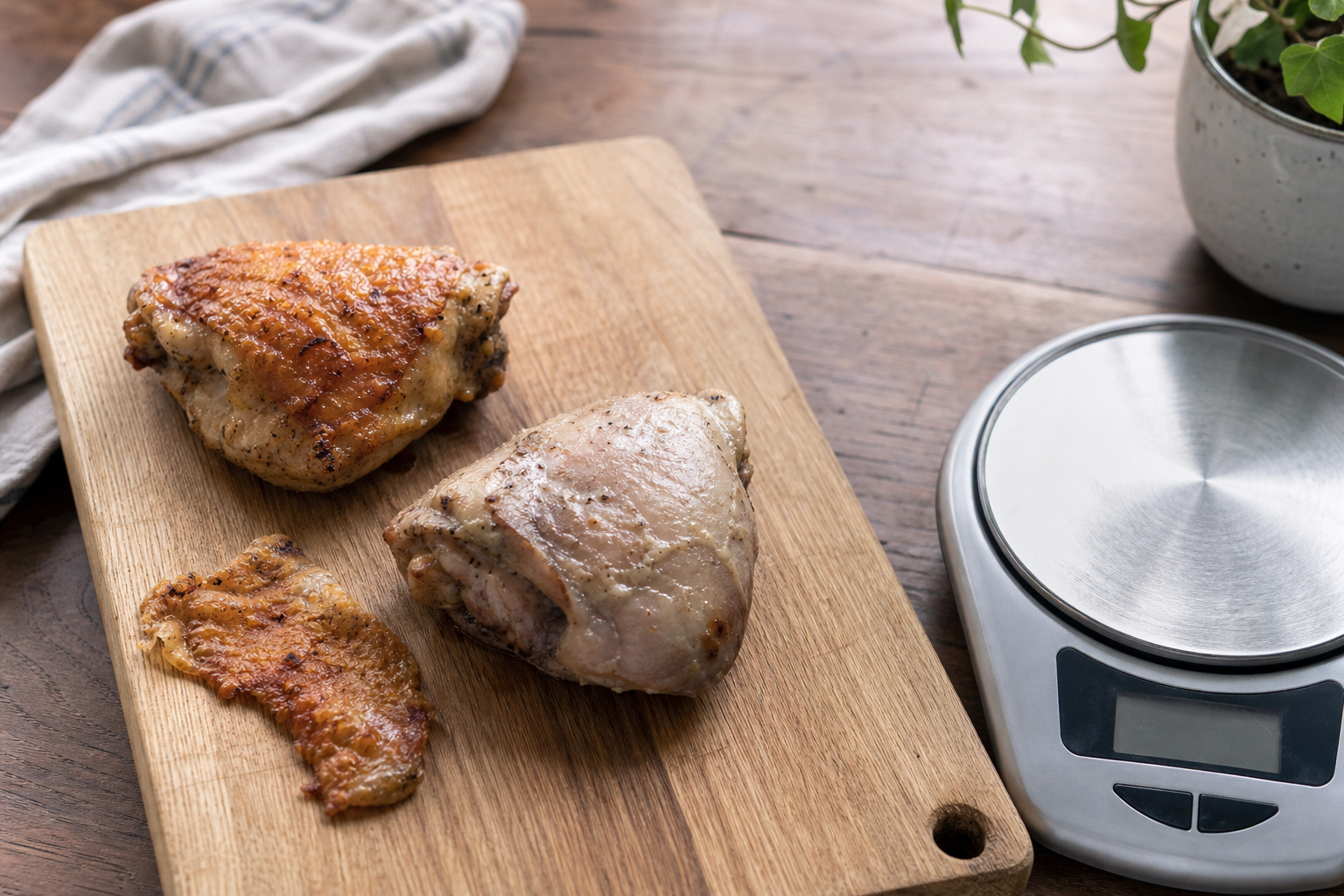
A roasted chicken thigh off the bone weighs 137 g with its skin and carries about 318 kcal, by USDA’s average portion weights. Pull the skin and it is 116 g and about 208 kcal. The skin is 15% of the weight on the plate and a third of the energy.
Look up chicken thigh calories and you get one number. There are four that matter: raw or roasted, skin or not. Here are all of them from USDA FoodData Central, and what I do with them at the stove.
Per 100 g
Chicken thigh per 100 g, USDA SR Legacy, no salt added unless noted
| Line | kcal | Protein, g | Fat, g | Sodium, mg | Catch |
|---|---|---|---|---|---|
| Skin only, roasted | 454 | 20.4 | 40.7 | 65 | Whole-bird skin, not thigh skin |
| Thigh, fried in flour, meat and skin | 262 | 26.8 | 15.0 | 88 | Frying oil included |
| Rotisserie thigh, meat and skin | 233 | 22.9 | 15.7 | 345 | Store seasoning |
| Thigh, roasted, meat and skin | 232 | 23.3 | 14.7 | 102 | You eat the skin |
| Thigh, raw, meat and skin | 221 | 16.5 | 16.6 | 81 | Weight before the oven |
| Thigh, roasted, meat only | 179 | 24.8 | 8.2 | 106 | Skin pulled after the roast |
| Thigh, raw, meat only | 121 | 19.7 | 4.1 | 95 | What a skinless pack is raw |
Raw, the skin is the gap between 121 and 221 kcal per 100 g. Roasted, the gap closes to 179 against 232. The oven renders fat out of the skin, and a lot of it does not come back.
Per thigh
One thigh off the bone, USDA average portion weights
| Thigh | Weight, g | kcal | Protein, g | Fat, g |
|---|---|---|---|---|
| Raw, meat and skin | 193 | 427 | 31.9 | 32.1 |
| Raw, meat only | 149 | 180 | 29.3 | 6.1 |
| Roasted, meat and skin | 137 | 318 | 31.9 | 20.2 |
| Roasted, meat only | 116 | 208 | 28.7 | 9.5 |
| Roasted skin, by difference | 21 | 110 | 3.1 | 10.7 |
Protein holds at 31.9 g from the raw thigh to the roasted one. That is how you know the two weights describe the same kind of thigh. Fat drops from 32.1 g to 20.2 g. About 12 g of fat, near 110 kcal, leaves each thigh and ends up on the sheet pan.
You can check that at home. Weigh a heatproof cup, pour in the drippings from six thighs, let it settle, and weigh again. The juice sinks and the clear fat sits on top. By USDA’s average, the fat layer is about 70 g.
Skin on, pull it after
USDA’s roasted meat-only line shares its portion weights with the meat-and-skin line: 137 g with skin, 116 g without. That reads as the same thighs, roasted skin-on and taken apart after. So 208 kcal is the figure for a thigh cooked with its skin and eaten without it.
The data hints at a small cost. Raw thigh meat has 4.1 g of fat per 100 g. Roasting drives off water, and protein goes from 19.7 g to 24.8 g per 100 g, a factor of 1.26. Fat at the same factor would be 5.2 g. USDA’s roasted meat has 8.2 g. About 3 g per 100 g, or roughly 30 kcal on a 116 g thigh, is more than water loss explains. Breast meat shows no such gap: 2.6 g of fat raw, 3.6 g roasted, in line with the water it loses.
What the data does not show: USDA has no thigh skinned raw and then roasted. It cannot tell you whether skinning first saves those 30 kcal. I cook with the skin on. A skinned thigh at 425°F goes dry at the edges before the middle is done.
The cook
Oven: 425°F, a wire rack over a sheet pan, thighs skin side up. I pat them dry with paper towels and salt them the night before, uncovered in the fridge. 35 to 45 minutes.
Stovetop: thighs skin side down in a cold 12-inch cast-iron skillet, medium heat, 12 to 15 minutes until the skin lets go of the pan. Pour off the fat, flip, and finish in a 425°F oven for 10 to 15 minutes.
FSIS sets 165°F as the safe minimum for all poultry, thighs included. That is the safety line. I take thighs to 180 to 185°F at the thickest part, probe off the bone. At 165°F the meat near the bone is still tight. Past 180°F it pulls clean, and a thigh has enough fat to take the heat.
USDA’s cooking-yield table puts a roasted bone-in thigh at 69% of its raw weight, with a range of 58 to 79%. The longer it roasts, the lower the yield, and part of what leaves is the 12 g of fat.
What the meat costs
BLS does not publish a thigh price. The closest series is chicken legs, bone-in: $1.785 per lb, US city average, May 2025. That is $0.39 per 100 g as bought. I use it here as a proxy and nothing more.
The bone is not in USDA’s portion data. Assume it is 15 to 25% of the raw weight, and weigh the bones from one package to pin your number. From there, USDA’s weights do the rest: 193 g of raw meat and skin roasts to 137 g with skin, or 116 g without.
Cost per 100 g of cooked meat, BLS May 2025 averages
| Cut | Price per lb | Cooked meat per 100 g bought, g | Cost per 100 g cooked | Catch |
|---|---|---|---|---|
| Bone-in thigh, skin eaten | $1.79 | 53 to 60 | $0.65 to $0.74 | Proxy price; 110 kcal more per thigh |
| Bone-in thigh, skin off | $1.79 | 45 to 51 | $0.77 to $0.87 | Proxy price; bone share assumed |
| Boneless breast | $4.22 | 72 | $1.29 | Less forgiving past 165°F |
The breast figure uses USDA’s paired piece weights: a 272 g raw boneless breast grills to 196 g, 72%. At a 20% bone share, skinless thigh meat costs $0.82 per 100 g cooked, about 36% less than breast.
What this file does not cover
- Seasoning, glazes and sauces. Not counted. A glaze is its own line.
- Salt. The USDA lines are unsalted. Roasted thigh with skin is 102 mg of sodium per 100 g; the seasoned rotisserie thigh is 345.
- Your thighs. USDA’s average raw thigh is 193 g of meat and skin off the bone. Packs run smaller and larger. Weigh one.
- Boneless skinless thighs cooked from raw. USDA has no roasted line for them. Raw, they are 121 kcal per 100 g.
- Air frying. No USDA line; see air fryer against the oven at 500 g.
For the store-bought bird done the same way, see rotisserie chicken math. For the oil that goes on before the oven, see the hidden 120 kcal tablespoon. For thighs or breast in a week of lunches, see five days of meal prep. All cooking files are on the Cooking desk.
How these numbers were built
Per 100 g figures and portion weights are from USDA FoodData Central, SR Legacy, consulted Jun 12, 2025. Per-thigh figures multiply USDA’s average portion weights by the per 100 g lines; the skin is by difference. The yield range is from USDA’s Table of Cooking Yields for Meat and Poultry. The 165°F line is FSIS’s. Prices are BLS US city averages for May 2025, not a receipt; the thigh price is the bone-in legs series, used as a proxy. The bone share is an assumption, printed as a range. Calorie figures are estimates.