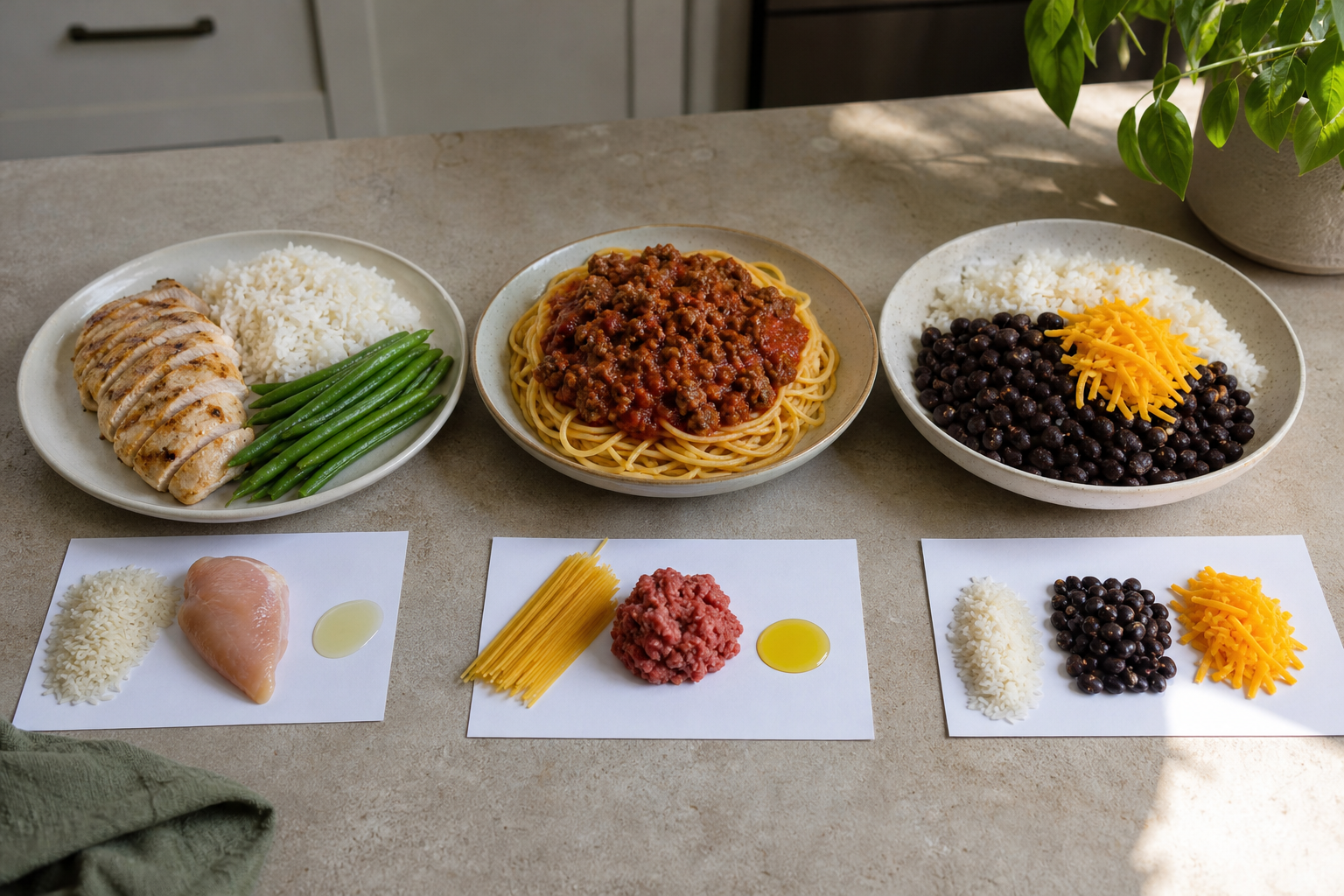
A 600 calorie dinner is three or four things on a plate, and two of them decide the total: the starch and the oil. The protein and the vegetables barely move. Here are three plates I cook on weeknights, built to land near 600 kcal by USDA figures, with every component in grams.
Everything below is weighed raw or dry, before the pan. That is the only weight that holds still. Cooked weights depend on your water and your heat.
The three plates
Three dinners, one portion each, USDA figures
| Plate | kcal | Protein, g | Cost per portion | Con |
|---|---|---|---|---|
| Chicken, rice, green beans | 586 | 42 | $2.71 | Rice and oil are 59% of the total |
| Spaghetti, beef, tomato | 590 | 32 | $2.43 | Beef fat stays in the sauce |
| Black beans, rice, cheddar | 593 | 25 | $1.32 | Lowest protein of the three |
Same total, give or take 7 kcal. The protein runs from 25 to 42 g, and the cost halves from the first plate to the last.
Plate one: chicken, rice, green beans
Plate one, raw and dry weights
| Component | Grams | kcal | Protein, g | Con |
|---|---|---|---|---|
| Chicken breast, raw | 150 | 180 | 33.8 | Dries out past 165°F |
| Long-grain white rice, dry | 70 | 256 | 5.0 | Cups vary; weigh it dry |
| Green beans, raw | 200 | 62 | 3.7 | Trim weight, not bag weight |
| Olive oil | 10 | 88 | 0 | Easy to double without noticing |
| Plate | 586 | 42.4 |
The cook: a 12-inch stainless skillet over medium-high. I butterfly a thick breast so it cooks evenly, then sear it in the 10 g of oil, 5 to 6 minutes a side, to 165°F at the thickest part. That is the FSIS line for all poultry. The chicken comes out to rest, the beans go into the same pan with a splash of water, lid on for 4 minutes, lid off until the water is gone. The rice is cooked by the method in the rice file, 70 g dry per plate.
If you cook this five times on a Sunday, the boxed version is in five lunches from one cook.
Plate two: spaghetti, beef, tomato
Plate two, raw and dry weights
| Component | Grams | kcal | Protein, g | Con |
|---|---|---|---|---|
| Spaghetti, dry | 85 | 315 | 11.1 | Over half the plate |
| Ground beef, 90% lean, raw | 80 | 141 | 16.0 | Rendered fat counted as eaten |
| Tomatoes, fresh | 200 | 36 | 1.8 | Watery in winter |
| Onion | 30 | 12 | 0.3 | None |
| Olive oil | 5 | 44 | 0 | None at this amount |
| Parmesan, grated | 10 | 42 | 2.8 | 180 mg sodium in 10 g |
| Plate | 590 | 32.0 |
85 g of dry spaghetti in 2 liters of salted boiling water. Meanwhile, the beef goes into a hot pan with the 5 g of oil and breaks up over medium-high until it browns, to 160°F, the FSIS line for ground meat. Onion in, 2 minutes, then the chopped tomatoes, 10 minutes at a hard simmer until they stop looking like tomatoes. I don’t drain the beef. At 90% lean there is not much to drain, and the plate counts all of it. Why the pasta is weighed dry is in the dry pasta file.
Plate three: black beans, rice, cheddar
Plate three, raw and dry weights
| Component | Grams | kcal | Protein, g | Con |
|---|---|---|---|---|
| Black beans, dry | 70 | 239 | 15.1 | Soak overnight; 60 to 90 minutes to cook |
| Long-grain white rice, dry | 50 | 182 | 3.6 | None |
| Cheddar | 20 | 81 | 4.6 | Densest gram on the plate after oil |
| Tomatoes, fresh | 150 | 27 | 1.3 | None |
| Onion | 50 | 20 | 0.6 | None |
| Olive oil | 5 | 44 | 0 | None at this amount |
| Plate | 593 | 25.1 |
I cook beans by the 500 g bag and portion them the way I portion rice: weigh the dry beans, weigh the cooked pot net of the pot, and divide. 70 g dry is one plate. The onion softens in the oil, the beans go in with a ladle of their liquid, and the tomato and the rest of the onion go on top raw. The cheddar is 20 g grated, which is more than it looks.
Where the plate lands
Plate one again. The chicken and the green beans are 242 kcal and never change. Only the dry rice and the oil move.
Plate one by dry rice and oil, kcal
| Dry rice | 5 g oil | 10 g oil | 27 g oil, 2 tbsp | Con |
|---|---|---|---|---|
| 50 g | 469 | 513 | 663 | Small rice portion |
| 70 g | 542 | 586 | 736 | The plate above |
| 100 g | 651 | 695 | 846 | A restaurant-size scoop |
Same chicken, same beans, 469 to 846 kcal. The 377 kcal gap is 50 g of dry rice and 22 g of oil. Two tablespoons in a hot pan is not a lot to look at. For what a pour really holds, see the hidden 120 in a tablespoon.
That is the whole method. Fix the protein and the vegetables, then set the starch and the oil on the scale. Those two set the total.
What it costs
Priced at May 2025 BLS US city averages, plus USDA ERS 2022 averages for green beans and onions, which BLS does not track:
- Plate one: chicken $1.39, rice $0.17, green beans $1.16. About $2.71.
- Plate two: spaghetti $0.25, beef $1.36, tomatoes $0.75, onion $0.07. About $2.43.
- Plate three: beans $0.26, rice $0.12, cheddar $0.26, tomatoes $0.56, onion $0.12. About $1.32.
Oil and parmesan are not in those totals. BLS publishes no average price for either. Prices are averages, not a receipt.
What this file does not cover
- Sauces and dressings beyond what is listed. A spoon of sour cream or a drizzle of hot sauce is its own line.
- Salt. The USDA lines are unsalted, apart from the cheese.
- Your chicken. A 150 g piece is a portion cut from a breast; whole breasts often run 250 g or more raw.
- Canned beans. They are a different weight and carry the can’s sodium.
Every recipe on this desk is on the Cooking desk.
How these numbers were built
Per 100 g figures are from USDA FoodData Central, SR Legacy, multiplied by the raw or dry grams shown. Totals add the rounded component figures. Temperatures are from the FSIS safe minimum internal temperature chart. Prices are BLS US city averages for May 2025, and USDA ERS 2022 average retail prices for green beans and onions, as bought. Consulted Jun 14, 2025. Calorie figures are estimates.