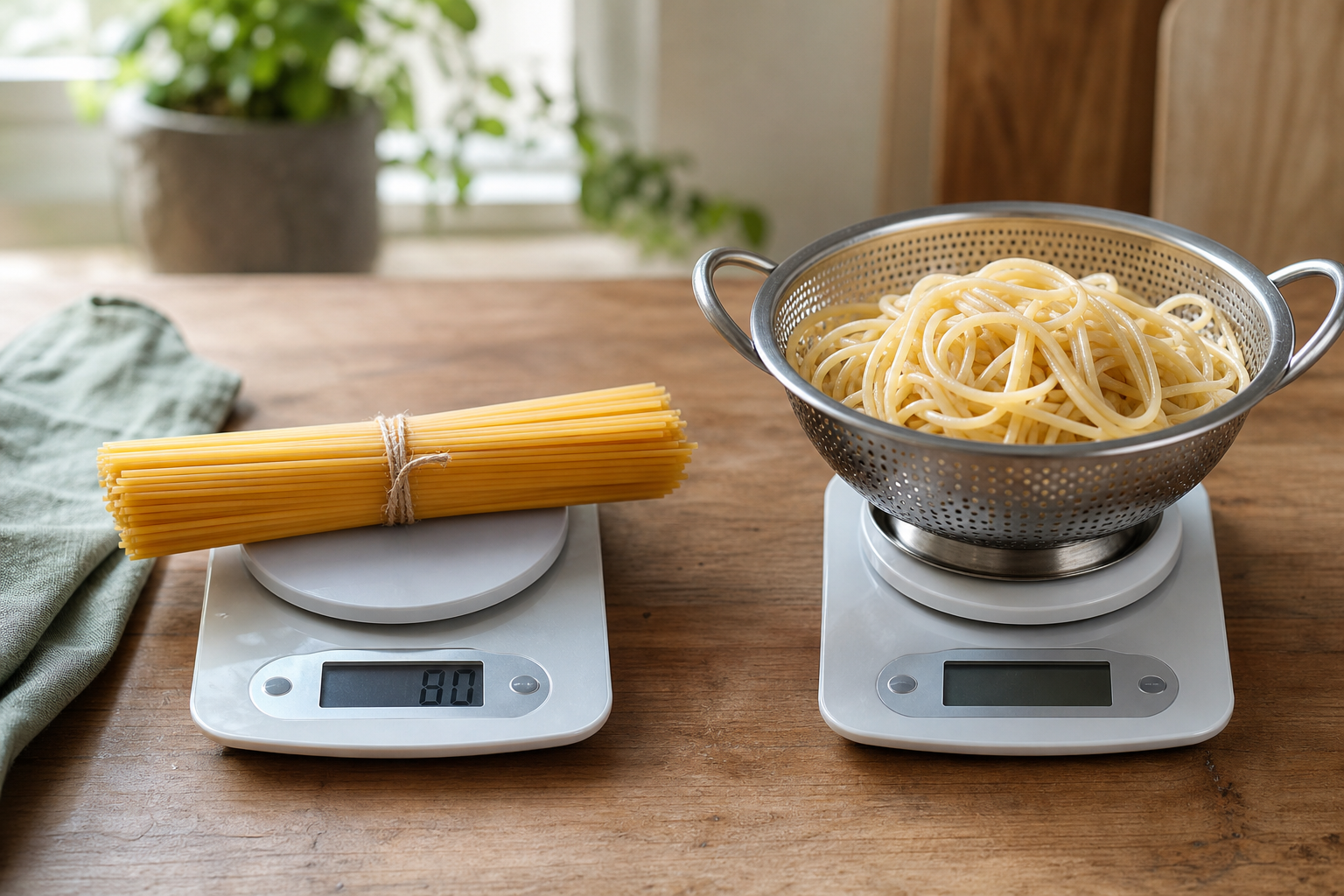
USDA lists enriched dry pasta at 371 kcal per 100 g and cooked pasta at 158. Same pasta, more water. That is a ratio of 2.35: by USDA’s figures, 100 g dry becomes about 235 g on the plate. Every figure for dry pasta calories holds whatever the pot does. The cooked figure does not.
My portion is 80 g dry. I weigh it before it goes into the water, every time. Here is why, and what to do when the pasta is already in the colander.
Two numbers per pasta
Pasta dry and cooked, USDA SR Legacy, per 100 g
| Pasta | Dry, kcal | Cooked, kcal | Dry to cooked | Con |
|---|---|---|---|---|
| Enriched, spaghetti or shapes | 371 | 158 | 2.35 | Cooked figure assumes USDA’s pot |
| Whole-wheat | 352 | 149 | 2.36 | 9.2 g fiber per 100 g dry, longer cook |
| Protein-fortified spaghetti | 374 | 164 | 2.28 | 21.8 g protein per 100 g dry, same kcal |
| Egg noodles | 384 | 138 | 2.78 | Cooked line is with salt |
| Fresh-refrigerated | 288 | 131 | 2.20 | Already holds water in the package |
“Dry to cooked” divides the two USDA figures. It is what your pasta would weigh if your pot behaved like USDA’s. Dry, the boxed pastas sit within 32 kcal per 100 g of each other. Fresh pasta is lower because it already carries water when you buy it.
The pot moves the cooked number
Cooked weight depends on the minutes in the water, the size of the pot and whether you drain it right away. Pasta pulled at al dente and drained holds less water than pasta boiled soft. Pasta that sits in its water, or in sauce, keeps drinking. Leftovers in sauce go on drinking in the fridge.
The kcal in the pot do not change. Only the grams do.
100 g of dry pasta, 371 kcal, at three drained weights
| Drains to | kcal per 100 g cooked | 150 g cooked portion, kcal | Con |
|---|---|---|---|
| 200 g | 186 | 278 | Firm, pulled early |
| 235 g | 158 | 237 | Matches USDA’s cooked figure |
| 270 g | 137 | 206 | Soft or held in water |
A 150 g scoop from the same box runs 206 to 278 kcal by the pot alone. Those three rows are arithmetic, not readings from my stove. Weigh your own drain once and you know where your pot sits.
The box serving
FDA’s reference amount for plain pasta is 55 g dry or 140 g prepared. For dry bulk pasta like spaghetti, the label can state it as 2 oz, 56 g. By USDA’s figures:
- 56 g dry is 208 kcal.
- 140 g cooked is 221 kcal, which is about 60 g dry.
- A 1 lb box is 1,683 kcal and 8.1 label servings.
Two serving sizes for one box, 13 kcal apart. Most people I cook for eat more than 56 g dry.
Cups by shape
A cup is a volume, and pasta shapes pack differently. USDA weighs a cup of each.
One cup of pasta by shape, USDA weights
| Shape | Dry cup, g | kcal | Cooked cup, g | kcal | Con |
|---|---|---|---|---|---|
| Elbows | 122 | 453 | 120 | 190 | Packed cooked cup is 132 g, 209 kcal |
| Rotini | 96 | 356 | 107 | 169 | Spirals trap air |
| Penne | 95 | 352 | 107 | 169 | None |
| Spaghetti | 91 | 338 | 124 | 196 | Packed cooked cup is 151 g, 239 kcal |
| Farfalle | 81 | 301 | 107 | 169 | Bows nest unevenly |
| Shells | 64 | 237 | 105 | 166 | Lightest dry cup by far |
A dry cup of elbows is almost twice a dry cup of shells, 453 kcal against 237. Cooked, the spread is 166 to 239 kcal, and most of it comes from whether you packed the cup. This is why I don’t own a pasta measuring cup.
Portions by dry weight
Dry portions at USDA’s ratio, spaghetti at BLS May 2025
| Dry | kcal | Cooked, about | Protein, g | Cost | Con |
|---|---|---|---|---|---|
| 56 g | 208 | 132 g | 7.3 | $0.16 | The label serving |
| 80 g | 297 | 188 g | 10.4 | $0.23 | My portion |
| 100 g | 371 | 235 g | 13.0 | $0.29 | A full plate before sauce |
| 125 g | 464 | 294 g | 16.3 | $0.36 | Restaurant territory |
Cooked weights are USDA’s 2.35 ratio. Yours will differ by the pot. The kcal won’t.
How I portion a batch
When I cook a full box for four:
- Weigh the dry pasta. 454 g is 1,683 kcal.
- Boil in at least 4 liters of salted water. Taste at the low end of the package time.
- Drain into a colander, then tip into a bowl you weighed empty.
- Weigh the bowl. Subtract the empty weight. That is your cooked total.
- Divide 1,683 by the cooked grams. That is kcal per gram for this pot.
Then portion by weight. If the pot came to 1,000 g, each 250 g plate is 421 kcal, or 113 g dry. For one or two people, skip all that and weigh the dry pasta per person before it goes in. Same method as rice, dry against cooked.
Salt adds no kcal, but it adds sodium. USDA’s cooked pasta with salt carries 131 mg per 100 g; without, 1 mg.
What it costs
At the May 2025 BLS average of $1.322 per pound for spaghetti and macaroni, dry pasta is 29 cents per 100 g. An 80 g portion is 23 cents. The sauce usually costs more than the pasta, and adds more of the plate’s kcal. Sauce math is in five sauces at 200 kcal. Prices are averages, not a receipt.
What this file does not cover
- Sauce, cheese and oil. Count them separately.
- Restaurant pasta. A chain plate is a different scale; see the Cheesecake Factory pasta problem.
- Gluten-free and legume pastas. Their labels vary by brand. Read the dry figure on the box and weigh dry.
- Pasta in a full dinner. A plate built to a total is in three dinners at about 600 kcal.
Every recipe on this desk is filed on the Cooking desk.
How these numbers were built
Dry and cooked figures and cup weights are from USDA FoodData Central, SR Legacy. The dry-to-cooked ratios divide USDA’s two figures; the drained-weight table is arithmetic on those figures. Reference amounts are from 21 CFR 101.12. The price is the BLS US city average for spaghetti and macaroni, May 2025. Consulted Jun 19, 2025. Calorie figures are estimates.