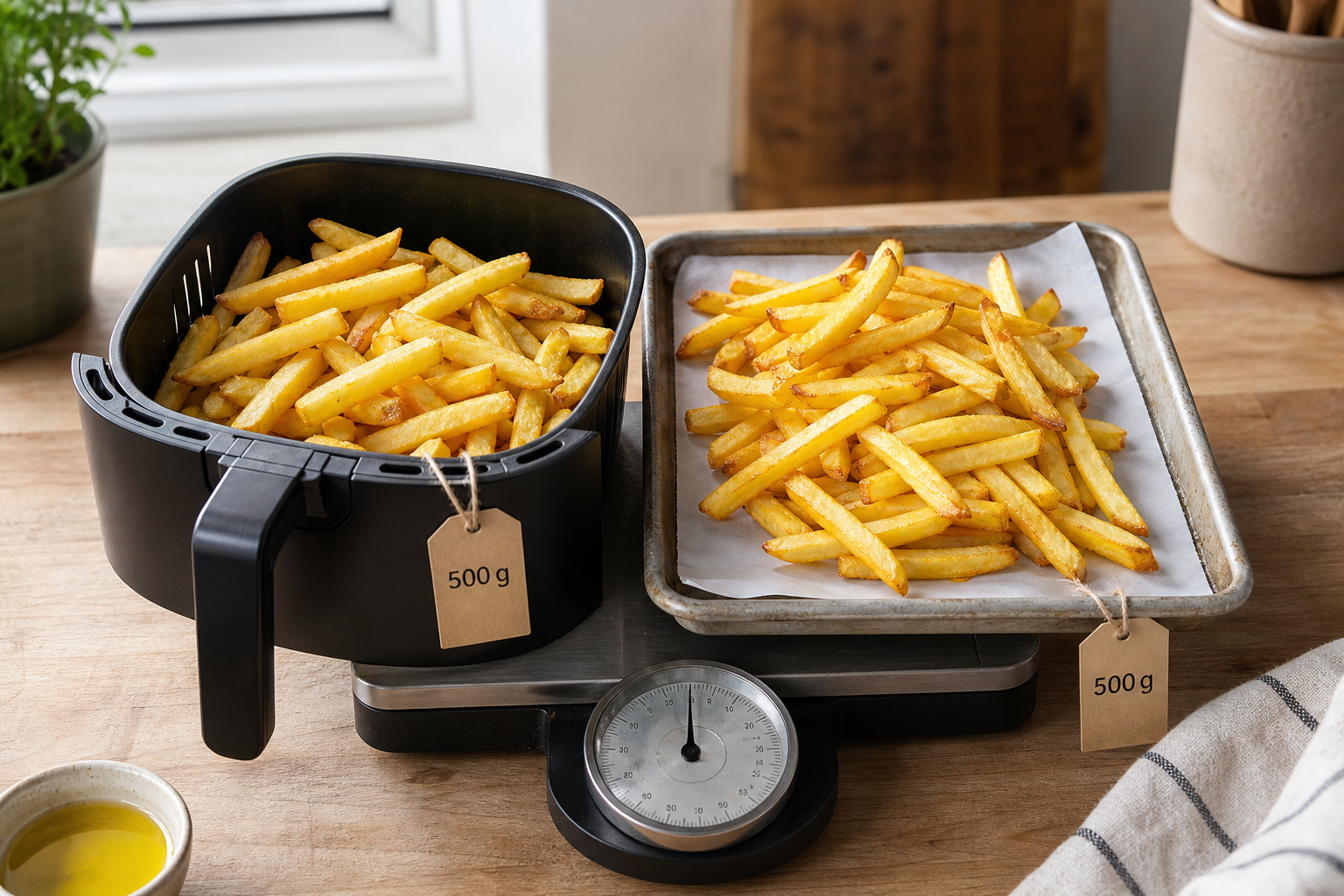
500 g of raw russet potatoes is 395 kcal. That number does not change with the machine. What changes is the oil you add to make them brown, and that is where the batches split: 435 kcal from the air fryer with a teaspoon of oil, 634 from a sheet pan with two tablespoons, about 700 from a deep fryer.
I run the same 500 g through each one: potatoes for two, then wings for two. Here is the arithmetic for both, from USDA figures.
The potatoes
My prep is the same for all three. 500 g of russet, skin on, cut into 1 cm batons. Rinse in cold water, then dry hard with paper towels. Wet potatoes steam instead of browning, in any machine.
- Air fryer: toss with 1 tsp of oil. 400°F, 18 to 22 minutes, shake every 6. If the basket can’t hold the batons in one layer, run two batches.
- Sheet pan: toss with 2 tbsp of oil. Preheat the pan in the oven. 425°F, 30 to 35 minutes, flip at 15.
- Deep fryer: 325°F for 5 to 6 minutes, rest on a rack, then 375°F for 2 to 3 minutes.
500 g of raw russet potatoes, three ways, olive oil
| Method | Oil | Batch kcal | Per portion, 2 | Con |
|---|---|---|---|---|
| Air fryer | 1 tsp, 4.5 g | 435 | 217 | Small baskets need two batches |
| Air fryer | 1 tbsp, 13.5 g | 514 | 257 | Browns more evenly, 40 kcal more per portion |
| Sheet pan | 2 tbsp, 27 g | 634 | 317 | Sticks with less oil; longest cook |
| Deep fryer | about 35 g absorbed | about 700 | about 350 | Absorption is an estimate; 1 to 2 quarts of oil to heat |
At the February 2025 BLS average of $0.957 per pound, 500 g of potatoes is about $1.05, or 53 cents a portion before the oil.
The sheet pan is not the problem. Two tablespoons is. Put a teaspoon on the sheet pan and its batch is 435 kcal too. I use more oil in the oven because the fries stick and tear without it, not because the oven needs it to cook.
What the deep fryer adds
The deep fryer adds oil you never measure. USDA’s survey database gives a way to estimate it.
French fries per 100 g, USDA figures
| Fries | kcal | Fat, g | Con |
|---|---|---|---|
| Fast food | 312 | 14.7 | Thin cut, more water out, more kcal per gram |
| Restaurant | 289 | 14.0 | Cut and oil vary by kitchen |
| From fresh, fried | 198 | 13.1 | Home deep-fried, the line used for the estimate |
| From fresh, baked | 166 | 9.2 | USDA assumes oil on these too |
| Frozen, oven-heated | 158 | 5.5 | The fat is added at the plant; read the bag |
USDA’s portion data puts a fry from fresh at about 15 g cooked for every ounce of raw potato. That means fries come out at about 53% of their raw weight. 500 g raw gives about 265 g of fries. At 13.1 g of fat per 100 g, that is about 35 g of oil, roughly 2.5 tablespoons and 307 kcal. If your fries lose less water, the figure goes up. Across 250 to 300 g of cooked fries, it runs 33 to 39 g.
The baked line tells a second story. USDA’s “from fresh, baked” fries carry 9.2 g of fat per 100 g, which across 265 g is about 24 g. That is close to my two tablespoons on the sheet pan. USDA’s database already assumes oven fries are oiled.
Per 100 g comparisons are skewed by water. A fast-food fry is 312 kcal per 100 g partly because it has lost more water than a thick home cut. That is why I do the batch math from raw weight: the potato’s 395 kcal stays in the batch, and the oil adds on top.
The wings
Wings need no oil in the air fryer or the oven. The skin carries its own fat and renders it as it cooks.
- Air fryer: pat 500 g of wings dry, salt them. 380°F for 22 minutes, turn at 11, then 400°F for 4 minutes.
- Oven: wings on a rack over a sheet pan. 425°F, 40 to 45 minutes, turn once.
- Deep fryer: toss in flour, 350°F, 10 to 12 minutes.
Check the thickest wing at the bone. FSIS puts poultry at 165°F.
Chicken wings per 100 g of meat and skin, USDA figures
| Wing | kcal | Fat, g | Protein, g | Carbs, g | Con |
|---|---|---|---|---|---|
| Fried, battered | 324 | 21.8 | 19.9 | 10.9 | Batter adds carbs and holds oil |
| Fried, floured | 321 | 22.2 | 26.1 | 2.4 | Pot of oil to heat and dispose of |
| Roasted | 254 | 16.9 | 23.8 | 0 | Skin stays soft unless the heat is high |
USDA has no separate entry for air-fried wings. FSIS describes air fryers as essentially countertop convection ovens, so I use the roasted line for both. Frying in flour adds about 5 g of fat and 67 kcal per 100 g of meat and skin.
Weight changes too. USDA’s cooking yield table puts a roasted wing at 74% of its raw weight, with a range of 64 to 83%. A floured, deep-fried wing comes out at 66%, range 53 to 78%. So 500 g of raw wings is about 370 g roasted, or about 330 g fried, bones in.
How much of that is bone depends on the wing. My check: weigh the plate before you eat and the bones after. If 250 g of meat and skin comes off the bones, that is about 635 kcal roasted and 802 fried, a 167 kcal gap from the method alone. This file prints no wing price; packs vary too much by store and size to pin to one.
Time and batches
FSIS notes that air fryers generally run 5 to 25 minutes at 350°F to 400°F, and warns against overcrowding the basket. Overcrowd and the food steams and cooks unevenly. For 500 g, the honest air fryer vs oven comparison includes the second batch. Two rounds of fries at 20 minutes each is 40 minutes. One sheet pan is 30 to 35, plus the preheat. The air fryer wins on oil. On a full 500 g, it does not always win on time.
What this file does not cover
- Your basket size. Batch counts depend on it.
- Frozen fries. The oil is in the bag already; read the label.
- Sauce on the wings. Buffalo sauce made with butter adds its own fat. That math is in how much of five sauces makes 200 kcal.
- Oil left in the pan or the basket. I count all of it as eaten. See the hidden 120 in a tablespoon of oil for how to check.
For skin-on chicken in a pan, see chicken thighs, skin on or off. For cooking a week of lunches at once, see meal prep for five days. Every recipe on this desk is on the Cooking desk.
How these numbers were built
Potato, oil and wing figures are from USDA FoodData Central, SR Legacy. Fry figures and the raw-to-cooked fry weight are from FoodData Central’s survey database, FNDDS 2021-2023. Wing yields are from the USDA Table of Cooking Yields for Meat and Poultry. Absorbed oil is an estimate: cooked fry weight times USDA’s fat per 100 g. The potato price is the BLS US city average for February 2025, not a receipt. Consulted Apr 10, 2025. Calorie figures are estimates.