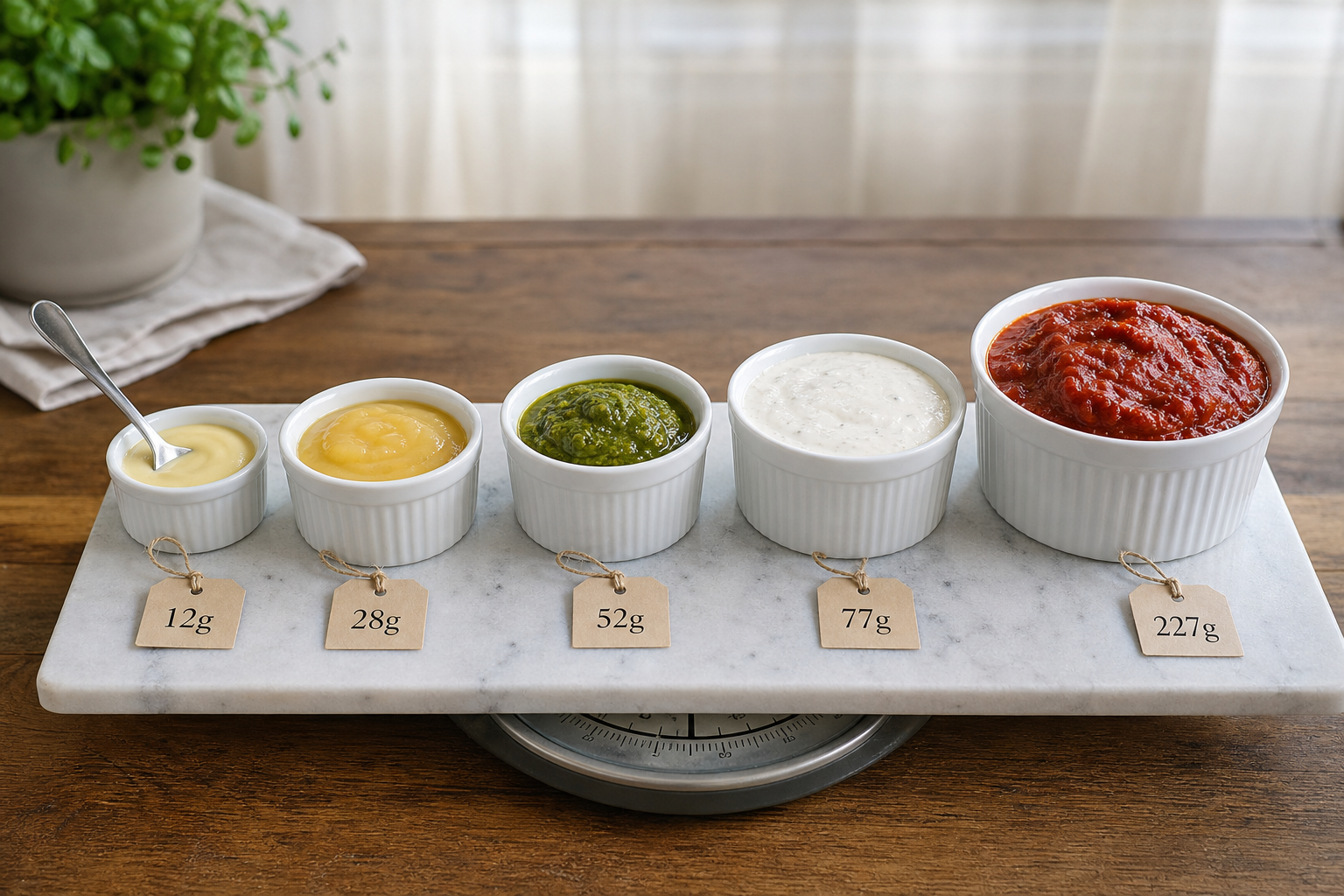
USDA lists ready-to-serve marinara at 50 kcal per 100 g and hollandaise at 546. Both are sauce for a plate. To reach 200 kcal, you need 400 g of the first and 37 g of the second. That is 1.5 cups against 2.3 tablespoons.
I build every sauce on this desk in grams, and I think about sauce in 200 kcal units, because that is what one sauced portion usually adds to a plate of pasta. Here are five sauces ranked by how much it takes to get there.
200 kcal, five ways
How much sauce makes 200 kcal, USDA figures, densest first
| Sauce | kcal per 100 g | Grams for 200 kcal | Tablespoons | Con |
|---|---|---|---|---|
| Butter sauce, hollandaise | 546 | 37 | 2.3 | 58 g of fat per 100 g; nearly all butter and yolk |
| Pesto, refrigerated | 418 | 48 | 3.0 | FDA’s 1/4 cup reference is 263 kcal |
| Peanut sauce | 257 | 78 | 4.3 | 1,041 mg sodium and 13 g sugar in those 78 g |
| Alfredo, survey figure | 150 | 133 | 8.2 | A light figure; my cream-based version runs 2.5 times it |
| Marinara, jarred | 50 | 400 | 24 | 1,748 mg sodium in 400 g, 76% of the Daily Value |
The densest sauce on the list is 11 times the lightest. A spoon of one is not a spoon of the other.
Label serving sizes don’t help much. FDA’s reference amount for spaghetti sauce is 125 g, about 63 kcal of marinara. For pesto and Alfredo it is a quarter cup: 263 kcal of refrigerated pesto, 98 of Alfredo at USDA’s survey figure. Hollandaise is counted with dipping sauces, at 2 tablespoons.
Why 200
80 g of dry pasta is my portion. USDA lists dry pasta at 371 kcal per 100 g, so that’s 297 kcal before sauce. A 200 kcal sauce takes the plate to about 500, and the sauce becomes 40% of it. At the March 2025 BLS average of $1.379 per pound, the pasta costs about 24 cents.
The sauce is the part of the plate that moves. The pasta doesn’t.
My versions, in grams
Jars and survey figures are averages. My sauces are what I cook. Each one is weighed in, and the kcal come from USDA’s figures for each ingredient.
My five sauces, ingredients weighed in
| Sauce | Batch | Batch kcal | kcal per 100 g | Portions | kcal per portion | Con |
|---|---|---|---|---|---|---|
| Pesto | 50 g basil, 80 g olive oil, 30 g pine nuts, 40 g parmesan, 6 g garlic | 1,086 | 527 | 4 | 272 | Oil is 65% of the kcal |
| Alfredo | 30 g butter, 240 g heavy cream, 60 g parmesan | 1,266 | 384 | 4 | 317 | Heaviest portion here; denser once reduced |
| Peanut | 64 g peanut butter, 16 g soy sauce, 15 g lime juice, 21 g honey, 60 g water, 3 g garlic | 463 | 259 | 4 | 116 | Peanut butter is 83% of the kcal |
| Pan butter sauce | 30 g butter, 60 g chicken stock, 15 g lemon juice, 10 g shallot | 247 | 215 | 2 | 124 | Butter is 87% of the kcal |
| Marinara | 794 g canned whole tomatoes, 27 g olive oil, 9 g garlic, 110 g onion | 423 | 45 | 4 | 106 | Oil is 56% of the kcal |
Kcal per 100 g is on the raw batch weight. Alfredo, the pan sauce and the marinara all lose water on the stove, so per spoon they end up denser than the table. The batch kcal does not change.
How I make them:
- Pesto. Toast the pine nuts in a dry pan over medium, 3 to 4 minutes, until they smell. Blend basil, garlic, nuts and oil. Stir in the parmesan by hand. 200 kcal of this is 38 g, about 2.4 tablespoons.
- Alfredo. Butter and cream to a simmer over medium-low, 4 minutes. Off the heat, cheese in, whisk. 200 kcal is 52 g before reducing.
- Peanut. Whisk everything with warm water, no heat. It lands at 259 per 100 g, within 2 of USDA’s peanut sauce. 200 kcal is 77 g.
- Pan butter sauce. After searing chicken, pour off the fat. Deglaze with stock over medium-high, scrape, reduce by half. Off the heat, cold butter in cubes, then lemon. Count it by the butter: 2 tablespoons, 28 g, is 201 kcal before the stock and lemon.
- Marinara. Oil and garlic over medium-low until the garlic sizzles, onion for 8 minutes, tomatoes crushed by hand, 30 minutes at a low simmer. 200 kcal is 444 g of the raw batch. If it cooks down by 10%, that’s 400 g, the jar’s 50 kcal per 100 g.
In all five, one ingredient carries most of the energy: oil in the pesto and the marinara, cream in the Alfredo, peanut butter, butter. Cut that one and the sauce moves. Cut the basil or the garlic and nothing does. That is the whole story of sauce calories in my kitchen.
The sodium runs the other way
Rank the same 200 kcal portions by sodium and the order flips. The lightest sauce per gram carries the most salt, because you eat so much more of it.
- Marinara, 400 g: 1,748 mg, 76% of the Daily Value.
- Peanut sauce, 78 g: 1,041 mg, 45%.
- Alfredo, 133 g: 736 mg, 32%.
- Pesto, 48 g: 288 mg, 13%.
- Hollandaise, 37 g: 120 mg, 5%.
Those are USDA’s reference figures, not your pot. At home, the salt is what you add, plus what’s in the soy sauce, the stock and the cheese.
The plate
80 g dry pasta plus one portion of my sauce
| Plate | Sauce kcal | Plate kcal | Sauce share | Con |
|---|---|---|---|---|
| Pasta Alfredo | 317 | 614 | 52% | Most kcal, least volume |
| Pasta pesto | 272 | 569 | 48% | Small spoonful, big share |
| Pasta, pan butter sauce | 124 | 421 | 29% | Needs a seared protein to make the sauce |
| Noodles, peanut sauce | 116 | 413 | 28% | Sodium: soy sauce plus peanut butter |
| Pasta marinara | 106 | 403 | 26% | Oil in the pot sets the number |
The 30 g of butter in the pan sauce costs about 32 cents at the March 2025 BLS average of $4.816 per pound, 16 cents a portion.
What this file does not cover
- Cheese on top. A tablespoon of grated parmesan is 5 g and 21 kcal by USDA. Three of them, 63 kcal, is more than half a marinara portion. See cheese per 30 grams.
- Added sugar in jars. The 50 kcal marinara is an average. Jars differ; see marinara added sugar.
- Peanut butter brands. Two-ingredient and no-stir jars land at the same kcal; see peanut butter with two ingredients.
- Reduction. I give raw batch weights. Weigh the pot after cooking and divide the batch kcal by the new weight.
For the oil in the marinara pot, see the hidden 120 in a tablespoon of oil. Every recipe on this desk is on the Cooking desk.
How these numbers were built
Sauce and ingredient figures are from USDA FoodData Central: SR Legacy for pesto, peanut sauce, marinara and the ingredients; the survey database, FNDDS 2021-2023, for Alfredo, hollandaise and the second pesto figure. Tablespoon weights are USDA’s: 16 g for hollandaise, about 16 g for pesto, Alfredo and marinara, 18 g for peanut sauce. Reference amounts are from 21 CFR 101.12. Prices are BLS US city averages for March 2025, not a receipt. Consulted Apr 15, 2025. Calorie figures are estimates.