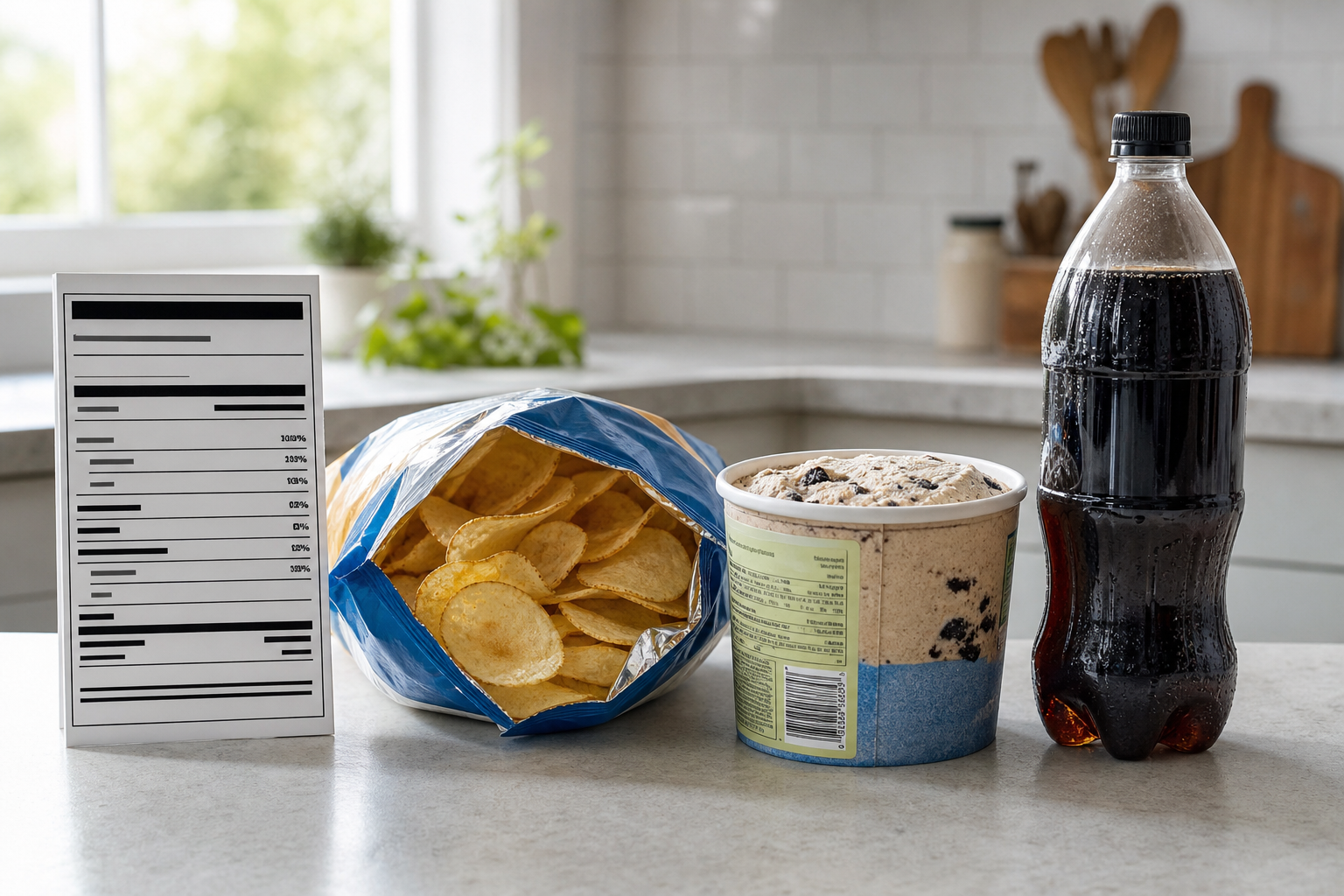
Every Nutrition Facts panel starts with a serving size. The number is not a portion anyone chose for you. It comes from an FDA table of reference amounts, one per food category, based on how much people customarily eat at one time. The label serving is the household measure closest to that amount.
That makes servings comparable across brands. It does not make them match the bag, the bottle or the plate. This file sets 14 label servings against a unit you are likely to buy or pour, with kcal from USDA reference values.
Three rules behind the panel
- Reference amounts are set by category. 12 fl oz for soda, 2/3 cup for ice cream, 30 g for chips and most cheese, 55 g dry for pasta, 110 g for bagels and muffins, 2 tbsp for nut butters and 1 tbsp for oil.
- Under twice the reference amount, the package is one serving. A 20 oz soda or a 15 oz can of soup is labeled as one serving.
- Two to three times the reference amount, some packages get two columns. FDA’s examples are a 24 oz soda and a pint of ice cream: per serving and per container.
The 2016 label update moved some reference amounts to match current eating. Ice cream went from 1/2 cup to 2/3 cup. Soda went from 8 to 12 fl oz. Yogurt went down, from 8 oz to 6 oz.
The table
Label serving against what you buy or pour, USDA values
| Food | Label serving | kcal per serving | Common unit | Servings in it | kcal in it |
|---|---|---|---|---|---|
| Cola | 12 fl oz (370 g) | 155 kcal | 20 fl oz bottle (614 g) | 1.7 | 258 kcal |
| Vanilla ice cream | 2/3 cup (88 g) | 182 kcal | Pint, 2 cups (264 g) | 3.0 | 546 kcal |
| Potato chips | 1 oz (28 g) | 149 kcal | 8 oz bag (227 g) | 8.1 | 1,208 kcal |
| Pasta, dry | 2 oz (56 g) | 208 kcal | Quarter of a 1 lb box (113 g) | 2.0 | 421 kcal |
| Bagel, plain | 110 g | 290 kcal | Large bagel, 4.5 in (131 g) | 1.2 | 346 kcal |
| Blueberry muffin | 110 g | 413 kcal | Extra-large muffin (168 g) | 1.5 | 630 kcal |
| Flour tortilla | 55 g | 168 kcal | 12 in burrito tortilla (117 g) | 2.1 | 358 kcal |
| Ranch dressing | 2 tbsp (30 g) | 129 kcal | 1/4 cup (60 g) | 2.0 | 258 kcal |
| Peanut butter | 2 tbsp (32 g) | 191 kcal | 1/4 cup (65 g) | 2.0 | 386 kcal |
| Cheddar | 1 oz (28 g) | 113 kcal | 1 cup shredded (113 g) | 4.0 | 455 kcal |
| Olive oil | 1 tbsp (13.5 g) | 119 kcal | 1/4 cup (54 g) | 4.0 | 477 kcal |
| Cottage cheese, 2% | 1/2 cup (110 g) | 89 kcal | 1 cup (226 g) | 2.1 | 183 kcal |
| Marinara sauce, jarred | 1/2 cup (125 g) | 63 kcal | 24 oz jar (680 g) | 5.4 | 340 kcal |
| Yogurt, plain, low-fat | 6 oz (170 g) | 107 kcal | 1 cup (245 g) | 1.4 | 154 kcal |
Label kcal here are USDA values at the label weight. Your package’s own label can differ by brand. Every figure is an estimate.
What the table says
- Bags and jars are where servings multiply. An 8 oz bag of chips is 8.1 servings and about 1,208 kcal. A 24 oz jar of marinara is 5.4.
- Bakery items run past the reference. The reference amount for a muffin is 110 g. USDA’s extra-large muffin is 168 g, 1.5 servings and about 630 kcal.
- Burrito tortillas are two servings. The tortilla reference is 55 g. A 12-inch tortilla weighs 117 g.
- Measures double quietly. A 1/4 cup of ranch or peanut butter is two label servings: 258 and 386 kcal.
- One drink, labeled as one. The 20 oz soda is 1.7 reference amounts and about 258 kcal, and the label now prints that as the serving.
- Some units shrink. A 6 oz cup of yogurt is the reference amount itself. A 1 cup bowl is 1.4.
The cons of label servings
- They are not portions. Nobody sized the reference amount to your appetite. Use it as a unit, then count units.
- Household measures round. A label serving of “1 oz (28 g)” and FDA’s 30 g reference are close, not identical.
- Category lines are blunt. One reference amount covers every muffin, from a small one to a café one.
- Dual columns are not universal. Packages outside the two-to-three-times range, like the 8 oz chip bag, still print per serving only.
Do the math once
- Read grams per serving on the panel.
- Weigh what you eat, or read the package weight.
- Divide your grams by the serving grams. Multiply the panel’s calories by the result.
The chip bag version of this math, bag by bag, is in the 30 g chip bag file. Ice cream by volume is in the ice cream file, and the 55 g tortilla rule in the tortilla file. To turn cups and spoons into grams, use cups to grams. Without a scale, portion sizes by hand gets you close.
Every lookup table is filed on the Reference desk.