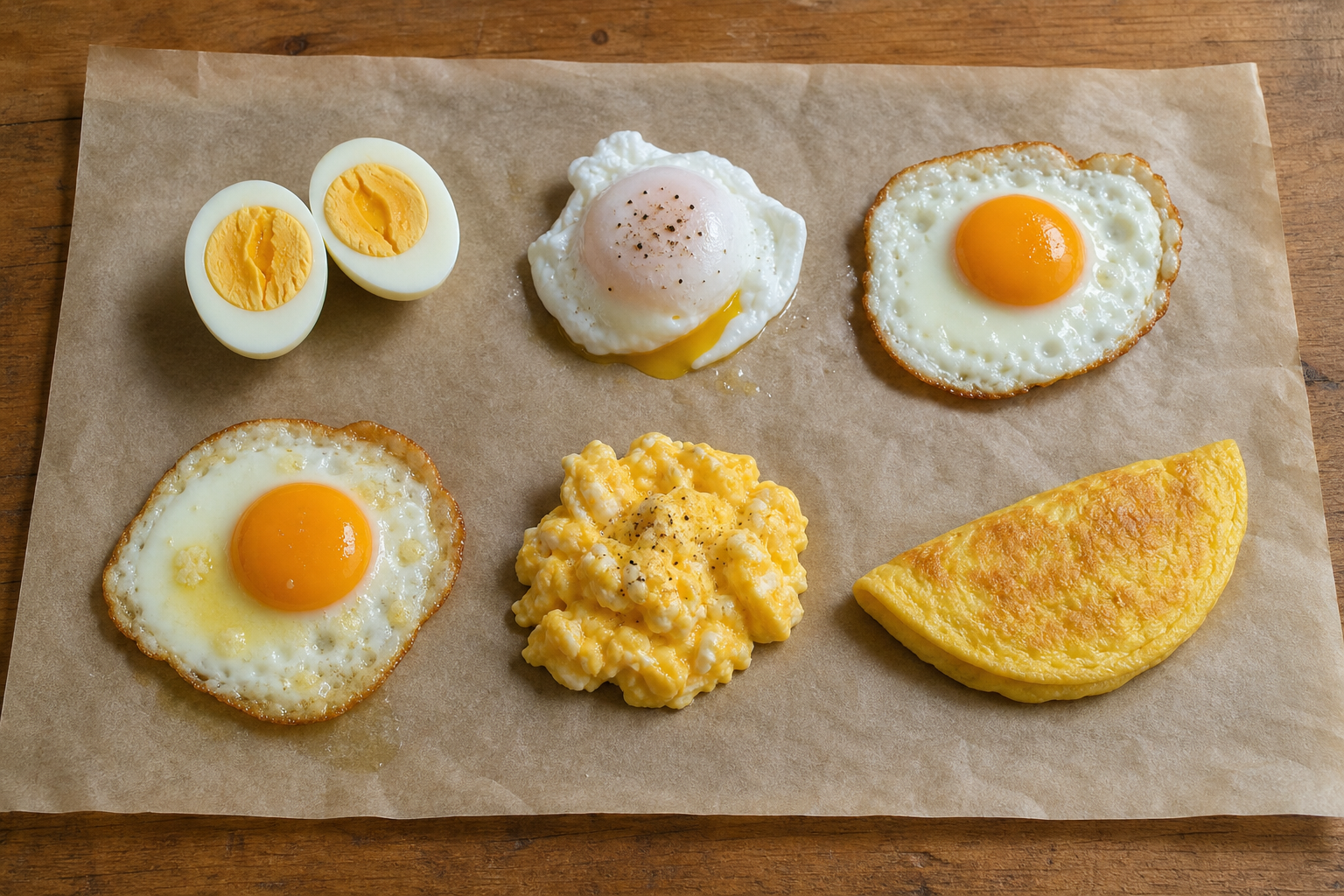
A large egg is 50 g out of the shell and 72 kcal raw, by USDA. Boiled or poached, it stays there. Fried in oil, USDA’s survey database puts it at 106. The egg did not change. The pan added about 3.7 g of fat.
That is the whole story of egg calories by cooking method: the egg is a fixed number and the fat is the variable. I cook eggs every morning, and these are the six ways I make them, with USDA’s line for each and what the pan puts on top.
The egg itself
Size moves the number before the pan does. USDA weighs each size without the shell.
One raw egg by size, USDA SR Legacy weights
| Size | Grams, no shell | kcal | Catch |
|---|---|---|---|
| Small | 38 | 54 | Rarely sold; recipes assume large |
| Medium | 44 | 63 | 9 kcal under a large |
| Large | 50 | 72 | The size recipes and labels use |
| Extra large | 56 | 80 | Eight more kcal per egg in a scramble |
| Jumbo | 63 | 90 | Two jumbos are 2.5 large eggs of kcal |
Split it and the energy is lopsided. The yolk is 17 g and about 55 kcal. The white is 33 g and about 17 kcal. The yolk is 76% of the egg.
Six ways, per large egg
USDA has two databases with egg lines. The standard reference has the classic six. The survey database splits fried and scrambled eggs by the fat used. I use both and name the line each time.
One large egg, six ways, USDA lines
| Method | USDA line | Weight, g | kcal | Fat, g | Con |
|---|---|---|---|---|---|
| Poached | SR, poached | 50 | 72 | 4.7 | 148 mg sodium, twice the raw egg |
| Hard-boiled | SR, hard-boiled | 50 | 78 | 5.3 | Gray-green yolk edge if overcooked |
| Scrambled | SR, scrambled, with milk and fat | 61 | 91 | 6.7 | USDA’s recipe; yours may use more butter |
| Omelet | SR, omelet | 61 | 94 | 7.1 | Fillings not counted |
| Fried in butter | FNDDS, fried with butter | 55 | 100 | 8.1 | Butter burns above medium heat |
| Fried in oil | FNDDS, fried with oil | 55 | 106 | 8.7 | The highest line here |
The spread is 72 to 106 kcal, 34 kcal per egg. Every kcal of it is fat from the pan or milk from the bowl.
What the pan adds
Subtract the egg’s own fat and you get the fat the pan left on it.
- USDA’s standard reference fried egg carries 6.8 g of fat. The hard-boiled egg carries 5.3 g. The pan added about 1.5 g, a third of a teaspoon.
- The survey database’s egg fried with oil carries 8.7 g. Fried with no added fat, 5.0 g. The pan added 3.7 g, about 33 kcal.
- Fried with butter, 8.1 g. The pan added 3.1 g of butterfat, about 27 kcal.
- Fried with cooking spray, 5.3 g. The pan added 0.3 g, 3 kcal.
So the pan adds 1.5 to 3.7 g of fat per egg on USDA’s figures. That assumes the egg takes what it touches and the rest stays in the pan. Basting is different. If you spoon a tablespoon of butter over two eggs and eat what is left, you ate the tablespoon: 102 kcal on top of 143.
How I cook each one
- Hard-boiled. Eggs straight from the fridge into boiling water, 12 minutes at a low boil, then into ice water for 5. Past 15 minutes the yolk goes gray at the edge.
- Poached. A 3-quart pot of water at a bare simmer, about 190°F on a probe. Crack the egg into a fine sieve first so the loose white drains off. 3 to 4 minutes for a set white; 5 for a firm yolk.
- Fried in oil. A 10-inch nonstick over medium-low, 1 tsp of oil, 4.5 g. The egg goes in when a drop of water sizzles without spitting. Lid on for the last minute to set the top.
- Fried in butter. Same pan, 5 g of butter, medium-low. When the foam goes quiet the butter is ready; when it browns it is too hot.
- Scrambled. Two eggs whisked with 30 g of whole milk, into 5 g of melted butter over low heat. Stir without stopping for 3 to 4 minutes and pull them while they still look wet. They finish on the plate.
- Omelet. An 8-inch nonstick over medium-high, 7 g of butter, three eggs. 60 to 90 seconds, fold, out.
FSIS’s line is firm: cook eggs until the white and the yolk are set, and egg dishes to 160°F. A runny yolk is outside that guidance. The 12-minute boil, the 5-minute poach and a lidded fried egg meet it.
Three plates, priced
Eggs averaged $3.599 a dozen in July 2025 on BLS figures, 30 cents each. In March they were $6.227, 52 cents. Butter was $4.797 a pound, about a cent a gram. Cheddar was $6.041 a pound.
Three egg plates, USDA kcal and BLS July 2025 prices
| Plate | What goes in | kcal | Cost | Con |
|---|---|---|---|---|
| Two fried eggs | 2 large eggs, 4.5 g oil | 183 | $0.60 plus oil | Counts all the oil; some stays in the pan |
| Two-egg scramble | 2 large eggs, 30 g whole milk, 5 g butter | 197 | $0.68 | Double the butter and it is 233 |
| Three-egg omelet | 3 large eggs, 7 g butter, 28 g cheddar | 378 | $1.35 | The cheddar alone is 113 kcal, 30% of the plate |
The scramble is the plate that drifts. Make it with a full tablespoon of butter and no milk and two eggs are 245 kcal before the toast, against 197 for mine. The diner side of that is in the brunch file, and the deli version is in the breakfast sandwich file.
What this file does not cover
- Egg whites from a carton. They have their own label; the raw white here is USDA’s.
- Restaurant eggs. The fat is whatever the cook uses.
- Toast, bacon, sausage and cheese beyond the omelet. Each is its own line.
- Your eggs. USDA’s large egg is 50 g without the shell. Crack one onto a scale to see where yours lands.
For how much oil a pan really holds, see the hidden 120 kcal tablespoon. The 160°F line is also in the cooking temperature table. All cooking files are on the Cooking desk.
How these numbers were built
Per 100 g figures and egg weights are from USDA FoodData Central: SR Legacy for raw, boiled, poached, scrambled, omelet and the standard fried egg, and the survey database, FNDDS 2021-2023, for eggs fried in each fat. Per-egg values multiply USDA’s weights by the per 100 g lines; the fat the pan adds is by difference. The firm-yolk and 160°F lines are FSIS’s. Prices are BLS US city averages for July 2025, not a receipt. Consulted Sep 5, 2025. Calorie figures are estimates.