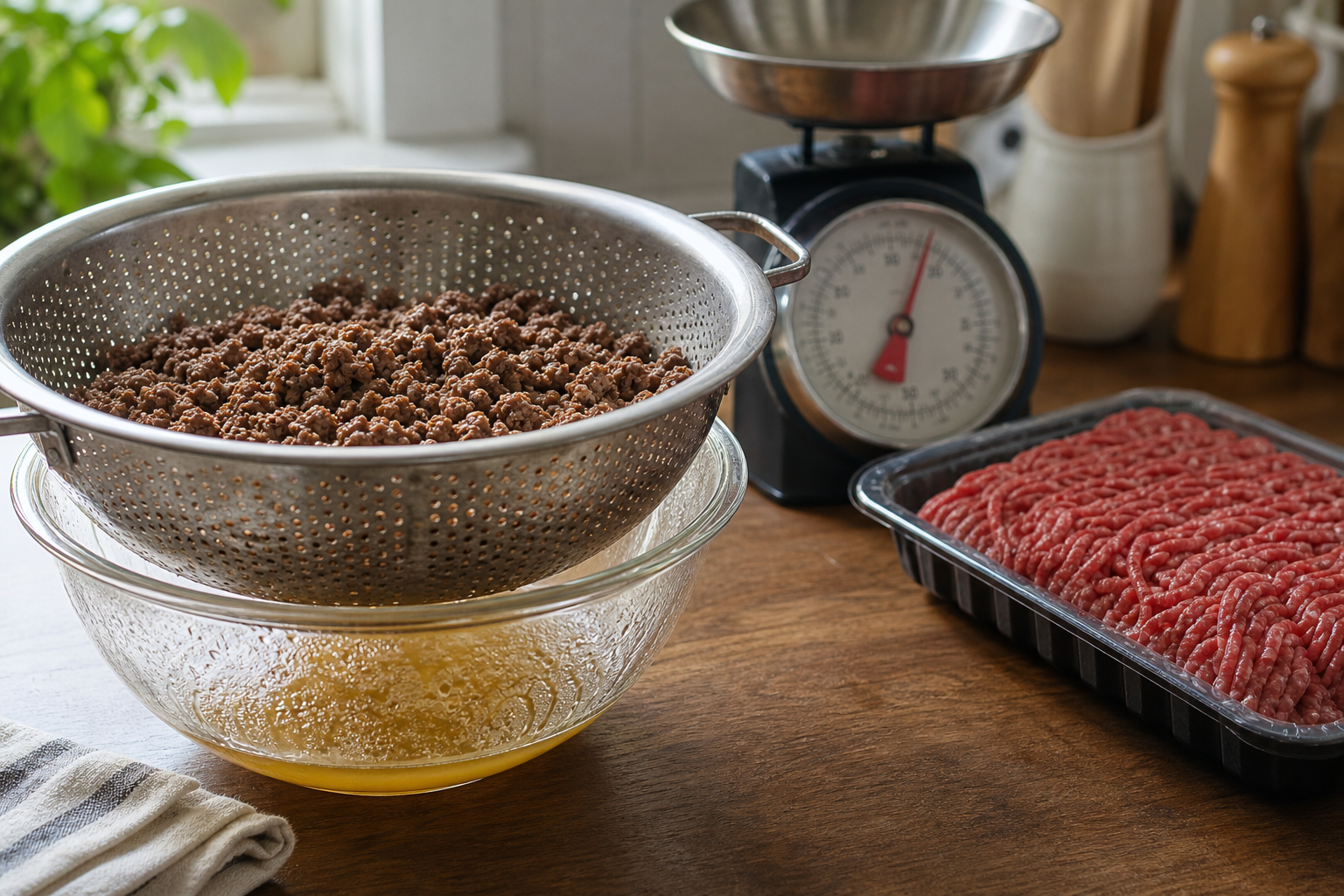
The label on a pack of 80/20 ground beef is a raw number. USDA puts 80% lean beef at 254 kcal per 100 g raw, 287 kcal for a 113 g quarter pound. Brown it, drain it in a colander, and USDA’s pan-browned line says that quarter pound comes out at about 72 g and 195 kcal. About 92 kcal of fat stayed in the colander.
I brown ground beef once or twice a week, for tacos, chili and rice bowls. The question at the stove is rarely which pack. It is whether the fat goes in the colander or in the pot. Here is that choice in grams, ratio by ratio.
Per 100 g, raw and browned
Ground beef per 100 g, USDA SR Legacy, no salt or fat added
| Lean / fat | Raw kcal | Raw fat, g | Crumbles kcal | Crumbles fat, g | Crumbles protein, g |
|---|---|---|---|---|---|
| 70/30 | 332 | 30.0 | 270 | 17.9 | 25.6 |
| 75/25 | 293 | 25.0 | 277 | 18.2 | 26.3 |
| 80/20 | 254 | 20.0 | 272 | 17.4 | 27.0 |
| 85/15 | 215 | 15.0 | 256 | 15.3 | 27.7 |
| 90/10 | 176 | 10.0 | 230 | 12.0 | 28.5 |
| 93/7 | 152 | 7.0 | 209 | 9.5 | 28.9 |
| 95/5 | 137 | 5.0 | 193 | 7.6 | 29.2 |
Raw, 70/30 and 95/5 are 195 kcal apart per 100 g. Browned and drained, 70/30, 75/25 and 80/20 land within 7 kcal of each other. The fat that separated them raw is in the colander.
Cooked figures run higher per 100 g than raw because the meat lost water. That is not added energy. It is the same beef in fewer grams.
What a quarter pound becomes
USDA’s method for crumbles: a preheated electric skillet, no fat added, about 5 minutes, then drained in a colander. To get from raw grams to cooked grams I use protein, which barely leaves the meat: raw protein per 100 g divided by cooked protein per 100 g. It is the same method as the raw to cooked weights table.
One 113 g raw portion, browned and drained, from USDA lines
| Lean / fat | Raw kcal | Cooked, g | Drained kcal | Fat left behind, g | Catch |
|---|---|---|---|---|---|
| 70/30 | 375 | 63 | 171 | 22.6 | Smallest portion on the plate |
| 75/25 | 331 | 68 | 188 | 15.9 | Undrained, 143 kcal more |
| 80/20 | 287 | 72 | 195 | 10.1 | Undrained, 92 kcal more |
| 85/15 | 243 | 76 | 194 | 5.4 | Drains to the same kcal as 80/20 |
| 90/10 | 199 | 79 | 183 | 1.7 | Little to drain, priced higher |
| 93/7 | 172 | 82 | 171 | 0.2 | Nothing to drain; dries out first |
Three things in that table.
Draining is worth something only at the fatty end. At 80/20 it takes out about 10 g of fat per portion. At 93/7 it takes out nothing you could weigh.
The drained column barely moves. From 70/30 to 90/10 every portion lands between 171 and 195 kcal. The fatty packs give you fewer grams back: 113 g of 70/30 leaves 63 g of meat, the same raw weight of 90/10 leaves 79 g.
The method has limits. USDA’s measured crumble yields are 62% for packs over 22% fat, 67% for 12 to 22% and 69% under 12%. The protein math puts 80/20 at 64%, the low edge of USDA’s range for its class. At 95/5 and 97/3 the math gives cooked kcal above raw, which cannot happen with no fat added, so I read those two packs at their raw values. Treat every row as an estimate.
The pan, the colander and the pot
My method: a 12-inch stainless or cast-iron skillet over medium-high for 2 minutes, no oil. One pound of beef in, pressed flat, left alone for 3 minutes so the bottom browns. Then I break it up and stir for another 4 to 5 minutes. FSIS sets 160°F for ground beef, and crumbles pass it well before they brown.
Then a choice.
- Colander. Tip the pan into a colander set over a heatproof bowl. This is USDA’s method and the drained column above.
- Spoon. Tilt the pan and spoon off what pools. Faster, and less comes out. Part of the fat stays on the meat and in the pan.
- Keep it. Chili, a meat sauce, anything that simmers in its own fat. Every gram stays in the dish. Use the raw column.
You can check your own number. Pour the drippings from a 1 lb pack into a cup, chill it overnight, lift off the fat disk and weigh it. By USDA’s lines, 80/20 leaves about 41 g of fat, near 360 kcal. A 90/10 pack leaves about 7 g. A 70/30 pack leaves about 91 g.
Patties are a different line
A pan-broiled patty sits in its own fat and never sees a colander. USDA’s pan-broiled 80/20 patty is 246 kcal per 100 g. By the same protein math, a 113 g raw patty cooks to about 81 g and 199 kcal. That is within 4 kcal of the drained crumbles. The patty keeps more water, the crumbles lose more fat, and they land close.
A quarter-pound 93/7 patty comes out at about 92 g and 168 kcal. It is also the one that goes dry first, so I keep lean beef for crumbles and sauces and use 80/20 for burgers.
What the pack costs
BLS does not price ground beef by ratio. It prices two packs: ground beef, 100% beef, at $6.254 per lb in July 2025, and lean and extra lean at $8.035. I use the first for 80/20 and the second for 90/10 and 93/7. That is a proxy, not a receipt.
Cost per 113 g raw portion, BLS July 2025 US city averages
| Pack | Price per lb | Per portion | Drained kcal | Per 100 g cooked | Catch |
|---|---|---|---|---|---|
| 80/20 | $6.25 | $1.56 | 195 | $2.17 | Drain it, or count 287 |
| 90/10 | $8.04 | $2.00 | 183 | $2.52 | 12 kcal less drained, 44 cents more |
| 93/7 | $8.04 | $2.00 | 171 | $2.45 | Same proxy price as 90/10 |
Drained, the 80/20 portion is 12 kcal heavier than 90/10 and 44 cents cheaper. Kept in the pot, it is 88 kcal heavier. The colander moves the plate more than the pack does.
What this file does not cover
- Rinsing. USDA has no line for browned beef rinsed with hot water, so there is no number to print.
- Seasoning, taco mix and sauce. Each is its own line.
- Ground turkey, pork and chicken. They have their own USDA lines and are not in these tables.
- Hamburger. FSIS allows beef fat to be added to hamburger but not to ground beef, and caps both at 30% fat. These tables are ground beef.
- Drippings that go back in. Fat poured over rice is fat eaten.
For the oil you add to every other pan, see the hidden 120 kcal tablespoon. Fat rendering out of poultry is in chicken thighs, skin on or off. The 160°F line and the rest of the federal chart are in the cooking temperature table. All cooking files are on the Cooking desk.
How these numbers were built
Per 100 g figures are USDA FoodData Central, SR Legacy, consulted Aug 15, 2025. Cooked weights use the ratio of raw to cooked protein; the measured crumble yields and USDA’s cooking method are from the ARS Table of Cooking Yields for Meat and Poultry. Fat left behind and the fat-disk weights are arithmetic from the same lines. The 160°F line and the 30% fat cap are from FSIS. Prices are BLS US city averages for July 2025, not a receipt, and the match of ratio to price series is my proxy. Calorie figures are estimates.