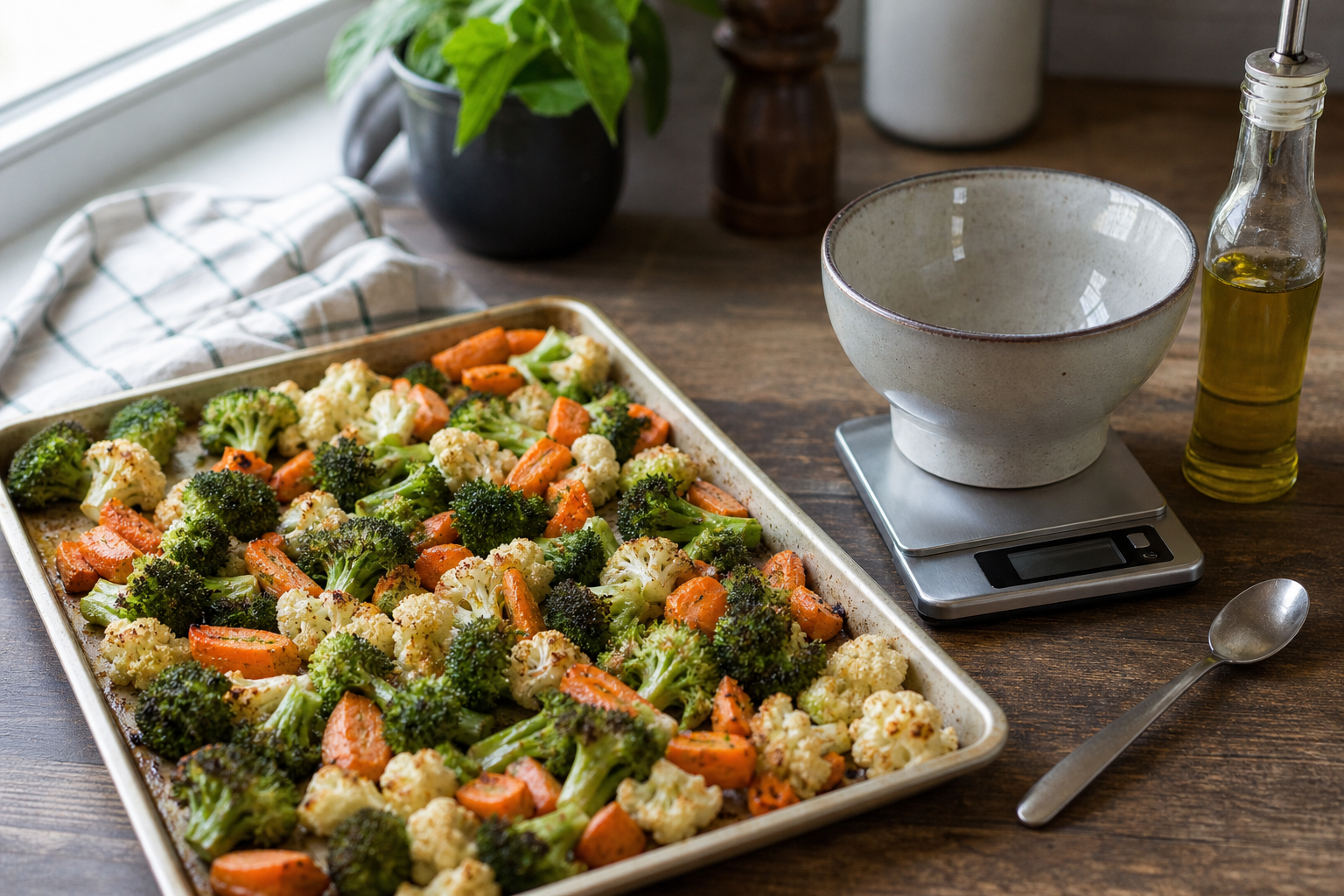
500 g of raw broccoli is 170 kcal. Toss it with two tablespoons of olive oil, 27 g, and the sheet is 409 kcal. The broccoli did not change. The oil is 58% of what comes out of the oven. Most roasted vegetables calories are the oil’s, not the vegetables’.
I roast a 500 g sheet at least three nights a week. It is two side portions or one big one. Here is what the oil does to it, what USDA’s own figures assume, and why the cooked weight matters.
One sheet, five vegetables
A 500 g raw sheet, by vegetable and olive oil, USDA figures
| Vegetable, 500 g raw | No oil, kcal | 1 tbsp, kcal | 2 tbsp, kcal | Oil share at 2 tbsp | Con |
|---|---|---|---|---|---|
| Cauliflower florets | 125 | 244 | 364 | 66% | Soaks oil into the cut faces |
| Broccoli florets | 170 | 289 | 409 | 58% | Florets burn before stems soften |
| Carrots | 205 | 324 | 444 | 54% | Thick coins stay hard in the middle |
| Brussels sprouts | 215 | 334 | 454 | 53% | Loose leaves char first |
| Russet potatoes | 395 | 514 | 634 | 38% | Sticks without enough oil |
The lighter the vegetable, the more the oil takes over. On cauliflower, the second tablespoon adds about as much as the 500 g of cauliflower. On potatoes the oil is a smaller share, because the potato brings its own 395 kcal. The potato side of this, against the air fryer, is in air fryer or sheet pan, 500 g at a time.
What USDA assumes
USDA’s survey database, the one behind national diet surveys, has paired lines for many vegetables: cooked with no added fat, and cooked with oil. It does not name the method, except for potatoes, which it lists as roasted. The gap between each pair is the oil USDA’s recipe puts in.
Cooked vegetables per 100 g, no added fat and cooked with oil, USDA FNDDS
| Vegetable | No added fat, kcal | With oil, kcal | Added fat per 100 g | Implied oil, 500 g raw sheet | Con |
|---|---|---|---|---|---|
| Potato, roasted, peel eaten | 93 | 131 | 4.7 g | 19 g | The only line coded as roasted |
| Broccoli | 41 | 67 | 3.0 g | 12 g | Method not stated |
| Carrots | 50 | 76 | 3.0 g | 12 g | Method not stated |
| Cauliflower | 26 | 52 | 3.0 g | 12 g | Method not stated |
| Green beans | 42 | 68 | 3.0 g | 12 g | Method not stated |
| Asparagus | 21 | 49 | 3.1 g | 12 g | Method not stated |
The implied oil assumes a 500 g raw sheet comes out at about 400 g, 81% for potatoes. So USDA’s working number for a sheet of green vegetables is about 12 g of oil, just under a tablespoon. For potatoes, about 19 g, a tablespoon and a half.
If your hand pours two tablespoons, you are running at more than twice USDA’s assumption. Counting your sheet from a survey figure will then undercount it.
The water leaves, the energy stays
A sheet loses weight in the oven. The kcal do not leave with the steam. So the same sheet carries more energy per 100 g the longer it roasts.
USDA gives one clean anchor. Its raw and baked potatoes share size classes: a large potato is 369 g raw and 299 g baked, 81%. The medium and small classes land at 81% too. Per 100 g, 77 kcal raw becomes 93 baked. The potato lost water, nothing else.
Here is the broccoli sheet with a tablespoon of oil, 289 kcal, at three finished weights:
500 g of broccoli and 13.5 g of oil, 289 kcal, by finished weight
| Comes out at | kcal per 100 g | Con |
|---|---|---|
| 425 g | 68 | Matches USDA’s broccoli cooked with oil |
| 375 g | 77 | Edges well charred |
| 325 g | 89 | Long roast, florets dry |
Raw broccoli is 34 kcal per 100 g. A long roast with a modest pour puts it at more than twice that. These rows are arithmetic, not readings from my oven. To get yours, weigh the empty sheet pan once, then weigh it full before and after.
How I roast a 500 g sheet
- Oven at 425°F, rack in the middle. A half-sheet pan, 13 by 18 inches. 500 g fits in one layer with gaps. Crowd it and the vegetables steam.
- Cut to even pieces: broccoli and cauliflower in 1.5-inch florets, carrots in half-inch coins, sprouts halved, potatoes in 1-inch cubes.
- Toss in a bowl on the scale. Put the bowl and vegetables on, zero it, pour oil until it reads the grams you want. That is the only measuring I do.
- Times: broccoli 18 to 22 minutes, sprouts cut side down 20 to 25, cauliflower and carrots 25 to 30, potatoes 35 to 40. Flip everything but the sprouts once, at the halfway mark.
- Salt after the oil, so it sticks.
Some oil stays in the bowl. Wipe it with a paper towel and weigh the towel, the check from the hidden 120 in a tablespoon. Whatever is left in the bowl is not on the sheet.
Per portion and per dollar
Half a sheet with a tablespoon of oil: 145 kcal of broccoli, 122 of cauliflower, 162 of carrots, 167 of sprouts, 257 of potatoes. For a side inside a full plate, see three dinners at about 600 kcal.
Cost of a 500 g raw sheet, as bought
| Vegetable | Price per lb | Sheet | Per portion, 2 | Con |
|---|---|---|---|---|
| Russet potatoes | $0.958, BLS May 2025 | $1.06 | $0.53 | Only one here with a current BLS price |
| Carrots | $0.976, ERS 2022 | $1.08 | $0.54 | 2022 average |
| Cauliflower heads | $2.184, ERS 2022 | $2.41 | $1.20 | Price includes the core you trim |
| Broccoli florets | $2.916, ERS 2022 | $3.21 | $1.61 | 2022 average |
| Brussels sprouts | $2.914, ERS 2022 | $3.21 | $1.61 | 2022 average |
BLS tracks potatoes but not these four vegetables, so their prices are USDA ERS national averages from 2022, the latest it has published. Olive oil is not priced; BLS has no series for it. Prices are averages, not a receipt.
What this file does not cover
- Sauces and glazes after the oven. Honey, balsamic and cheese are their own lines.
- Frozen vegetables. They carry more water and roast differently.
- Vegetables roasted under meat, in its fat. For what a roast leaves in the pan, see chicken thighs, skin on or off.
- The exact oil left in your bowl. Weigh it.
Every recipe on this desk is on the Cooking desk.
How these numbers were built
Raw vegetable figures and the paired potato weights are from USDA FoodData Central, SR Legacy. The cooked-with-oil and no-added-fat lines are from FoodData Central’s survey database, FNDDS 2021-2023; implied oil is the fat gap times the assumed cooked weight. Oil is olive oil at USDA’s 13.5 g and 119 kcal per tablespoon. The potato price is the BLS US city average for May 2025; the others are USDA ERS 2022 average retail prices. Consulted Jun 30, 2025. Calorie figures are estimates.