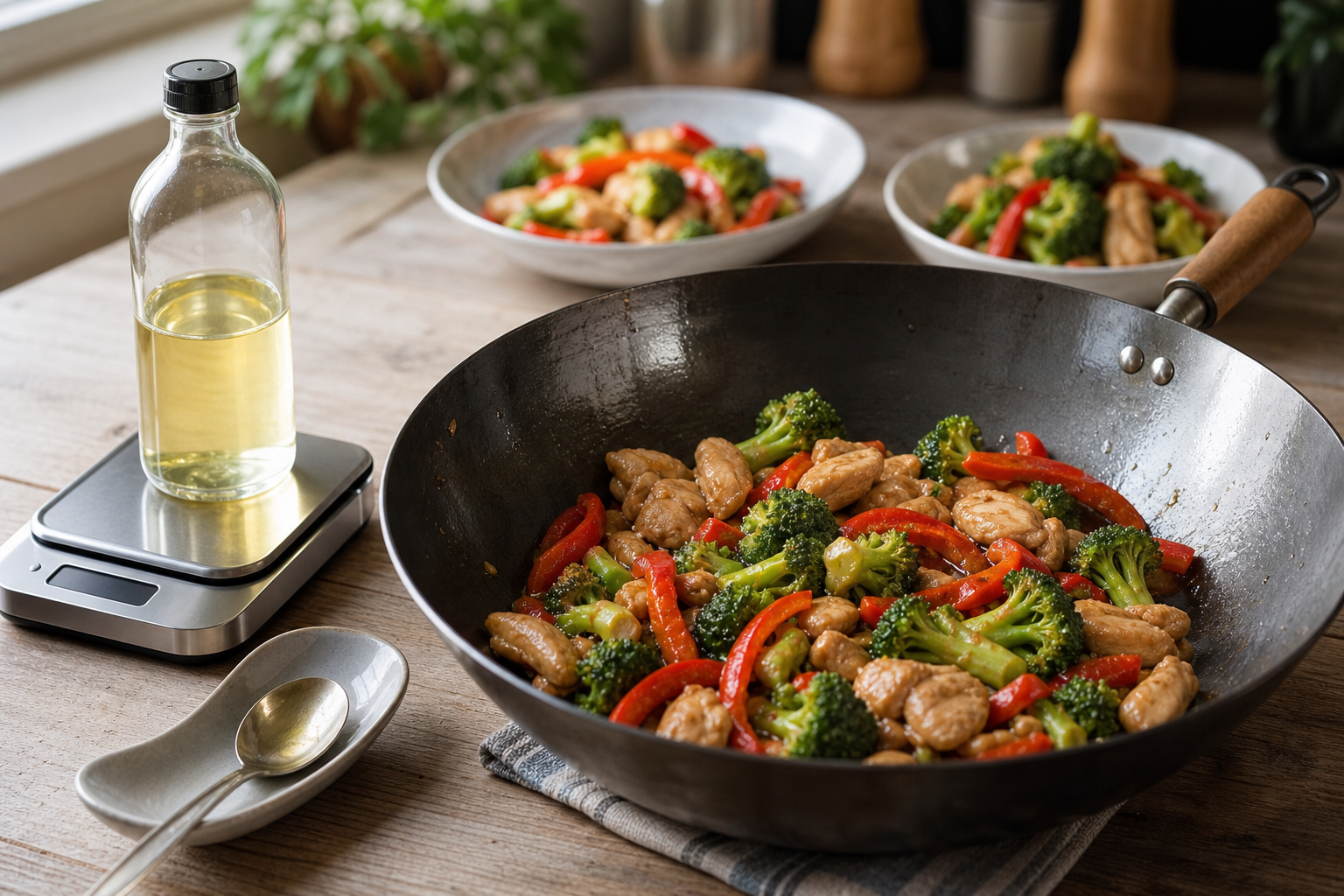
My chicken and broccoli stir-fry is 742 kcal for the pan, 371 a portion, with one 14 g tablespoon of canola for two plates. Pour a quarter cup instead, the way a pan looks right when the oil pools at the edge, and the same food is 557 a portion. The sauce bottles barely register. The oil bottle decides the plate.
I learned to stir-fry on a restaurant range. At home the burner is weaker, so the method changes: smaller batches, a pan heated longer, and water to steam the vegetables instead of more oil. This is that method in grams.
What the oil does, and where it goes
Oil in a stir-fry has two jobs: keep the meat from sticking, and carry heat into the vegetables. The first takes very little. The second can be done by steam.
USDA’s survey database gives the anchor. Its Asian stir-fry vegetables, cooked with fat added, carry 2.84 g of fat per 100 g. Cooked with no added fat, 0.30 g. The difference, about 2.5 g per 100 g, is the oil USDA assumes the vegetables hold. At that rate one tablespoon covers about 550 g of cooked vegetables.
My pan holds 400 g of raw vegetables and 300 g of chicken. One tablespoon is close to what USDA’s own recipes put on that much food. Anything past it does not cling. It pools, it goes into the sauce, and the sauce goes on the rice.
The dial
The same pan for two, by the oil poured, canola at 14 g per tablespoon
| Oil | Oil kcal | Per portion | With 150 g rice | Oil share of the plate | Con |
|---|---|---|---|---|---|
| 1 tbsp, 14 g | 124 | 371 | 566 | 11% | Needs a hot pan and two batches |
| 2 tbsp, 28 g | 248 | 433 | 628 | 20% | Easier on a weak burner |
| 3 tbsp, 42 g | 371 | 495 | 690 | 27% | Oil visible in the sauce |
| 1/4 cup, 56 g | 495 | 557 | 752 | 33% | The pool; a third of the plate is oil |
The food did not change between rows. One portion moved from 566 to 752 kcal with rice on the pour alone. For comparison, the takeout file puts one restaurant order of chicken and vegetables at 693 g and 658 kcal before rice.
The sauces, per tablespoon
Stir-fry sauces per tablespoon, USDA SR Legacy
| Sauce | Grams | kcal | Sodium, mg | Sugar, g | Con |
|---|---|---|---|---|---|
| Fish sauce | 18 | 6 | 1,413 | 0.7 | The most sodium per spoon here |
| Soy sauce | 16 | 8 | 879 | 0.1 | Two tablespoons is 1,758 mg |
| Soy sauce, low sodium | 14.2 | 8 | 511 | 0.1 | Still salty; same kcal |
| Oyster sauce | 18 | 9 | 492 | 0.0 | Mostly a sodium question |
| Tamari | 18 | 11 | 1,005 | 0.3 | Heavier per spoon than soy |
| Teriyaki | 18 | 16 | 690 | 2.5 | Sugar and salt both |
| Sweet and sour | 17.5 | 27 | 94 | 3.3 | Low sodium, mostly sugar |
| Hoisin | 16 | 35 | 258 | 4.4 | Four times the soy kcal |
| Plum sauce | 19 | 35 | 102 | n/a | No USDA sugar figure |
| Sesame oil | 13.6 | 120 | 0 | 0.0 | It is oil; count it as oil |
The thin sauces are under 20 kcal a tablespoon. The sweet ones run 27 to 35. Sesame oil is in this table because people pour it like a sauce. It is 120 kcal a tablespoon, the same as the cooking oil. I use 1 teaspoon, off the heat, for the smell.
The recipe, for two
- 300 g boneless chicken breast, sliced 5 mm thin, tossed with 1 tbsp soy sauce and 1 tsp cornstarch.
- 250 g broccoli florets and 150 g red bell pepper in strips.
- 3 cloves garlic and 10 g ginger, minced.
- Sauce: 1 tbsp soy sauce, 1 tbsp oyster sauce, 1 tsp sugar, 2 tsp cornstarch, 60 g water.
- 14 g canola oil, weighed. 1 tsp sesame oil to finish.
- Heat a 12-inch carbon-steel or cast-iron skillet on high for 3 minutes, until a drop of water skitters and vanishes. On a home burner, a flat 12-inch pan gives me more hot metal than a round wok.
- 4.5 g of the oil, then half the chicken in one layer. 2 minutes untouched, 1 minute tossing. Out. Repeat with another 4.5 g and the second half. A crowded pan stews the chicken instead of browning it. FSIS’s line for poultry is 165°F; probe the thickest slice.
- The last 5 g of oil, then the broccoli and 45 g of water. Lid on for 90 seconds. Lid off; the water boils away in about 30 seconds.
- Pepper, garlic and ginger, 1 minute.
- Chicken back in, sauce stirred and poured, toss for 1 minute until it turns glossy. Off the heat, sesame oil.
Tilt the empty pan when you plate. If oil runs to the edge, you poured more than the food could hold, and the rest went out with the sauce.
What it costs
Chicken breast averaged $4.212 a pound in August 2025 on BLS figures: $2.79 for 300 g. BLS has no broccoli or pepper series, so those come from USDA’s Economic Research Service 2022 retail averages, the latest it had published: broccoli florets $2.92 a pound, red peppers $1.87. 250 g of broccoli is $1.61, 150 g of pepper $0.62. Rice at $1.059 a pound is 12 cents for 53 g dry, which cooks to about 150 g.
That is $2.63 a portion with rice, before oil, sauces, garlic and ginger, which I do not price. The vegetable prices are three years older than the chicken price. Read the total as an estimate.
Sodium is the other number on this plate. The two tablespoons of soy and one of oyster sauce put about 1,240 mg in each portion, counting the chicken and vegetables. Low-sodium soy sauce takes about 370 mg off each portion and changes nothing in the kcal.
What this file does not cover
- Deep-fried or battered meat. General Tso’s and sweet and sour chicken carry frying oil before the sauce.
- Noodles. Lo mein is a separate pan with its own oil.
- Peanuts and cashews. 28 g of either is its own line, at about 160 kcal.
- Your burner. A weak flame takes more batches, not more oil.
For the oil math behind every pan on this desk, see the hidden 120 kcal tablespoon. For thicker sauces counted out to 200 kcal, see five sauces at 200 kcal. For the rice side, weighed dry or cooked, see rice, dry vs. cooked. All cooking files are on the Cooking desk.
How these numbers were built
Per 100 g figures and tablespoon weights are from USDA FoodData Central, SR Legacy; the added-fat assumption for stir-fry vegetables is from the survey database, FNDDS 2021-2023. Recipe kcal add up the raw ingredients with the oil weighed in. Chicken and rice prices are BLS US city averages for August 2025; vegetable prices are USDA ERS 2022 retail averages. None is a receipt. The 165°F line is FSIS’s. Consulted Sep 16, 2025. Calorie figures are estimates.